
If you’ve ever driven into Moab from the north, you’ve crossed the Colorado River within spitting distance of one of the biggest environmental cleanups in the country. And odds are you didn’t give it a second glance.
For decades, a 90-foot mound of radioactive sand sat on the riverbank about 3 miles outside town, left behind by a Cold War uranium mill. From the road, it looked like one more sand hill in a state full of them.
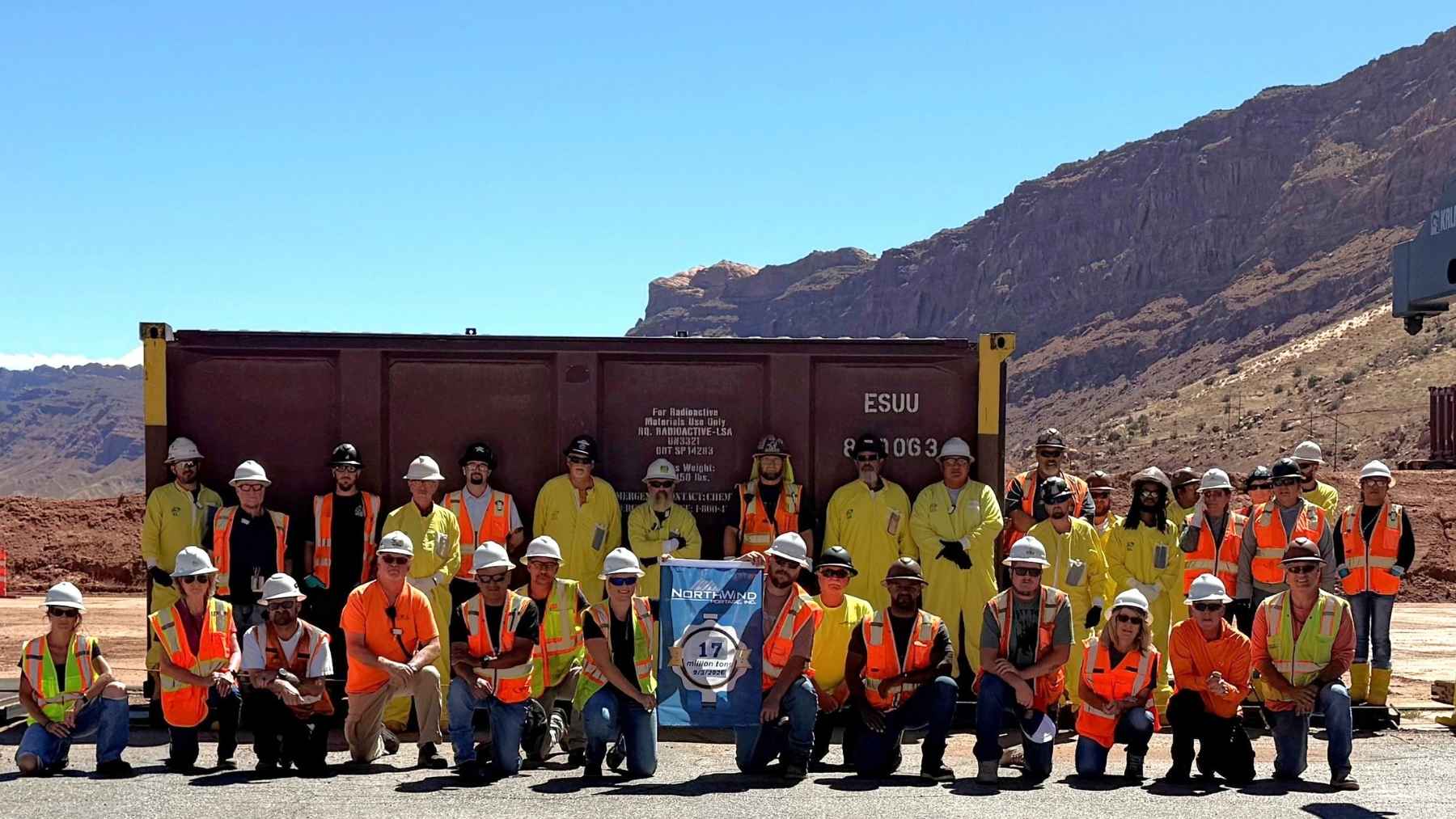
Well, it’s gone. The Department of Energy announced on September 29th that crews have now hauled 17 million tons of uranium mill tailings off the riverbank by train. But wait… The entire pile was estimated at only 16 million tons.
So where did the extra million tons come from?
Mostly from underneath. The pile itself was declared fully removed back in April, when Moab held a ceremony for the roughly 16.2 million tons shipped by then. The trains, since then, have largely been carrying the ground on which they sit.
The DOE hasn’t published a breakdown of what that seventeenth million ton actually was, but The Times-Independent reported last December that roughly 1 million tons were still waiting under and around the pile’s footprint, and that contaminated soil is still on the DOE’s to-do list.
At that April ceremony, Tim Davis, executive director of the Utah Department of Environmental Quality, said: “16 million tons is about the same amount that 100,000 blue whales weigh.”
I couldn’t tell you who’s been out there weighing blue whales, but it does paint a crazy picture.
So why was radioactive sand sitting next to the Colorado River?
Because that’s where the mill was. The Uranium Reduction Company built it in 1956 and sold it to Atlas Minerals in 1962, and through December 1970, its product, a uranium concentrate called yellowcake, went to the Atomic Energy Commission for the weapons program. After that, the mill supplied commercial nuclear plants until Atlas shut it down in 1984.
If you’ve never thought about how uranium milling works, it’s pretty simple. Ore goes in, a small amount of yellowcake comes out, and essentially everything else (meaning the ground-up rock and the processing chemicals) stays behind as a wet, sandy leftover the industry calls tailings.
The Moab mill chewed through about 1,400 tons of ore a day, and the tailings got pumped as slurry into an unlined pond on the river’s floodplain. Keep that up for 28 years, and you end up with a mound 90 feet tall covering about 130 acres of the 480-acre site.
I’m no environmental engineer, but… If this sounds a bit concerning, you’re not wrong. An unlined pond on the bank of a river that something like 40 million people rely on downstream is, frankly, a wild place to store uranium leftovers by today’s standards. But by 1950s standards, it was simply how milling worked.
Atlas went bankrupt in 1998, Congress ordered the site handed to the federal government, and the DOE took title in 2001. The first loaded train rolled out in 2009.
Moving the pile took a dedicated rail operation and 17 years
The mechanics are a pretty tidy piece of choreography. Crews dug the tailings up and let them dry out in beds on top of the pile itself, because you don’t want to pay a railroad to haul water. The dried material went into locking-lid steel containers, a gantry crane stacked them onto the train, and the train ran them about 30 miles north to an engineered disposal cell near Crescent Junction.
At full clip, the project ran four trains a week, each carrying up to 156 containers, according to the DOE’s project overview.
At the far end, the containers were tipped through end gates into the cell, the material got compacted, and the empties rode the train back to Moab for a refill, which has to be the least scenic shuttle route in a town that sells scenery.
That cell now measures 4,400 feet long by 1,800 feet wide. A Government Accountability Office report from July says it’s designed to hold the material for 1,000 years, where achievable, and for no less than 200 in any case.
The pile also held pieces of the mill itself. When the plant came down, the buildings and equipment were torn apart and buried right in the tailings, so some of those containers carried chunks of demolished uranium mill along with the sand.
We’ve been watching a lot of American nuclear waste on the move lately, from a 30-gallon drum headed for a salt bed in New Mexico to a 28,000-yard concrete swap in Texas. Moab beats both on sheer tonnage, and it isn’t close.
The cleanup doesn’t stop when the last train leaves
It’s no surprise, but the groundwater under the site picked up ammonia and uranium over the decades of milling, left over from the ore and the chemicals used to process it. And the Colorado River runs right past the property line.
Since 2003, an interim system of extraction wells has removed roughly 1 million pounds of ammonia from that groundwater, plus more than 5,000 pounds of uranium, per the GAO. The DOE plans to submit its final groundwater fix to the Nuclear Regulatory Commission in 2027, and monitoring could continue for decades after the sand’s gone.
That’s the same river a 726-foot dam downstream depends on, which is arguably reason enough for the long timeline.
The GAO puts the cost at about $970 million so far and expects it to top $1.16 billion by the time the work wraps up. For that money, Moab gets its north gateway back. Local officials spent decades calling the pile a landmark the town never asked for, and they’re already sketching out recreation and community uses for the land, though the GAO notes the DOE hasn’t made a final decision on transferring most of the site to Grand County.
What’s left is the unglamorous tail end of the job. Dig out the soil beneath the old footprint, finish the cover, sealing the disposal cell, settle the groundwater plan, regrade and revegetate 480 acres. The DOE marked the 17 millionth ton on September 29th, 2026, and if the GAO’s schedule holds, the last crews will walk away from a clean site in 2029. Finally.