
Utility-scale solar announcements have settled into a house style by now. A tech company buys the electricity, an executive calls it historic, and the hardware quietly ships in from wherever it was cheapest that quarter. The steel holding the whole thing out of the mud almost never gets a sentence of its own.
Steel River, the 2.5-gigawatt project that broke ground in northeast Arkansas on July 14, runs the other way, and you can read the difference right off the hardware. Each of the more than 400,000 piles being driven for its first two phases carries the same stamp: “Proudly made in Mississippi County, Arkansas.”
That’s the county the project sits in. The steel behind those piles was melted and rolled a few miles up the road, and the coils crossed one county line exactly zero times on their way to the site.
The biggest solar build in the country, and it isn’t close
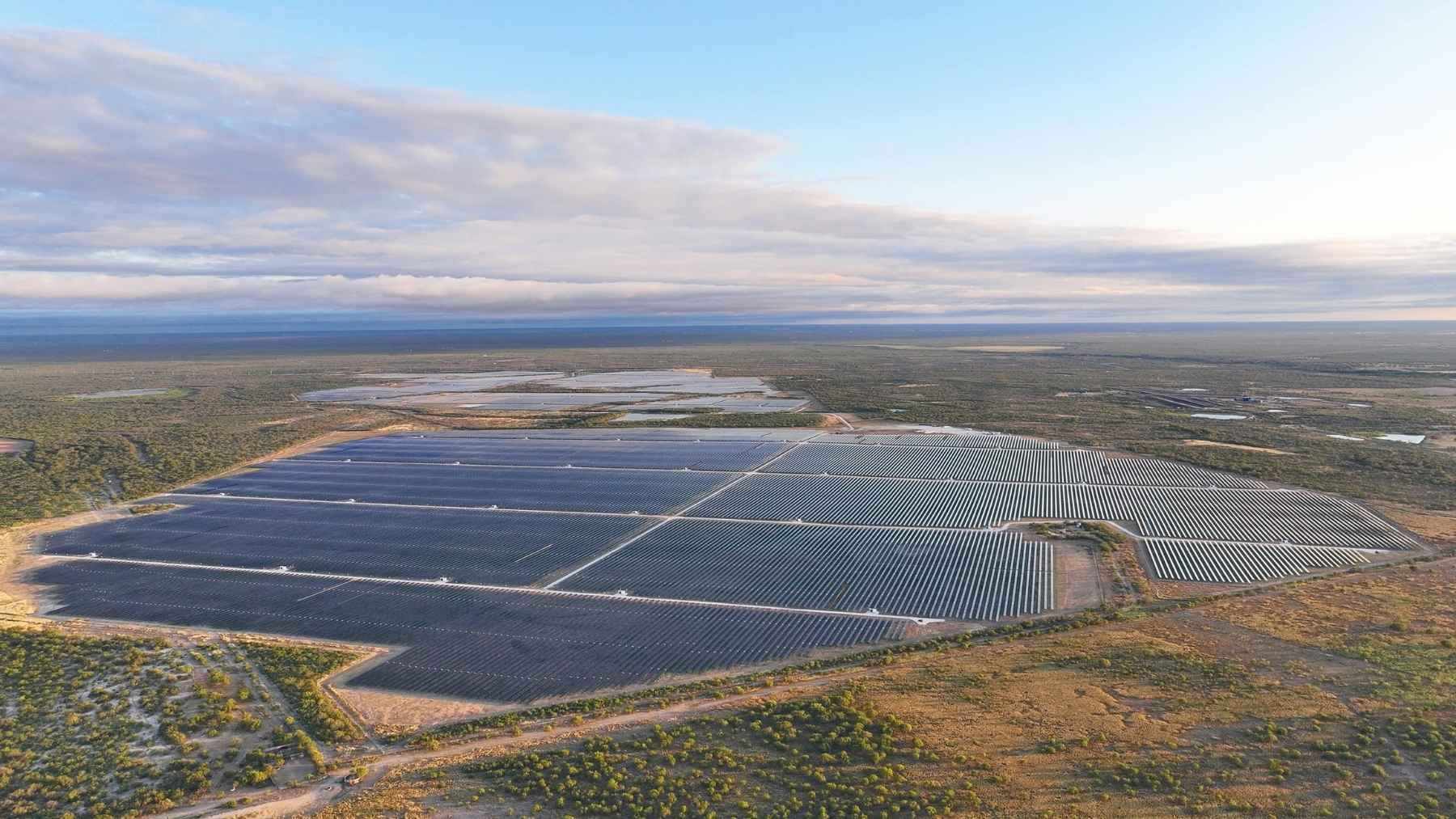
Start with what got announced. Cypress Creek Energy and Google broke ground on the first two phases of Steel River Energy Center near Wilson, Arkansas, on July 14. Those two phases alone add 1.6 gigawatts of solar and 1.9 gigawatt-hours of battery storage to the local grid.
The full three-phase project lands at 2.5 gigawatts of solar paired with 2.9 gigawatt-hours of batteries, with everything scheduled to be running by 2029. Cypress Creek puts the output at enough electricity for more than 315,000 Arkansas homes, and the total capital cost north of $4.5 billion. For scale, the current largest solar project in the US, Edwards & Sanborn in Kern County, California, is about to lose its title to a soybean-and-cotton corner of the Arkansas Delta.
The project didn’t appear out of nowhere. Swift Current Energy spent six years developing it, locked in permits for all three phases, then sold the whole package to Cypress Creek in a deal announced March 11. Moss is handling engineering, procurement, and construction, and by the time the ribbon photos were taken in July, pile drivers were already working the first field.
Somebody named this thing Steel River years before a single pile went in. For once in the renewables business, the name on the letterhead describes the actual product.
Mississippi County makes more steel than any other county in America
Here’s the part every other headline skipped. Mississippi County, Arkansas, population around 40,000, is the top steel-producing county in the United States. Five electric arc furnace mills sit within 30 miles of each other there, and between Nucor-Yamato, Nucor Steel Arkansas, Big River Steel, Big River 2, and the new Hybar rebar mill, the county’s capacity has pushed past 12 million tons a year.
If your mental map still files American steel under Pittsburgh and Gary, Indiana, that’s roughly 30 years out of date. The cotton fields of the Arkansas Delta quietly became the densest steelmaking corridor in the country, and the county’s own economic development agency is literally named Cotton to Steel.
Steel River leans on that corridor for nearly all of its structural steel. PACO Steel is forming the 400,000-plus piles at its Blytheville operation, working through more than 142,000 tons of steel coils produced at U.S. Steel’s Big River Steel plant in Osceola, about 20 miles down the road. Then each finished pile gets that stamp before a driver hammers it into Delta soil.
The rest of the equipment list reads the same way. The trackers come from Nextpower and are built with domestic steel, including material from Big River. The modules are 100% US-made First Solar panels, and the batteries are LG Energy Solution Vertech systems assembled in the US with cells manufactured entirely in North America.
“This project is proof,” Cypress Creek Energy CEO Kevin Smith said at the groundbreaking, answering the standing question of whether a domestic solar supply chain can actually exist. He called Steel River the largest solar project with energy storage in the country and confirmed the structural steel and panels are entirely American-made. When the pitch is that specific, checking it is easy: the receipts are stamped into the foundation.
Google’s name is on the power bill, not the gate
Google isn’t building any of this. What Google did is sign a power purchase agreement covering the output of the first two phases, a 20-year deal that makes Steel River the largest solar and battery project in Google’s entire global portfolio. The majority of everything Steel River generates is already spoken for before the first panel goes up.
The reason sits about 40 miles south of the project. Google is developing a data center in West Memphis, Arkansas, according to Solar Power World, and if you’ve seen what a modern data center does to a power bill, locking up gigawatts within driving distance tracks. The company is also putting $5 million into energy affordability programs for Arkansas residents and K-12 schools, on top of a $3 million community fund from Cypress Creek that starts with a $400,000 playground for the Rivercrest School District.
Zoom out and the timing makes even more sense. Solar and battery storage accounted for 91% of all new electricity-generating capacity added in the US in the first quarter of 2026, per SEIA figures cited by Cypress Creek. The buildout has reached the stage where Minnesota is plugging a 710-megawatt solar farm into a retiring coal plant, Frankfurt Airport is standing 37,000 panels upright along a runway, and German researchers are testing whether a big enough array can make its own rain. A 2.5-gigawatt farm in the Delta stopped being science fiction a while ago. What’s new is where the metal underneath it comes from.
The mill making the piles already runs partly on solar
There’s a loop hiding in this story that nobody put in a press release, and it’s my favorite detail of the whole project. Big River Steel, the Osceola plant rolling those 142,000 tons of coils, sits next door to Driver Solar, a 250-megawatt field that Entergy Arkansas owns and operates. According to Arkansas Business, that field was sized to cover up to 40% of the new Big River 2 mill’s demand, around 230 of its 550 megawatts.
So the sequence goes like this. Sunlight hits panels outside Osceola. Electric arc furnaces melt scrap partly on that power. The coils travel 20 miles to Blytheville, get formed into piles, get stamped, and go back into the ground to hold up more panels. The steel makes the solar and the solar makes the steel, in one county, with a paper trail.
The local math is straightforward too. Cypress Creek expects roughly 700 construction jobs per phase, 19 permanent positions once it’s running, and an estimated $300 million in tax revenue over the project’s life, flowing to Rivercrest schools, Mississippi County, and the town of Wilson. In a county of about 40,000 people that already pays some of the best manufacturing wages in Arkansas, that’s not an abstract number.
Plenty still has to go right. Two phases are in the ground, the third is on the books for the 2029 finish, and $4.5 billion projects have a long list of ways to slip. The national solar record has also changed hands before and will again, probably sooner than anyone in Wilson would like.
The stamp is a different kind of record. Whoever pulls one of those piles out of the Delta mud decades from now will still be able to read exactly where it came from, and it won’t say Shanghai, Pittsburgh, or anywhere else. It’ll say the county it never left.