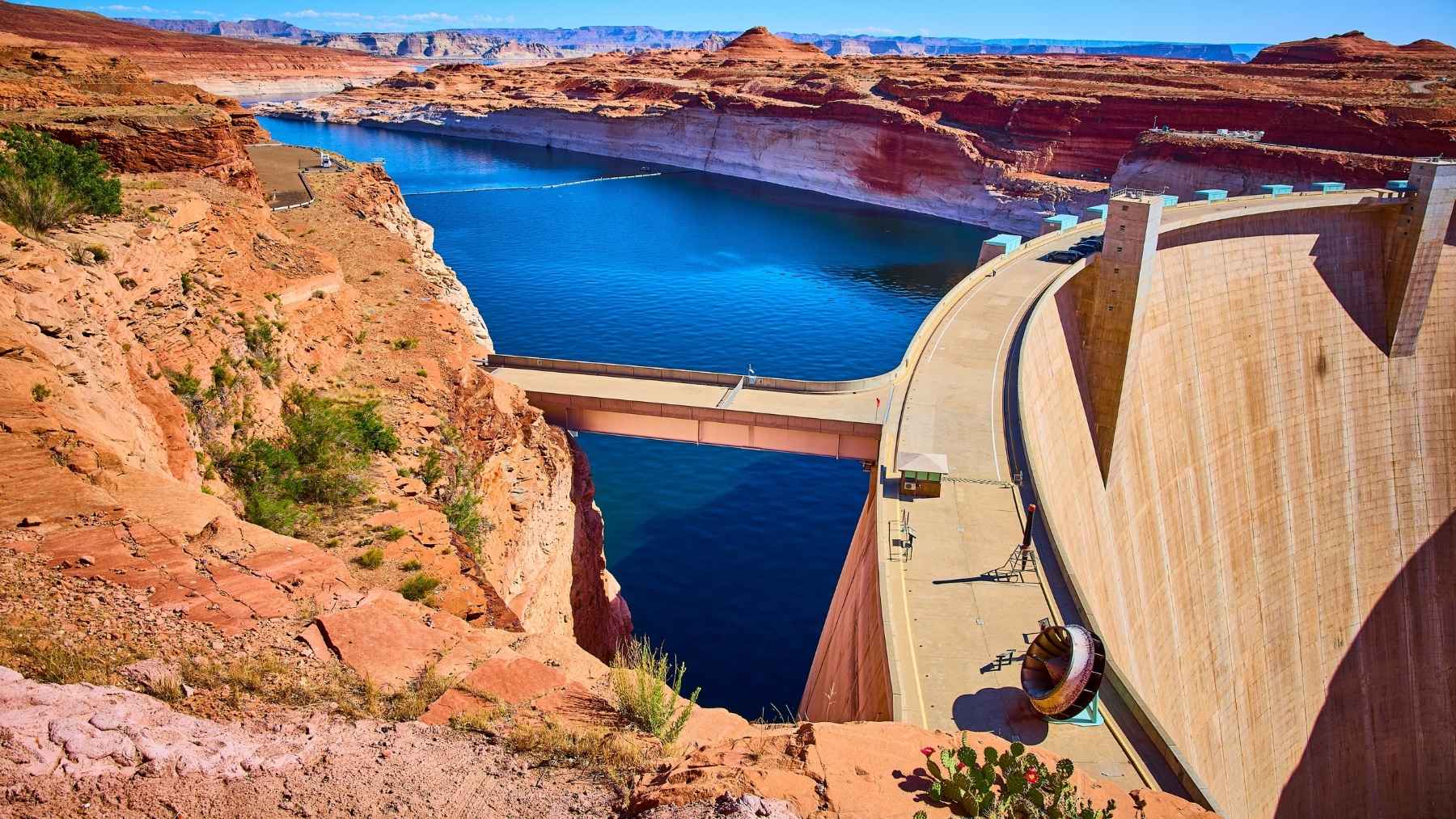

You have probably read a Lake Powell story at some point this summer. Record low, white bathtub ring, boat ramps that stop short of the water. The photos do most of the work in that coverage, and the coverage mostly stops at the photos. I spent this week reading something drier instead: the Bureau of Reclamation’s daily gauge at Glen Canyon Dam, which on September 2 put the lake at 3,517.85 feet. Subtract the 3,490 feet where the dam’s turbines shut down, and you get 27.85 feet of usable water. That is a pretty thin cushion for a 710-foot machine.
So instead of another look at how empty the lake is, I want to walk you through the dam itself, a concrete wall built with exits at three heights, and what happens as the Colorado River closes them from the top down.
So how does water actually get out of this dam?
Glen Canyon Dam is easiest to understand as a concrete wall with doors on three floors. Spillways sit near the crest at 3,648 feet, and with the water surface now 130 feet below them, they are about as relevant as a fire escape on a one-story building. Eight penstocks run through the middle, steel tubes roughly 15 feet across with intakes at 3,470 feet, and they are the main doors: water drops through them, spins eight turbines, and leaves the canyon having generated up to 1,320 megawatts on the way.
Reclamation shuts those turbines down when the lake reaches 3,490 feet, a full 20 feet above the intakes themselves. Why the buffer? Because running a turbine on shallow water pulls in vapor bubbles that collapse hard enough to pit steel, a process called cavitation, and the agency would rather lose the power than the machinery. That 3,490-foot line is called minimum power pool.
A 2024 Reclamation technical memo, reported by Circle of Blue, contains my favorite fact in this whole saga: the official gauge that measures Lake Powell physically ends at 3,477.5 feet, the top of the penstocks. The engineers who designed this dam in the 1950s apparently never planned on measuring water that low. Their optimism is now about 40 feet from being tested.
Below the turbines, the basement: four 96-inch valves at 3,374 feet, formally the river outlet works, which can pass about 15,000 cubic feet per second. That is roughly 112,000 gallons a second, and still considerably less than the penstocks move. Another 4 feet down, at 3,370 feet, the lake hits dead pool and the dam stops releasing water entirely.
Lake Powell spent August breaking its own record
The old record low was 3,519.92 feet, set in April 2023. The lake slid past it on August 15 at 3,519.91 feet, a margin of about a hundredth of a foot, and then kept right on going.
Lake Mead had set its own record earlier that month, its lowest level since it first filled in 1937. Jack Schmidt, a senior research scientist at Utah State University’s Center for Colorado River Studies, put it to NPR plainly: “We now are in the unfortunate situation of breaking records.”
July explains the trajectory. Reclamation measured 84,000 acre-feet of unregulated inflow to Lake Powell for the entire month, 9 percent of average, while releasing 482,000 acre-feet out the other side. An acre-foot is basically a football field under a foot of water, if you want something to picture. The forecast for the full water year sits at 3.59 million acre-feet of inflow, 37 percent of average, after the worst snowpack on record last winter.
The lake kept falling anyway.
Another dam is draining itself to keep this one running
So why is Powell still 27.85 feet above the shutdown line instead of below it? Partly because Reclamation rewired the river’s plumbing back in April. The agency’s April model run projected the lake would slip under 3,490 feet by August without intervention, and its response came in two moves. First, it cut this water year’s release to Lake Mead from 7.48 million acre-feet to 6.0 million.
Second, it opened up Flaming Gorge Dam, a 502-foot wall on the Green River hundreds of river miles upstream, to send between 660,000 acre-feet and 1 million acre-feet toward Powell through April 2027. Flaming Gorge pays for that with about 35 feet of its own elevation, dropping from 82 percent full to roughly 59 percent, which means one reservoir is being drawn down so another reservoir’s turbines stay wet.
I could not find a running public total of how much of that water has actually arrived; Reclamation publishes the planned range, not a ticker, and some of the water evaporates or soaks into the riverbed on the way down.
August was supposed to be the month the turbines stopped. It wasn’t.
If the scale of this bailout sounds strange, it fits a pattern American hydropower keeps running into: the infrastructure math has gotten weird everywhere, from the 35-kilowatt river turbine in Alaska that gets licensed like a giant dam to the Army Corps swapping out turbine runners that date to 1957. Meanwhile Tanzania just inaugurated a 440-foot dam holding back more water than Lake Mead, which stings a little from an American chair. Concrete, it turns out, is the easy part of hydropower.
Those four valves are not a backup plan
Reclamation said it plainly in its April announcement: below 3,490 feet, “water releases would be only through the river outlet works.” The trouble is the outlet works have a track record, and it is not a great one. An inspection tied to a 2023 high-flow experiment found cavitation erosion inside the four pipes, and Reclamation’s 2024 memo concluded the agency should not rely on them as the only way to move water for any sustained stretch. These are valves finished in the early 1960s for occasional floods and experiments, not for carrying the Colorado River every single day.
And the forecast keeps pointing at them.
The August 24-Month Study, the agency’s rolling projection, has the lake below 3,540 feet on October 1 and dropping under 3,510 feet sometime during water year 2027, even with the Flaming Gorge water landing. Next year’s release from Powell is penciled in at 6.0 to 7.0 million acre-feet under new operating rules with a name that gives the game away: the Low Elevation Infrastructure Protection Range.
Reclamation’s August model run has Lake Powell finishing the water year at 3,515.89 feet on September 30, 2026, which would leave 25.89 feet of turbine water heading into a winter that has to out-snow the last one. The agency publishes its next full set of minimum and maximum projections in October.
 @pabloquez ROOKIE1 month ago