
If you’ve ever sat on a stalled train somewhere under the Hudson while the conductor promised you’d be moving shortly, you were sitting inside a tube that opened in 1910. Every train between New Jersey and New York’s Penn Station still squeezes through that single pair of century-old tracks, around 200,000 passengers a day, and Superstorm Sandy soaked the whole thing in saltwater it never really recovered from.
So the ceremony on September 28 at the bottom of a pit in North Bergen, New Jersey, mattered a little more than your average ribbon cutting. Governors Kathy Hochul and Mikie Sherrill flipped a switch, the cutterhead on a 1,680-ton boring machine started to turn, and work on the first new rail tunnel under the Hudson in more than a century wasn’t theoretical anymore.
Did the machine actually start digging, though?
Not quite.
The first machine’s still working through final testing, and Gateway officials say the real digging starts by October 13, according to Gothamist. Its twin’s sitting right beside it in the trench, still being assembled. And look, there’s a grand American tradition of flipping the ceremonial switch a couple of weeks before the real work starts. This particular project also spent part of the year with its federal funding frozen until a federal judge ordered the money released in February, as the AP reported, so I don’t blame anyone involved for celebrating a little early. “Nothing will stop us from digging this tunnel,” Hochul said at the launch. Standing in the tail end of a nor’easter to switch on a machine that hasn’t finished testing is arguably a political statement as much as a construction milestone, and from the looks of things, everyone in that pit knew it.
So what exactly did they switch on?
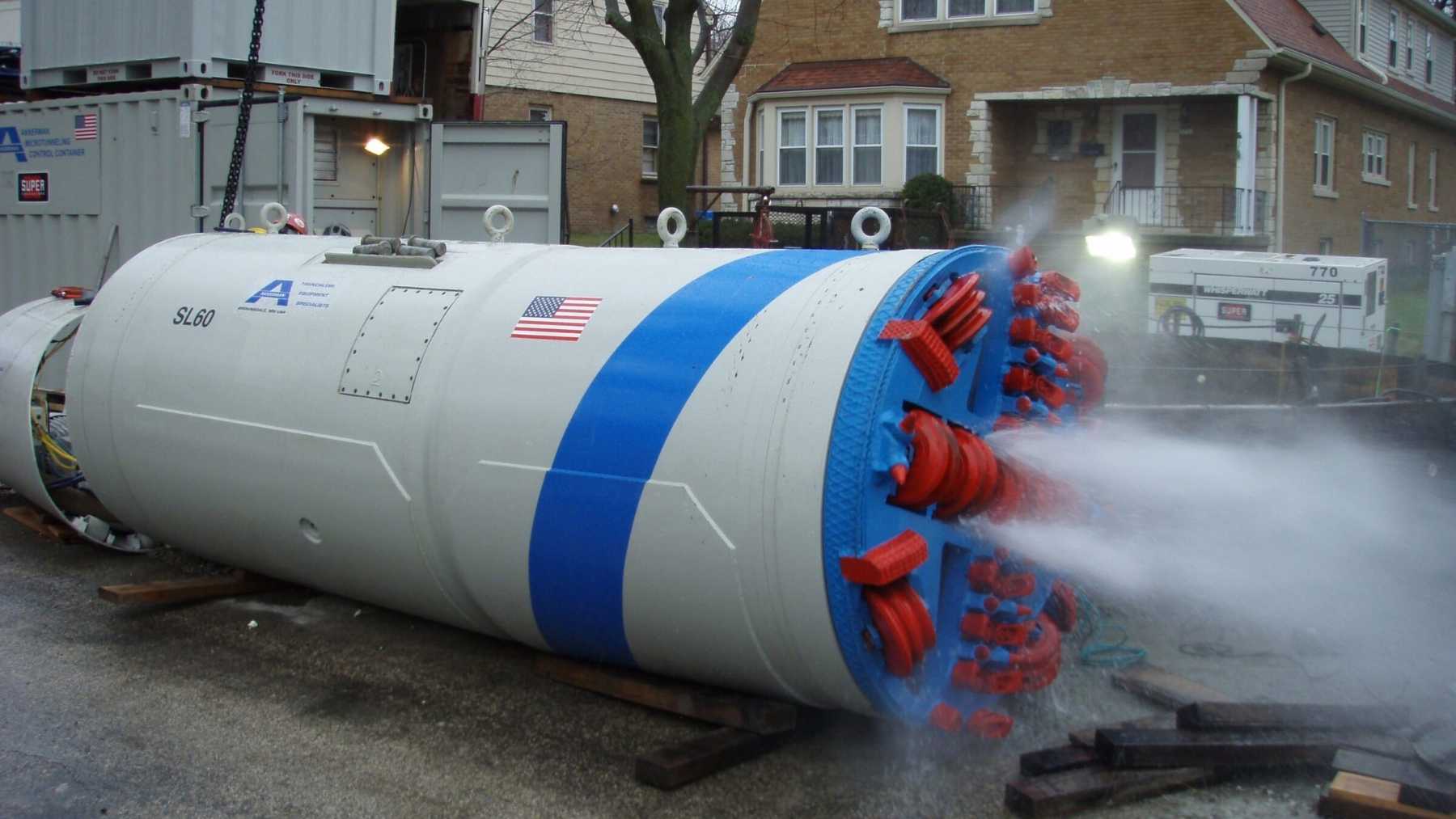
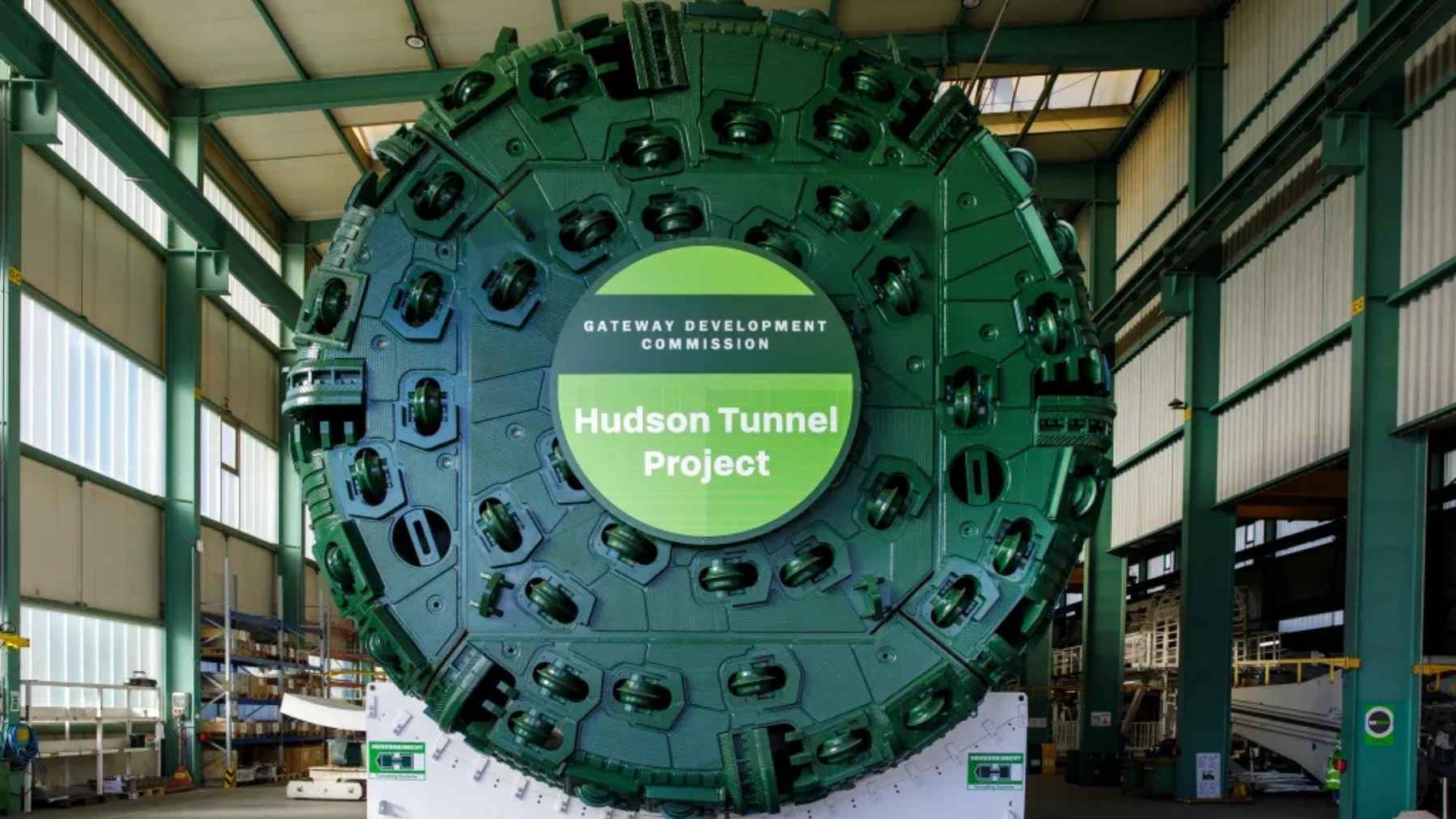
Each of the two machines weighs 1,680 tons, carries a cutterhead measuring 28 feet, 8 inches across, and drags roughly 500 feet of trailing gantry behind it. The parts came over from Herrenknecht’s factory in Germany in close to 100 components, a crew of about 40 rides inside while it’s working, and more than 1,000 sensors watch everything from the machine’s position underground to the air quality in the tunnel. We covered the assembly of these two machines while welders were still fusing the cutterheads together in that same trench.
If you’ve never looked into how one of these works, it’s less a drill and more a rolling factory. Discs mounted on the spinning cutterhead grind into the rock and crack it off in chips, and a conveyor carries the chips back out through the gantry. Right behind the head, an erector arm bolts curved concrete segments into a ring, and hydraulic jacks then shove the whole machine forward off the ring it just built. The tunnel comes out finished behind it.
It’s a pretty elegant setup, and at roughly 30 feet of lined tunnel a day, a patient one. Boring machines also traditionally get names before they dig, and as far as I can tell, Gateway hasn’t announced any for this pair yet.
A mile of rock, then a swap
The pair will grind through the Palisades Sill, the dark volcanic ridge you can see from Manhattan’s West Side, down to an access shaft on the border of Weehawken and Hoboken. Gateway puts the drive at 5,100 feet of solid rock, call it a mile, and at that daily pace that’s about a year of grinding.
Then both machines come out of the ground through that shaft and get replaced, which sounds backwards until you look at what’s past Weehawken. These two are single-shield machines built for hard, dry rock that tests at around 35,000 psi. The riverbed’s soft, saturated sediment that needs grout injection and even ground freezing before anything can bore through it, so a second pair of machines with different heads takes over for the crossing itself. We’ve already gone through the full four-machine lineup if you want the whole picture.
About those 1910 tubes
The crossing all of this relieves is the pair of North River Tunnels that Pennsylvania Railroad crews dug largely by hand, the same brutal shield work tunneling ran on for most of a century. They’ve carried essentially every train across the Hudson since 1910, on the busiest passenger rail corridor in the country. One disabled train in there and your evening commute’s done.
The new tunnel runs almost 2.5 miles with two tracks inside, and it doesn’t retire the old one. Once the new tubes open, the 1910 tunnels get pulled out of service one at a time and rehabilitated, which I’d argue is the quietly important half of the plan, because the region ends up with four tracks under the river instead of two. The whole Hudson Tunnel Project carries a $16 billion price tag and anchors the larger Gateway Program of rail fixes between Newark and Penn Station.
Gateway’s schedule has the first machine cutting the Palisades for real by October 13 and its twin following once assembly wraps up, and the GDC is targeting 2035 for the first trains through the new tubes.