
- 3 MONTHS AGO · ENERGYA 155-millimeter shell left a howitzer over New Mexico at 18,000 times the force of gravity, which is 2,000 times what knocks a fighter pilot out, then lit a liquid-fueled jet engine in midair and flew on under power, and the 93 miles it is built for is still a design number
- 2 MONTHS AGO · ENERGYA 20-foot steel canister built to hold a nuclear reactor went 100 feet down a 34-inch borehole in Florida and came back up on the rigging, with 2 inches of clearance per side, run by the company that has drilled the state’s sewage wells since 1971
- 1 MONTH AGO · ENERGYA 300-megawatt reactor designed to cool itself without pumps just became the first small commercial reactor cleared for construction in America, four months ahead of the regulator’s own schedule, on the riverbank where an earlier federal reactor never got built at all
- 1 MONTH AGO · ENERGYA 19-megawatt dam on a Maine river ran one of its three turbines for four hours on a Saturday in the middle of a herring run of about a million fish, thousands of them came out the other side dead, and the owner shut the whole plant down and has kept it dark since to let the rest go by
- TODAY · THIS ARTICLESix floating tidal turbines built on a 750-ton Scottish design just got the federal fish permit that sank an earlier company in the Bay of Fundy, where a five-story turbine has sat dead on the seabed since its owner went under and four rail cars full of concrete still mark where another developer moored
If you’ve ever moved into a house and found the last owner’s junk still sitting in the basement, you’ve already got a pretty good feel for the Bay of Fundy.
The bay sits between Nova Scotia and New Brunswick, and it has what the local test center calls the highest tides in the world. About 176 billion tons of water push through it on every tide. That’s roughly four times the flow of all the planet’s freshwater rivers combined, according to the Halifax outlet Signal HFX. So for years, companies have shown up with machines to turn that current into electricity. A few of them never fully left.
Now another one is on the way. Marine Technology News reports that Fisheries and Oceans Canada has expanded its authorization for a floating tidal array in Minas Passage from three turbines to six, and Transport Canada has signed off on all six under the Canadian Navigable Waters Act. The project is called the Eauclaire FORCE Tidal Array, and it belongs to Canadian developer Eauclaire Tidal and Scotland’s Orbital Marine Power.
So what’s going in the water?
Six of Orbital’s O2-X turbines, adding up to 15 MW. The developers say that’s enough for around 6,600 Nova Scotia homes once all six are running, and they’ve already lined up long-term power purchase arrangements with Nova Scotia Power.
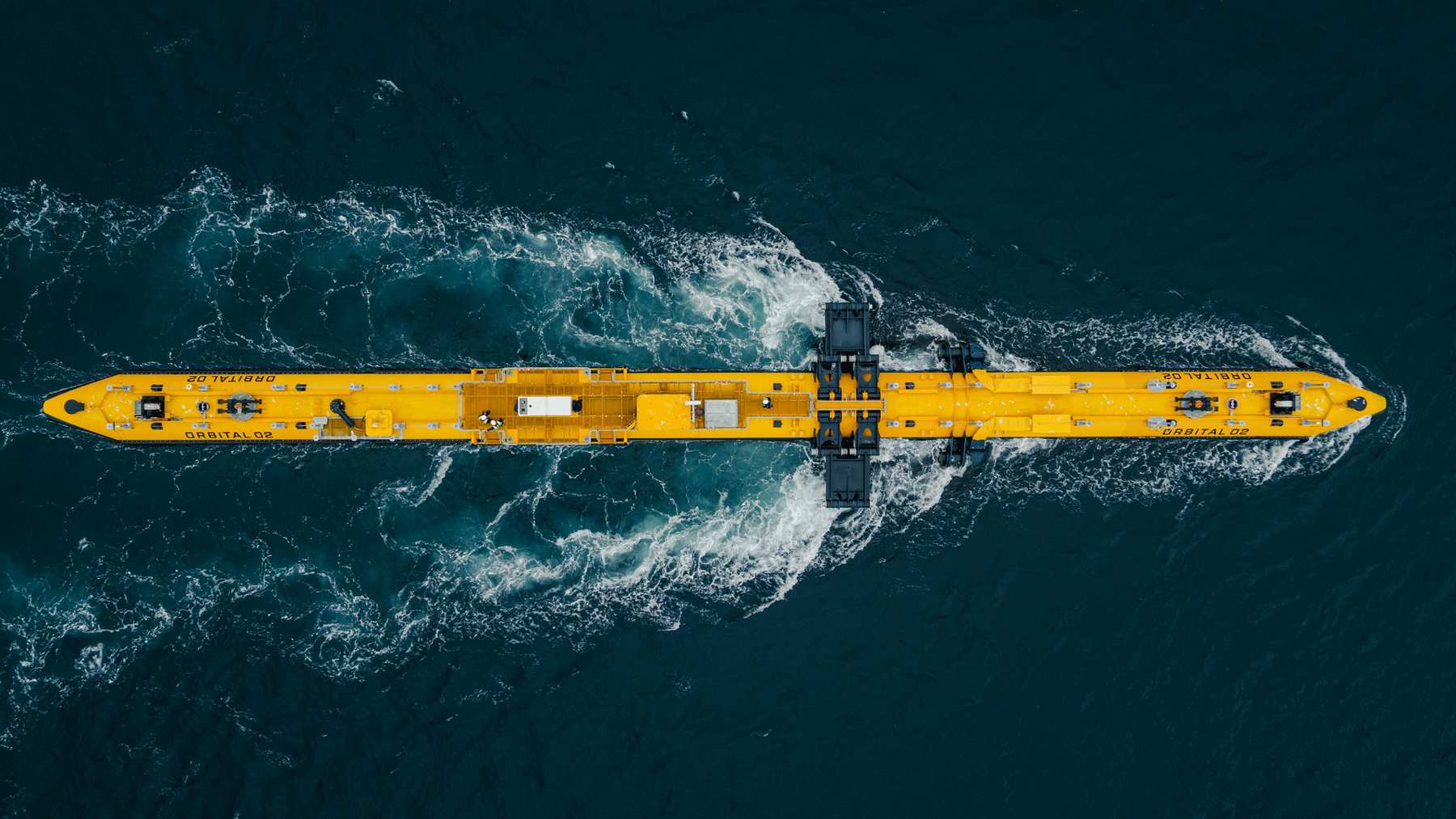
The O2-X is the next-generation version of the O2, which has been feeding the UK grid off Orkney, Scotland, for more than five years. The O2 is a 243-foot floating hull that weighs about 750 tons, with a 66-foot rotor hanging off each side on a retractable leg. Each O2-X is rated at about 2.5 MW, up from 2 MW on the O2.
Orbital hasn’t published a weight for the X version as far as I can tell. So I’d take any tonnage you see quoted for it with a grain of salt.
Why does floating matter? A lot of tidal turbines sit on the seabed, which means every repair needs a heavy-lift ship and a calm weather window in some of the fastest water anywhere. The O2 can swing its rotors up out of the water, so a small workboat can get to them, and the X version is built on the same design. That’s frankly a pretty sensible choice for a bay with a habit of eating turbines.
Our earlier look at the O2 and Nova Scotia’s go-ahead covers the provincial side of the deal, so I’ll stick to what’s changed.
There’s already a dead turbine down there
More than eight years ago, a company called OpenHydro lowered a ring-shaped turbine onto the floor of Minas Passage. It’s about five stories tall. Reports put its weight anywhere from about 1,100 tons to more than 1,400, depending on whose figure you trust. OpenHydro went out of business that same year, and the turbine has been sitting on the bottom, not working, ever since.
So why hasn’t anyone pulled it out? Basically, nobody has agreed on who pays for it. The Energy Mix reported that fishers say it’s been stuck there for years, and EcoPortal wrote in October that there’s still no deal on removal. I haven’t found a public estimate of what a recovery would cost, but hauling well over a thousand tons of steel out of water this fast isn’t going to be cheap.
Then there’s the company that took over OpenHydro’s berth. A little over two years ago, Nova Scotia confirmed that Occurrent Power, formerly BigMoon Power, had filed for bankruptcy. Occurrent had sunk four rail cars packed with concrete near Walton, on the Minas Basin, to use as moorings. According to EcoPortal, they’re still in the channel.
If you’re wondering why anyone would sink a rail car on purpose, it’s less weird than you’d think. A freight car full of concrete is a very heavy block that’s easy to get hold of, so you drop it on the bottom and tie your mooring lines to it.
The fish permit already sank one floating project
Floating turbines aren’t new to the bay either. Sustainable Marine Energy ran a platform there with four rotors, each about 21 feet across, on arms that raised them out of the water. All four together were rated at 280 kW. About three and a half years ago, the company’s Canadian business went into voluntary bankruptcy. CEO Jason Hayman told Water Power Magazine that “DFO will not provide permission to proceed.”
DFO is Fisheries and Oceans Canada, and what Sustainable Marine needed was a Fisheries Act authorization. It’s essentially Ottawa’s permission to run something in the water that could hurt fish, with conditions meant to keep that harm in check. It’s the same kind of authorization Eauclaire has now gotten for six machines.
That makes three developers gone in roughly six years. It’s a rough record for any industry, and it’s arguably why four Canadian outlets jumped on this approval within a day.
So what’s different this time?
Mostly the rulebook. A year ago, DFO gave Eauclaire the first authorization under what it calls a Staged Approach, which came out of a federal tidal task force run with Natural Resources Canada. FORCE said at the time that the system lets a developer put one turbine in the water, watch what it does, and add more as the environmental data comes in. That first authorization covered three turbines, with rules on protecting fish, watching for environmental effects and reporting the data. The new expansion doubles it to six.
What I can’t tell you is which conditions come attached to the six-turbine version, or the exact day DFO signed it. The Nov. 18 reports don’t say, and I haven’t been able to find the authorization itself published. There’s no construction schedule in them either.
The developers call the federal approvals an important step toward a final investment decision. That’s industry speak for the moment the money actually gets committed, and they haven’t reached it yet. Honestly, that’s the milestone I’d keep an eye on. If you want a sense of how that can go, a set of six seabed turbines in a French strait got hung up on a single missing document.
Marine Technology News reported on Nov. 18 that the project also made the investment prospectus for Prime Minister Mark Carney’s Canada Investment Summit in September.
 A 908-megawatt Ohio reactor once ran with a football-sized hole eaten through more than 6 inches of its steel lid by leaking boric acid, leaving a stainless liner three-eighths of an inch thick to hold back 2,155 psi, and its replacement lid came from a plant that never openedEnergy · 2 hours ago
 A 92-turbine wind farm on the South Dakota prairie had more than 20 of its machines wrecked and nearly 300-foot steel towers folded in half by a 131-mph gust in June, and early on an October Monday firefighters drove 10 miles south of Highmore to a turbine burning with nobody insideEnergy · 17 hours ago
 A 427-foot ferry carrying more than 275 tons of batteries just started hauling up to 2,100 passengers and 225 cars nearly 35 miles across the River Plate, on a charge that lasts about 90 minutes and a roughly 40-minute top-up at the dock before it turns around on eight electric waterjetsElectric Vehicles (EVs) · 18 hours ago