
Nobody digs a 34-mile tunnel from one end to the other. Crews attack the mountain from both portals and a handful of access points in between, bore separate sections toward each other for years, and trust the surveyors to make it all meet in the dark.
Until this week, the west tube of the Brenner Base Tunnel was exactly that: a chain of separate holes under the Alps, dug from different directions on two sides of a border, waiting to become one continuous tube.
On August 25, a tunnel boring machine named Wilma ground through the final inches of rock and turned that chain into one hole. BBT SE, the Austrian-Italian company building the tunnel, confirmed the breakthrough the same day: the western main tube now runs unbroken for 34 miles (55 kilometers), from the Sill Gorge just outside Innsbruck, Austria, to Fortezza in northern Italy.
Wilma spent 706 days grinding out her 4.7-mile (7.5-kilometer) share of it, and hers was the breakthrough that completed the first of the project’s two main tubes. Trains are another matter. Track, power and signaling still have to go in, and the first departures are penciled in for 2032.
Two years underground, and the mountain kept changing the rules
Wilma launched on September 18, 2024, from a chamber excavated inside the H53 Pfons-Brenner construction lot, and spent the next 23 months boring north toward Innsbruck. BBT SE says she crossed several geological fault zones where the character of the rock changed within a few meters, which on a job like this means adjusting thrust, pace and ground support on short notice, over and over. Her stretch covered the northern half of the lot; drill-and-blast crews handled the southern half, down to the Italian border.
The mountain did not cooperate.
Wilma still averaged about 35 feet (10.6 meters) of finished tunnel per day, against roughly 16 feet (5 meters) for the drill-and-blast crews on the project, according to RailFreight. Blasting leaves the concrete lining as a separate job. A single-shield machine like Wilma installs it as she cuts.
A 590-foot factory built from 80,000 parts
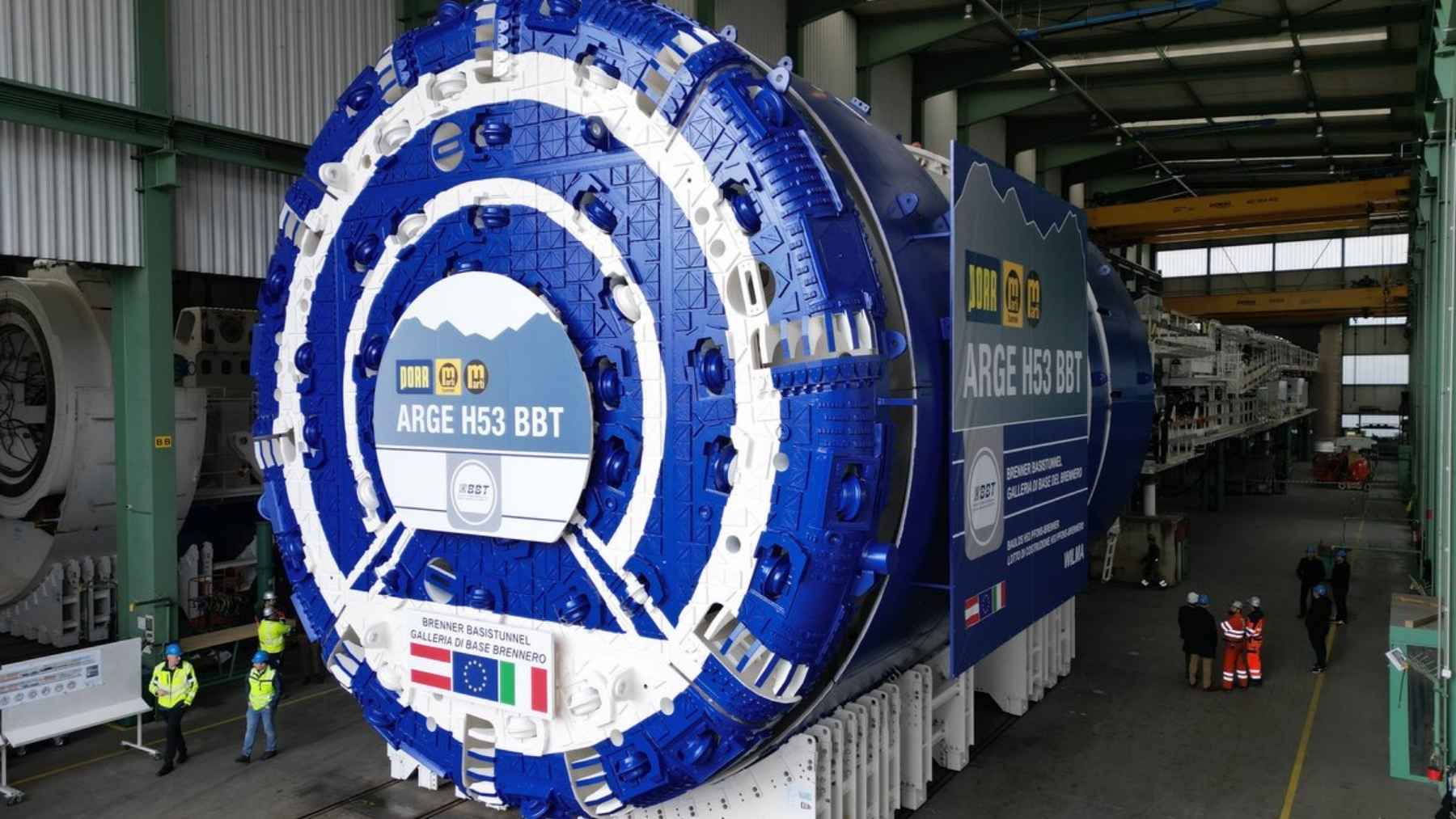
Herrenknecht assembled Wilma for testing at its plant in Schwanau, Germany, then took her apart and shipped roughly 80,000 components to Austria in 170 special transports, where crews rebuilt her inside a purpose-built underground chamber. The finished machine stretches 590 feet (180 meters) with her trailing backup gantries, weighs close to 6 million pounds (2,700 metric tons), and turns a 34-foot (10.37-meter) cutterhead that alone weighs 573,000 pounds (260 metric tons).
Installed power comes to about 13,300 horsepower (9,928 kilowatts), nine Bugatti Chirons’ worth, with 6,100 horsepower (4,550 kilowatts) going to the cutterhead drive. Her thrust cylinders can press that head into the rock face with up to 40 million pounds of force (180,000 kilonewtons).
Behind the cutterhead, Wilma ran a production line. Site trains rolled in with precast concrete segments, each around 22,000 pounds (10 metric tons), delivered by rail over the Wolf link to keep heavy loads off local roads. An erector arm swung them into rings behind the shield.
Conveyor belts carried the broken rock out to the Padastertal disposal site nearby. Technicians serviced her systems around the clock. Geologists watched the face ahead. By breakthrough day, Wilma had built 3,720 complete rings from 22,320 individual segments.
Michael Knapp, BBT’s project manager for the lot, put that supply chain at the center of the whole operation. “Logistics are at least as important as the machine itself,” he said in the company’s announcement, crediting the rail-fed setup with cutting around 45,000 truck trips.
Three breakthroughs in eleven months
BBT has stacked three border milestones in eleven months. Crews connected the exploratory tunnel in September 2025, the first physical link between the Austrian and Italian workings. On July 28 of this year, miners blasting from the Austrian side broke into the Italian-bored sections of both main tubes within about an hour of each other, 4,600 feet (1,400 meters) below the Brenner Pass, as Railway Gazette reported.
The surveyors earned their keep: crews measured the alignment error at the earlier breakthroughs in centimeters, per International Railway Journal. August 25 delivered the biggest piece: with Wilma’s arrival at an auxiliary access point called IRIS, every section of the west tube, dug by different crews over more than a decade, now connects into a single bore.
The three are not the same kind of hole. The exploratory bore measures about 16 feet (5 meters) across and exists for geology, drainage and logistics. The July event joined the running tunnels at the border itself. Wilma’s tube is the full product: 34 feet across, 34 miles long, the first of the two bores that trains will actually use, open from end to end.
The highway overhead explains the whole project. More than 2.5 million trucks cross the Brenner Pass every year, according to the European Commission’s infrastructure agency, roughly one every 12 seconds. The rail line up there dates to the 1860s and climbs steeply enough that freight trains need two or three locomotives; through the base tunnel, one locomotive will pull trains up to 2,428 feet (740 meters) long, against a 1,476-foot (450-meter) limit on the mountain route today.
A passenger run through the tunnel is designed to take 25 minutes; the same trip over the pass takes an hour and 20 minutes today, per BBT’s figures. We covered Wilma and Olga in July, when the two machines had about 3.7 miles (6 kilometers) left to dig between them, and the southern approach that will feed this tunnel from Italy has its own borer named Kathrin working the Fortezza-Ponte Gardena lot.
Gotthard Base Tunnel in Switzerland holds the current record at 35.4 miles (57 kilometers), and trains through the finished Brenner system will run 40 miles (64 kilometers) underground counting the existing Innsbruck bypass it plugs into. Engineering News-Record puts the running bill at $11.5 billion.
Olga is still down there
Wilma has a twin sister named Olga, and Olga has the east tube. Her drive measures about 4.7 miles (7.6 kilometers); she launched the same month, from the same lot, pointed the same direction, and the RailFreight report notes only a short stretch of it remains.
When she breaks through, machine excavation ends on the longest railway tunnel ever dug, and the job flips from making holes to filling them: slab track, power, signaling and safety systems, years of it.
Olga is now the last boring machine cutting rock anywhere on the project. BBT SE’s live counter reads 221 kilometers of tunnel excavated out of a planned system of about 230, call it 137 miles of 143. Wilma’s counter stopped at 24,600 feet (7,500 meters) on August 25, 2026.