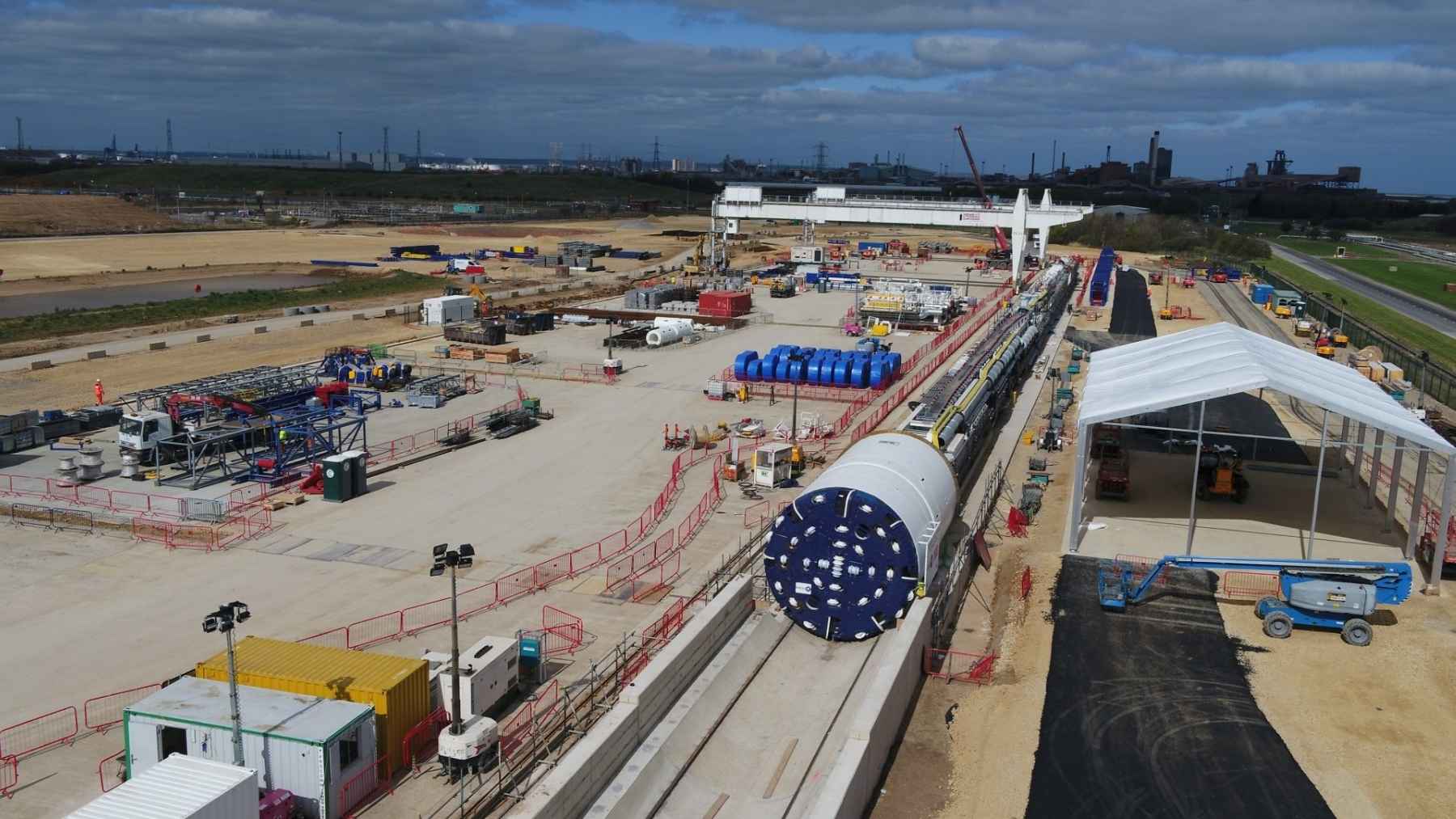

Big tunnels come with big machines. That is the deal every single time: somebody builds a cutterhead the size of a house in Germany, ships it over in pieces, drops it down a shaft, names it after a woman, and it grinds along under somebody’s houses while the invoices stack up behind it.
Norway looks at all that and reaches for explosives instead.
That difference is the entire argument in a proposal that landed in Britain this week. A firm called Future Works wants to put a 14-mile road under the Peak District National Park, linking Manchester and Sheffield, and it says the thing can be built for less than £2 billion, about $2.7 billion at today’s exchange rate. The government’s own attempt at the same tunnel died at several times that.
The scheme is called Trans-Pennine Connect. It has no government backing, no chosen route, no client and no money. What it has is a claim about method, and that claim is checkable, because Norway is currently blasting a longer road tunnel 1,286 feet under a fjord and publishing what it costs.
Britain picked the machine before it picked the price
The Trans-Pennine Tunnel Study is a real document, not a rumor. The Department for Transport and Transport for the North commissioned Highways England to write it in July 2015, and the Stage 3 report landed in November 2016. So I pulled it.
It is not a hatchet job. It says the link is buildable. It says the Pennine bedrock is millstone grit, that ground conditions across the study area are unusually consistent, and that the Victorians already proved the point by driving the Woodhead railway tunnel through the same rock.
Then it reaches construction, and makes one assumption that quietly decides everything after it. For a tunnel this long, a mechanized method using tunnel boring machines is, in the report’s own words, “widely accepted as the preferred option.”
From there the arithmetic writes itself. Five shortlisted routes came in at £6.5 billion to £10.1 billion in 2014 prices, or roughly $8.7 billion to $13.5 billion. Add project risk and unscheduled items and the range becomes £7.8 billion to £11.6 billion, call it $10.5 billion to $15.5 billion. That is before inflation and before portfolio risk, neither of which the report includes.
Nobody was hiding anything. The machine was simply the default answer, and the default answer set the bill.
Britain has a borer under a national park right now. Stella Rose, a 1,775-ton Herrenknecht, has cut 18.6 miles under the North York Moors and holds the world record for the longest tunnel ever driven by a single machine. She works. What she is not is cheap, and neither are her relatives. The three borers now under Adelaide belong to a road project costing about $10.7 billion, and it buys 6.5 miles.
Norway lets the rock hold itself up
Drill-and-blast sounds like the primitive option. A rig drills a pattern of holes into the face, crews pack them with explosives, everybody backs off, the round goes, a loader clears the rubble. Then it happens again.
Norwegians have spent decades refining that loop and gave it a name: the Norwegian Tunnelling Method. The trick isn’t the explosives. It’s the hour after the blast.
Geologists map the fresh rock face and score it on the Q-system, a rock quality index, and that score decides how much support this specific stretch of hole gets. Fiber-reinforced sprayed concrete and rock bolts, applied where the rock asks for them and skipped where it doesn’t.
Then the temporary support becomes the permanent support. One shell, not two. No full concrete lining unless the ground demands it. The load stays where it already was, which is in the mountain.
A boring machine does the opposite. It cuts a perfect circle and lines every meter of it with precast concrete rings weighing several tons apiece, whether that particular rock needed them or not.
Britain’s own study spelled out the trade. In good ground a TBM advances up to 100 meters a week. Nothing about drill-and-blast on a single face gets close to that.
So Norwegians don’t work a single face. They open several and blast from all of them at once.
The method also goes places a machine can’t follow. Norway is about to blast a 1.7-kilometer passage straight through a coastal mountain so cargo ships and full-size cruise liners can sail through solid rock instead of around the worst water on the coast. No cutterhead anywhere in that plan.
Rogfast is the receipt
Here is the part that makes the $2.7 billion hard to laugh off.
Statens vegvesen, Norway’s road agency, is building a road tunnel called Rogfast under the Boknafjord, between Randaberg near Stavanger and Bokn. It runs 26.7 kilometers, about 16.6 miles. Twin bores, 10.5 meters across, two lanes in each. At its lowest point it sits 392 meters below sea level, or 1,286 feet.
When it opens in 2033 it will be the longest and deepest undersea road tunnel on the planet. The agency’s own project page puts the total at 20.6 billion kroner in 2020 money, roughly $2.1 billion.
There is no boring machine. Rogfast is drill-and-blast, chosen deliberately, through rock nobody had mapped in detail, with water shoving in at pressures around ten times what comes out of your kitchen tap.
Anne Merete Gilje, the Statens vegvesen project manager for Rogfast’s Randaberg section, told The B1M that in geology this uncertain “it would be too risky to go with a TBM.” A borer runs hundreds of meters long. When it hits trouble you cannot reach the face. With drill-and-blast you walk up and deal with it.
Now run it per mile, which is where it gets uncomfortable for anyone calling the Peak District pitch fantasy. Rogfast lands around $127 million a mile, undersea, at record depth. Future Works is asking for under £2 billion for 14 miles, which is closer to $190 million a mile, on dry land, under a moor.
Norway’s figure is in 2020 kroner and Rogfast has been repriced upward before, so treat both numbers gently. Even so, those two projects are arguing about the same order of magnitude. Fifteen and a half billion dollars is not in that conversation.
Not every number in the pitch survives a look
Michael Dnes, who co-founded Future Works with Alex Griffiths after leaving the Department for Transport in 2024, told The Times the proposition “seems genuinely too good to be true.” He is right to flag it, so let’s do the flagging for him.
Start with the £10.6 billion, about $14.2 billion. That figure is the firm’s, attributed to a previous government assessment. It sits comfortably inside the published Stage 3 range of £7.8 billion to £11.6 billion, and inside the up-to-£12 billion, roughly $16.1 billion, that New Civil Engineer reported from a 2020 Highways England assessment. It is not the headline number of either published report.
Then there’s Lærdal. Future Works points to it as proof that long tunnels come cheap, and it is a fair example on its face: 24,509 meters, opened in November 2000, still the longest road tunnel in the world, cut with explosives and no machine.
Statens vegvesen also publishes what Lærdal carries. About 2,100 vehicles a day, 26 percent of them heavy. One tube, one lane each way, no hard shoulder.
The Peak District crossing takes around 20,000 vehicles a day right now, and Britain’s 2016 study forecast the new link at up to 35,000. Twin bores, full highway standard, hard shoulders. That is a different animal from Lærdal and it prices like one. Rogfast is the honest comparison here, not Lærdal.
The funding has a wrinkle too. Future Works wants Scandinavian-style tolls, possibly with northern pension capital behind them, and argues the route is busy enough to pay for itself without Westminster. The 2016 study examined tolling this exact link and concluded that, as things stood, it would not meet the study’s agreed objectives.
And the East Midlands Combined County Authority welcomed the discussion to the BBC, then immediately named the A38 in Derby and the A46 at Newark as schemes closer to delivery and more important. Which is the politest available way of saying get in line.
The road this would replace has been sliding for 90 years
None of this is abstract if you actually drive it.
The A57 Snake Pass is a 12-mile stretch and one of the highest roads in the Peak District. Derbyshire County Council says more than 30,000 vehicles a week use it, including 1,500 heavy trucks.
It has four live landslip sites: Doctor’s Gate, Alport, Gillot Hey and Wood Cottage. There are traffic lights where the road drops to one lane, and a limit that keeps anything over 7.5 metric tons off it entirely, onto a signed diversion strung across eight other roads.
The council’s own page notes that landslip closures here go back at least 90 years.
This June, Derbyshire shut the whole thing from June 15 to July 3 and parked two drilling rigs across the roadway to bore 10 meters down at Doctor’s Gate and work out why the hill keeps moving. Eighteen days, for one of the four sites, backed by £7.6 million of government safety money, about $10.2 million. While it was closed, volunteers picked up 53 bags of litter.
The Department for Transport’s answer, given to the BBC this week, is that it has “no plans for a Trans-Pennine tunnel due to significant financial and environmental costs,” and that National Highways has already identified safety and resilience measures for the A628/A616 corridor under the third Road Investment Strategy.
The man expected in Downing Street on Monday spent nine years running Manchester
Timing is doing a lot of work in this story.
Andy Burnham was Mayor of Greater Manchester for nine years. He won the Makerfield by-election on June 18, took his Commons seat on June 22, and by July 13 held the nominations of 349 Labour MPs. Labour is expected to confirm him as leader at a special conference on July 17, and he is expected to become Prime Minister on July 20. His whole pitch is regional rebalancing, down to a proposed “No. 10 North.”
Trans-Pennine Connect surfaced on July 13.
Nobody involved has suggested the two are connected, and a department saying no this week is a department, not a Prime Minister. But the fiscal weather is worth reading. The BBC reports that the A38 and A46 schemes the East Midlands ranked above a tunnel are themselves facing the axe so the money can go to defence.
Which is precisely the gap Future Works is aiming at. Its entire argument is that Westminster doesn’t have to pay for this one.
Trans-Pennine Connect is a proposal from a two-man consultancy with desk research behind it. No ground investigation, no route, no funding, no client. The $2.7 billion is an estimate of something nobody has designed yet, and Britain’s track record on estimating tunnels is the reason we are all standing here in the first place.
But the method is not speculative. Statens vegvesen is blasting a twin-bore road tunnel 1,286 feet under a fjord right now, through rock nobody had mapped, and posting the bill on its website.
In June, Derbyshire parked two drill rigs across the Snake Pass for 18 days to bore 10 meters into a hillside and find out why a road keeps sliding off it. Norway uses the same basic kit to go 400 meters under the sea. The rigs were never the problem.