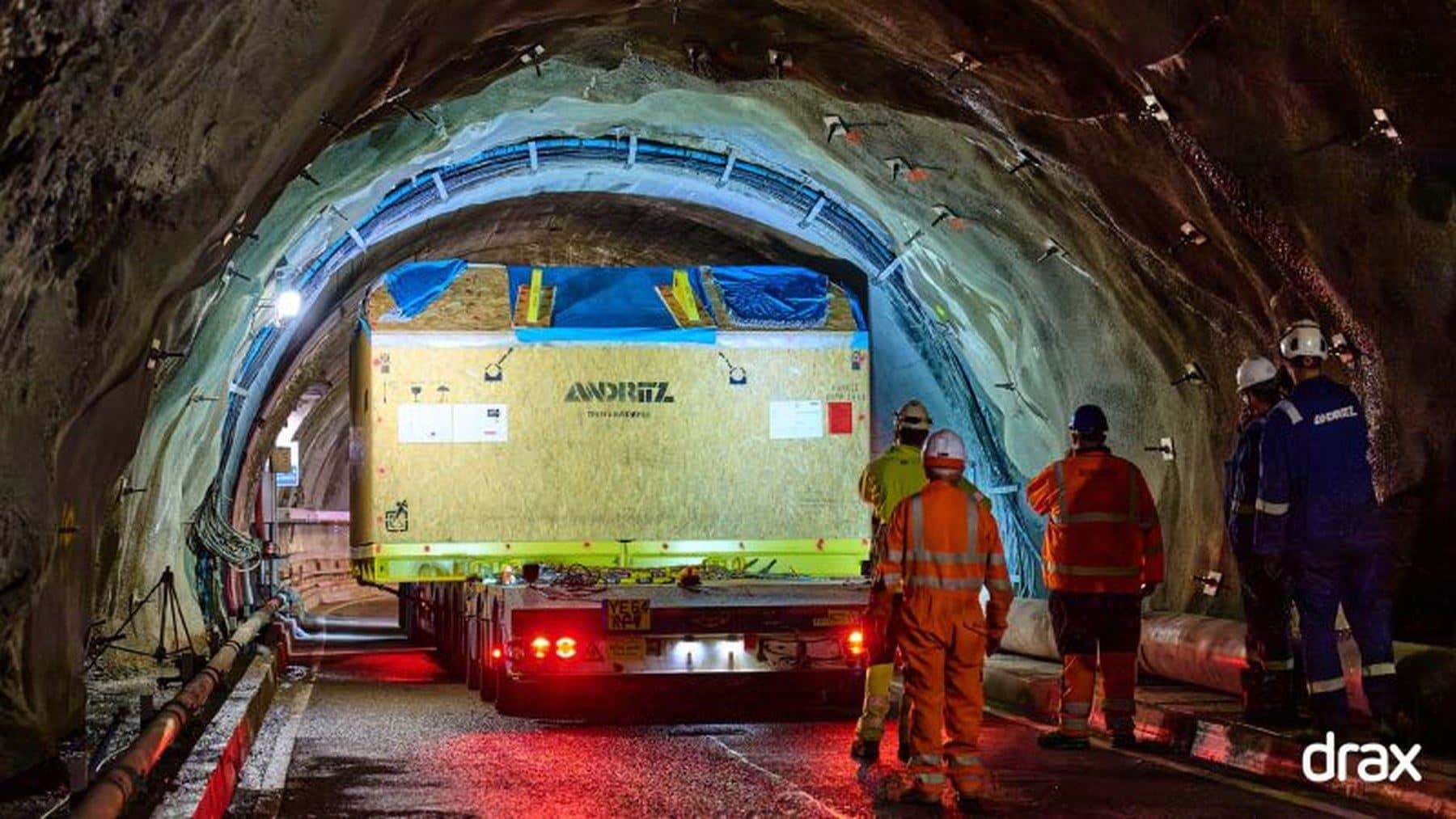

If you’ve spent much time on an interstate, you’ve probably been stuck behind an “Oversize Load” banner at some point, crawling along while a pilot car flashes its lights at you. It’s annoying. But at least that load is usually headed somewhere with a loading dock and a big gravel lot to turn around in.
A heavy delivery for Drax in Scotland had a much stranger address. It was headed for Cruachan, a pumped storage power station carved into Ben Cruachan, a mountain in Argyll, and the last leg of the trip runs through an access tunnel into the rock.
The cargo was a rotor body. According to Drax’s own post about the delivery, it weighs 70 metric tons, which works out to about 154,000 pounds. Put it on a truck and the whole rig came in at more than 100 metric tons, or north of 220,000 pounds.
Getting that to Cruachan took a police escort and a 200-mile detour.
So what’s a power station doing inside a mountain in the first place? I’ll get to that. First, the trip.
The rotor started out in Austria
Drax says the rotor body set off from Weiz, a town in Austria, then crossed the North Sea from Rotterdam before heading north through Scotland. That starting point makes sense once you know who’s doing the work. ANDRITZ, the Austrian engineering group Drax hired as main contractor for this job, runs a generator plant in Weiz that builds pump-storage generators and motors, among other things.
Drax’s photos show the load crossing Connel Bridge, and the company made a point of showing how big the access tunnel is, since the rotor had to pass through it to reach the station. But Drax hasn’t published the tunnel’s dimensions or said exactly which roads the detour was dodging, so I can’t tell you how much room the driver actually had to play with.
If you’re wondering what a rotor body even is, here’s the short version. A big generator has two main halves: a stationary outer ring called the stator, and a rotor that spins inside it. Spin the rotor and you get electricity. Feed electricity in instead, and the same machine runs as a motor, which turns out to be the whole trick at Cruachan.
Drax calls this piece the rotor body, and I’d take that to mean the main structure of the rotor rather than every last part bolted to it. The company hasn’t said which of the two units being rebuilt it’s for.
So what is Cruachan, exactly?
Cruachan is basically a battery made out of water, a mountain and gravity. There’s a reservoir up on the mountain and there’s Loch Awe at the bottom. When the grid has more electricity than it needs, the station uses it to pump water from Loch Awe up to the upper reservoir. When demand spikes, it lets that water fall back down through its turbines and generates power on the way. The higher the top reservoir sits above the bottom one, the more electricity you get out of every gallon, which is why these plants tend to end up in mountains.
The clever bit is that the same machines handle both jobs. Each unit pairs a pump-turbine with a motor-generator, so it can run one way as a pump and the other way as a generator. That’s what “reversible” means in “reversible pumped storage,” and Drax says Cruachan was the first large-scale plant of that kind anywhere in the world when Queen Elizabeth II opened it in 1965.
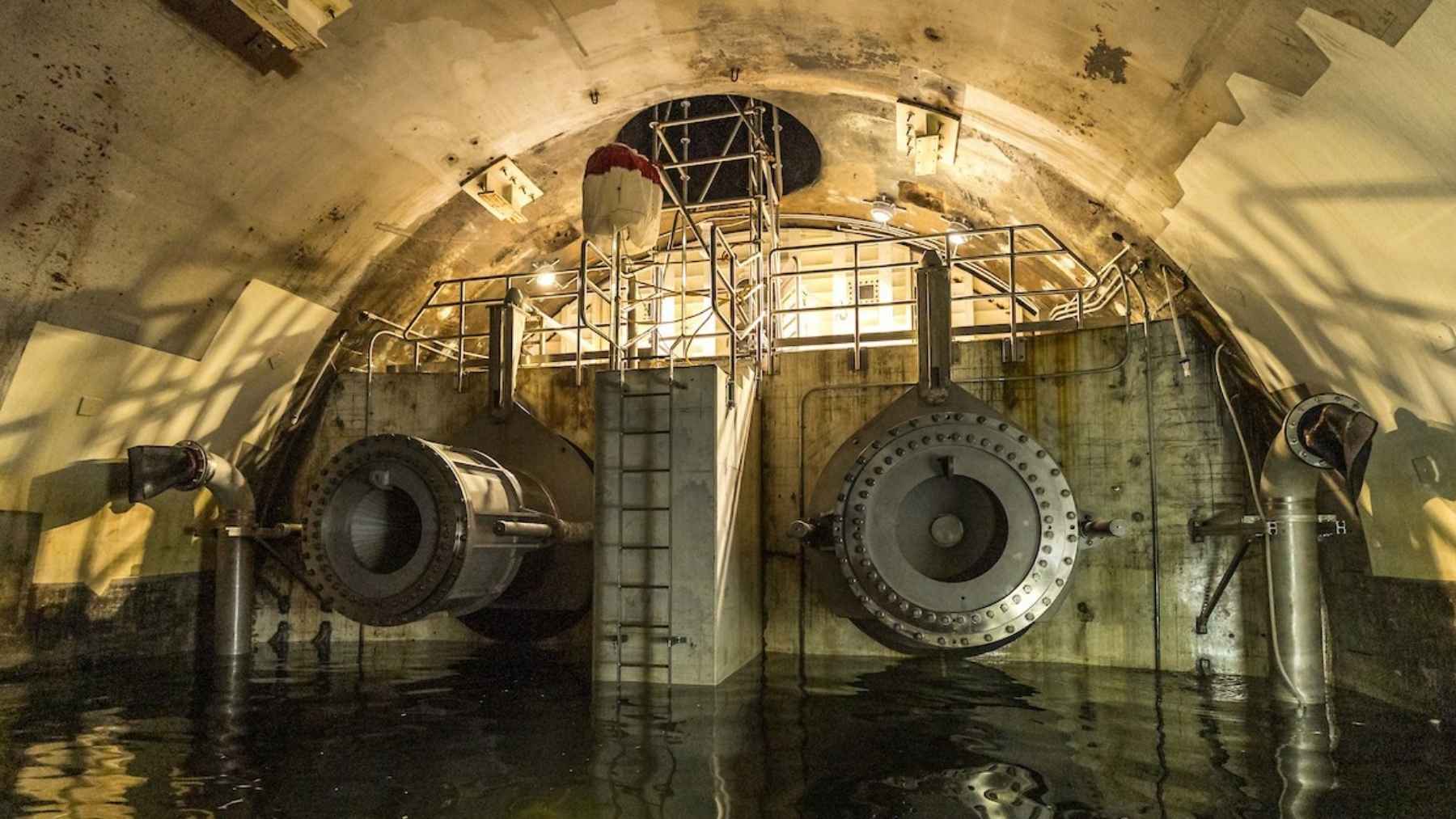
Then there’s the location. The turbine hall sits roughly 3,300 feet inside Ben Cruachan, according to Drax, which is why the place gets called the Hollow Mountain. It’s a frankly spectacular piece of 1960s engineering. It also means this rotor had to go in through a tunnel, and it’s a very, very heavy rotor.
You might be thinking this sounds like an old idea, and you’d be right. Over in Wales, Dinorwig is pulling its first two machines out after four decades of work. But it’s arguably more useful now than when Cruachan was built, because wind farms don’t produce power on a schedule, and something has to soak up the surplus on a windy night and hand it back when everyone gets home and starts cooking dinner.
Two of the four units are getting rebuilt
Cruachan has four generating units. Drax already overhauled units 1 and 2 back in the early 2000s. Units 3 and 4 are the ones getting the treatment now, as part of an £80 million project.
When ANDRITZ announced the contract, it said the deal covered two new generating units, each with its own pump-turbine and motor-generator, plus new main inlet valves. In an August update on the project, written around a visit from Scottish First Minister John Swinney, Drax said all four of the station’s main inlet valves are being replaced. The company compares each valve to three double-decker buses, which is a very British unit of measurement that I’m not going to try converting into pounds. If you want a sense of what valve work inside a mountain involves, TVA has done the same kind of job inside Raccoon Mountain in Tennessee.
Each of the two rebuilt units is planned to go from 100 megawatts to 120 megawatts. That takes the station from 440 megawatts to a planned 480 megawatts once the work is done.
Forty extra megawatts won’t sound like much if you’re used to reading about gigawatt-scale projects. Still, it’s 40 megawatts squeezed out of a cavern that’s been there since the 1960s, which seems like a pretty sensible way to spend the money.
Drax has also lined up a 15-year Capacity Market agreement worth more than £220 million that backs the rebuild of units 3 and 4. Basically, that’s the UK government’s way of paying power plants to be available when the grid needs them, so Drax gets paid for having the rebuilt units ready even on days they sit idle.
Don’t expect 480 megawatts just yet
The work isn’t finished, and units 3 and 4 have had a rough stretch. Late last December, a grid connection failure took both of them offline. Drax says the fault was in equipment owned by Scottish Power Energy Networks, the local grid company, rather than at Cruachan itself.
The timing could’ve been worse, I suppose. Drax had already planned to take those two units out of service for the rebuild through 2026 and 2027, so the outage hit machines that were due to come apart anyway. Units 1 and 2 stayed online, and in April Drax said they were running well.
Don’t confuse the rebuild with another project that has a similar name. Drax has proposed a whole new underground pumped storage station right next to the existing one, which it calls the Cruachan Expansion. That’s a different plan, and it isn’t what this rotor is for.
So when will Cruachan actually hit 480 megawatts? In its half-year results on July 30, Drax said work on units 3 and 4 should keep going through 2027, and that it expects Scottish Power Energy Networks to restore the grid connection that same year.