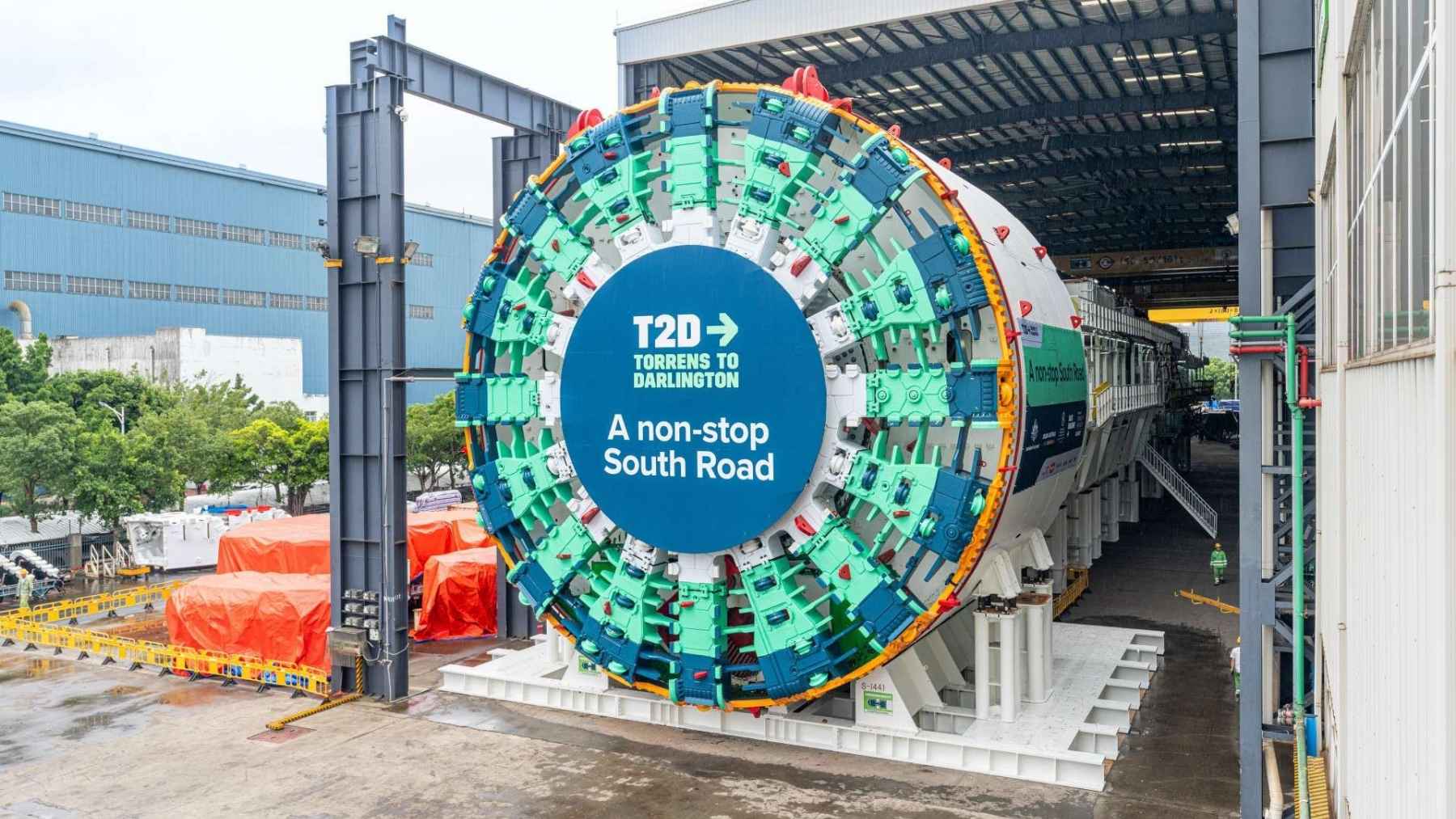

Mary has been turning under Adelaide’s southern suburbs since July 1. She is a 3,858-ton (3,500-metric-ton) Herrenknecht boring machine with a 49-foot cutting wheel, up to 20 people riding inside her at any one time, and a shift pattern that never stops. For seven weeks she had the ground to herself.
Then Catherine and Elizabeth switched on.
Over the weekend of August 22, all three of the large tunnel boring machines on the River Torrens to Darlington project were excavating at the same time, under the same city, on the same road job. South Australia’s Department for Infrastructure and Transport calls that a first in Australian history for an underground road project. Federal Infrastructure, Transport, Regional Development and Local Government Minister Catherine King confirmed the three machines were working together on August 25.
If you read our piece on Mary’s launch in July, you already know the machine. Now she has two sisters doing the same thing a few suburbs away, and three machines under one set of suburbs is a coordination problem nobody in this state has had to solve before.
Mary got a seven-week head start, and that was deliberate
Mary launched from the project’s Southern Precinct at Clovelly Park and is grinding 2.8 miles (4.5 km) north toward Glandore. Catherine launched from the same box and is following her to build the second of the twin Southern Tunnels.
Elizabeth is the odd one out. She started from the Central North Precinct at Hilton and is heading 1.4 miles (2.2 km) north toward the Brickworks Marketplace at Torrensville, digging the first of the twin Northern Tunnels.
By mid-August Mary had cut about 330 feet (100 meters) beneath South Road, according to the state government’s August 17 update on the three machines. Catherine and Elizabeth were still in final preparation at that point and went in days later.
Running three lets the northern and southern tunnels get built concurrently instead of one after the other. State Infrastructure and Transport Minister Joe Szakacs put it plainly: “Mary, Catherine and Elizabeth will now work in concert underneath Adelaide.”
The whole tunnelling program is scheduled to take up to 24 months.
South Australians picked the names themselves, in a public competition that closed on November 30, 2025. All three honor state suffragists: Mary Lee, Catherine Helen Spence and Elizabeth Webb Nicholls. Boring machines have been given women’s names since miners started praying to Saint Barbara in the 1500s, and Adelaide stuck with it, blessings included. Elizabeth got hers on Saturday, July 25.
Each cutterhead carries 82 discs, and somebody has to go inspect them
At the front of every machine sits a 49-foot-tall cutterhead weighing 331 tons (300 metric tons). King’s office lists what is bolted to it: 82 cutting discs weighing up to 772 pounds (350 kg) each, plus almost 200 teeth.
Those parts wear out. Rock does that to steel.
So crews inspect the discs and teeth for wear on a regular cycle, and the workers who do it complete specialist hyperbaric training first, because the space behind the cutterhead is pressurized. Same principle as a dive chamber, except the thing on the other side of the bulkhead is a wall of Adelaide clay held back by pressure.
Full speed for one of these is 26 to 33 feet (8 to 10 meters) a day. None of the three is there yet. Crews are ramping up gradually, adjusting cutterhead rotation speed, penetration rate and thrust force as the ground changes, which is the sensible way to do it when you have three machines and no prior local experience to lean on. South Australia had never run a major road tunnelling job before this one.
The tunnels pass 33 to 82 feet under people’s houses
The machines bore between 33 and 82 feet (10 to 25 meters) below the surface, per the project’s published tunnelling information. Above them sits ordinary suburban Adelaide, and the state’s own figure is that a machine typically passes beneath a given property in about three days.
So who owns the dirt down there?
South Australia amended the Land Acquisition Act 1969 in July 2020 to handle exactly this. The state acquires the land from 33 feet (10 meters) down. Surface ownership is untouched, no compensation is payable because there is no loss of use, and owners along the alignment are offered a free pre-construction property condition survey. The Department for Infrastructure and Transport is blunt about why the mechanism exists: without underground acquisition, it says it would have needed to acquire and demolish roughly another 300 homes and businesses to build T2D.
Three hundred houses, or a legal amendment. The state picked the amendment.
Residents can look up the tunnel depth under their own address on the project’s public TBM tracker, which also shows roughly where each machine is. It updates every few weeks rather than live, so it will not tell you Mary is directly under your kitchen this afternoon.
Every machine sends 8.3 million tons of dirt the other way
While the cutterheads push forward, spoil moves backward. Conveyors carry it from the tunnel face to a spoil shed at the surface, where it gets loaded into covered trucks and hauled to a re-use site at Gillman.
Across the whole project, the state expects about 8.3 million tons (7.5 million metric tons) of spoil. Tunnelling accounts for roughly 5.5 million tons of that, with the other 2.8 million tons coming from civil works.
Inside each machine, a segment erector installs 10 precast concrete segments to form a ring, then hydraulic cylinders shove off that ring to drive the machine forward. Materials come in on 27-meter multi-service vehicles that can be driven from either end, because there is nowhere down there to turn a truck around.
Two smaller machines handle the rest. Each is 13.5 feet (4.1 meters) in diameter, and they dig the cross passages linking the parallel tunnels every 394 feet (120 meters). Those passages carry operating equipment and double as the emergency escape route between tubes. The first arrived in Adelaide in July, and the project says it is the first time an Australian tunnelling job has used two dedicated cross-passage machines instead of digging them by hand.
Elizabeth has to be taken apart underground and turned around
Mary and Catherine will finish at Glandore and come out at a portal. Elizabeth has a harder assignment.
When she reaches Torrensville, crews will dismantle her into sections, rotate her, and reassemble her to drive the southbound tunnel back to Hilton, according to trade publication The Tunnelling Journal. Taking a 3,858-ton machine to pieces at the bottom of a hole and putting it back together facing the other way is a normal enough tunnelling maneuver, and it is still 3,858 tons in a confined space.
Sydney went through the extraction version of this recently. Two 1,100-metric-ton Metro West machines came out of a cavern 89 feet down in roughly 16 major pieces each, one piece per 68-wheeler truck, moved through the city at night. We covered that retrieval when it happened, and Melbourne did something similar with a 4,400-ton machine that needed traffic lights removed along the route.
Whether Adelaide’s three get refurbished for another job or scrapped is not settled. The project’s own answer is that wear decides it, and that a machine’s “useful remaining life may not be sufficient to make refurbishment and re-use worthwhile.”
What Adelaide gets for A$15.4 billion
T2D is the final 6.5-mile (10.5 km) piece of the North-South Corridor. Finishing it completes 48 miles (78 km) of continuous, traffic-light-free motorway between Gawler and Old Noarlunga, and takes 21 sets of traffic lights out of the drive between the River Torrens and Darlington.
The tunnels run three lanes each way at 50 mph (80 km/h).
Crews keep working long after the machines stop. Once tunnelling ends, they still have to build the actual road surface inside the tunnels, install the mechanical, electrical and safety systems, then run testing, commissioning and compliance checks. The open motorway section, bridges and footpaths included, has to be finished and tied into both tunnel sets.
The Australian and South Australian governments are each putting in A$7.7 billion, for a total of A$15.4 billion, which The Tunnelling Journal converted to about US$10.3 billion in August. The job is expected to support around 5,500 positions a year during main construction. The T2D Alliance building it is John Holland, Bouygues Construction Australia, Arcadis, Jacobs and Ventia, working with the state department, under a contract executed in September 2024.
Non-stop South Road is scheduled to open in 2031. Between now and then, Mary and Catherine have 2.8 miles each to cut toward Glandore, Elizabeth has 1.4 miles to Torrensville before she gets taken apart and spun around, and all three were confirmed turning at once on August 25, 2026.