
If you’ve ever had a backyard pool, you know what turns up in the skimmer basket. Leaves, bugs, and, every so often, a frog that made a pretty bad decision. The pump pulls water in, and whatever happens to be swimming in it gets pulled in too. It’s annoying, but it’s not a huge deal.
Now scale that up to a nuclear power plant that cools itself with seawater.
EDF is building one called Hinkley Point C on the Somerset coast in southwest England, and on October 1st, the company announced that an 88-ton tunnel-boring machine named Sarah Guppy had completed a 2,034-foot (620-meter) tunnel beneath the Bristol Channel.
That tunnel has one job. It takes the fish that get sucked into the plant and sends them back to sea.
So why does a nuclear plant need its own fish tunnel?
Hinkley Point C drinks a lot of seawater
A nuclear reactor is basically a very expensive way to boil water when it comes down to it. The steam spins the turbines, and then it needs to be cooled back down, and a plant on the coast usually does that by pumping seawater through and sending it back out a little warmer.
Hinkley Point C will have two reactors, and EDF says they’ll make enough electricity for around six million homes. That takes a lot of water. It’ll pull that water through two intake tunnels, each running a little over 2 miles out under the seabed, and they’re about 20 feet (6 meters) across. A third tunnel, the outfall, carries it all back out.
You can probably see the problem, especially if you’re a fish that wanders too close to the intakes. If you do, there’s a decent chance you’re going along for the ride.
You’d think a big mesh screen would do the job, and the plant does have screens. But the company’s gone a lot further than that here. It says its three fish protection systems will cost more than $950 million (£700 million) and that they’ll give the plant “more fish protection than any other power station in the world.”
Fish get three chances to stay out
The fish’s first chance starts at the intakes. The plant has four low-speed intake heads on the seabed, designed to keep the water moving slowly enough that a fish 6.6 feet (2 meters) from the opening can still swim away. That’s in a channel that’s 12.4 miles (20 km) wide, so it’s a pretty fair deal for the fish.
Then there’s the acoustic deterrent, nicknamed the “fish disco.” That’s arguably the best name any piece of nuclear hardware has ever had. It uses high- and low-frequency sound to steer different kinds of fish away from the intakes. At one point, EDF wanted to drop it and replace it with up to 900 acres of new salt marsh, but that plan faced local opposition and legal challenges.
A redesigned high-frequency version built around ceramic transducers underwent sea trials with Swansea University, and the company says it was more than 90% effective. Only one tagged twaite shad (a herring around that area) came within 98 feet (30 meters) of the intakes while the system was switched on. With it off, 14 did.
Shad, as a family, apparently have a habit of finding their way into nuclear plants. A different species, the gizzard shad, packed the intake screens at Ontario’s Bruce plant by the millions, forcing operators to pull a reactor off the grid. Jellyfish have done something similar at France’s Gravelines plant, where operators shut two reactors by hand before a swarm could clog the screens.
So, we need all these deterrents. However, the fish disco isn’t approved yet. EDF’s fish protection page says the trial results will go to regulators as part of an application later in 2026, and I haven’t found any sign that the application has been filed.
Fish that get past the slow intakes and the sound end up at the drum screens that guard the cooling water pumps. A drum screen is basically a giant rotating mesh cylinder. Water goes through, and anything bigger than the holes doesn’t.
The company says the screens will direct fish to the return system, which sends them through Sarah Guppy’s tunnel, 5.9 feet (1.8 meters) wide, and out into the channel. I haven’t seen EDF put a number on how many fish it expects the tunnel to carry.
Sarah Guppy is an 88-ton machine
Tunnel boring machines in Britain usually get a name before they start digging, and local schoolchildren picked this one. Sarah Guppy was a 19th-century Bristol engineer and inventor who’s generally credited as the first woman to hold a bridge patent, or more precisely, a patent for making bridge piling safer.
She also patented a tea urn that could cook eggs in its steam. Honestly, that sounds more useful than half the gadgets in my kitchen.
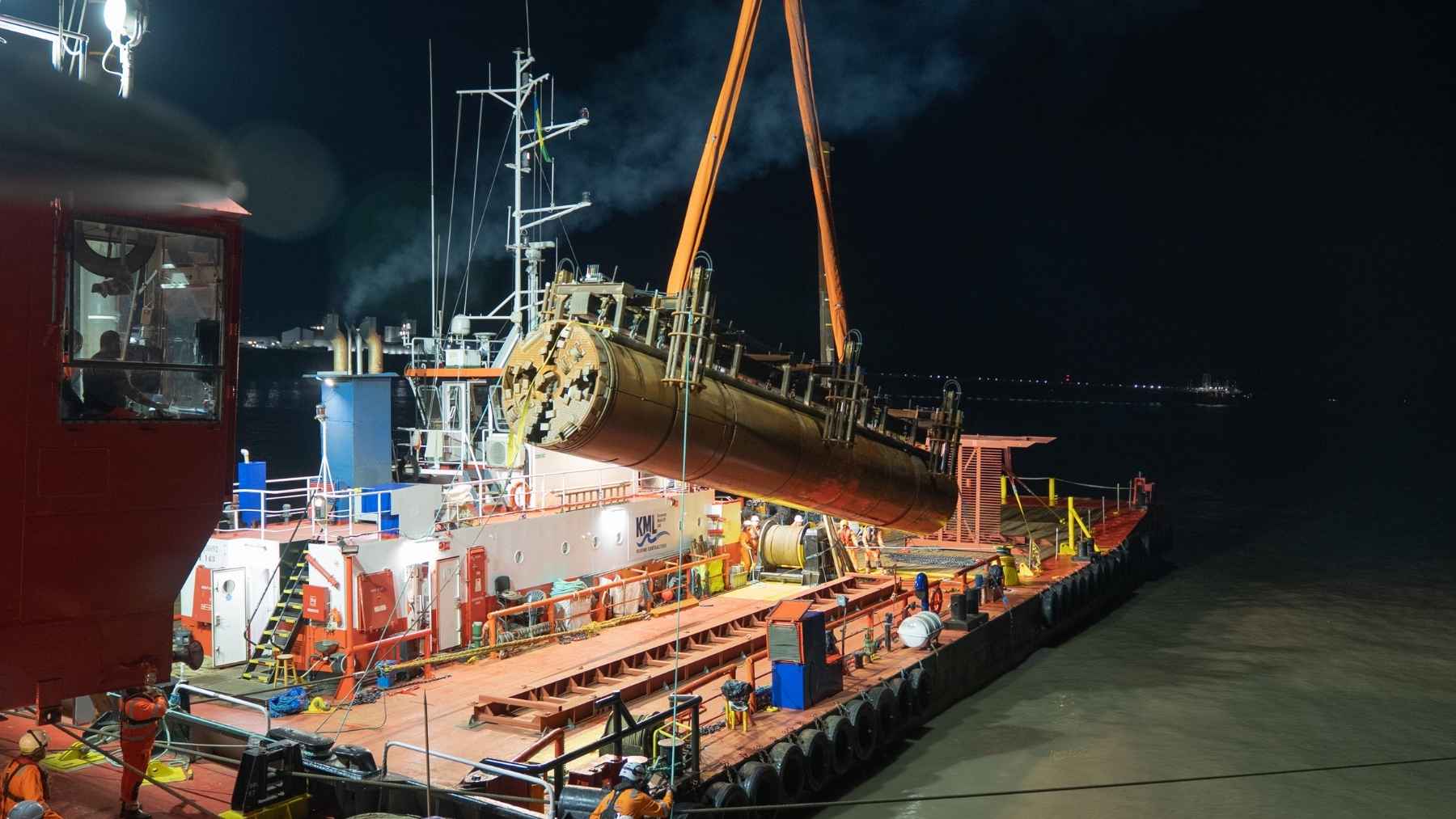
The machine that bears her name weighs 88 tons (80 metric tons), according to Joseph Gallagher, the tunneling firm working on the job for the main contractor, Kier BAM. It’s a closed-face machine, which basically means the front is sealed off and the rock it cuts gets crushed and turned into a slurry that’s pumped away. Gallagher put its expected pace at around 52 feet (16 meters) a day. It hasn’t said who built it.
Sarah Guppy also doesn’t move the way the giant machines that dug the cooling tunnels did. Those pushed themselves along. This one gets pushed. The job uses pipe jacking, where hydraulic jacks at the launch site on shore shove the machine through the ground, and a new section of precast concrete pipe gets slotted in behind it each time there’s room.
So the tunnel’s lining is literally pushed into place behind the cutter, one pipe at a time.
Interestingly, the route isn’t a straight line. Gallagher describes an alignment with two vertical curves and an angled breakthrough at the far end, where the machine punched into a 148-foot (45-meter) concrete structure out in the channel after five months underground. EDF didn’t give the exact day that happened.
A floating crane then lifted the machine out of the water, which Gallagher says is often hit by bad weather and big tides. Only Canada’s Bay of Fundy sees a bigger gap between high and low tide than the Bristol Channel, so “big” is putting it mildly.
With Sarah Guppy out, the plant has roughly 5 miles (8 km) of tunnel under the channel, according to World Nuclear News and local reporting.
So how many fish are we talking about?
Well, that depends on who you ask. EDF says that once all three systems are running, the plant’s remaining impact on fish will come to about 48.5 tons (44 metric tons) a year, a figure it worked out with the Environment Agency. It says that’s less than one small fishing boat that lands in a year.
The local fisheries regulator sees it pretty differently. The Devon and Severn Inshore Fisheries and Conservation Authority estimates the plant’s marine fish kill is equivalent to more than 4.6 million adult fish a year. A government-commissioned review of nuclear regulation, meanwhile, held the whole package up as an example of nuclear red tape gone too far, and river and nature groups have accused that review of fudging its figures.
I’m not in a position to referee a fish count. Still, you don’t often see a power company dig a tunnel under the sea purely to give fish a ride home, whichever side of that argument you’re on.
Sarah Guppy, after five months under the Bristol Channel, is off for what I’d imagine is a pretty thorough wash before it’s put to work on another site. The tunnel it left behind is complete, according to EDF’s October 1st announcement, and the company says the fish disco’s application will go to regulators later in 2026.