
An automatic reactor trip is the safety system doing its job, and it’s arguably the most expensive way to solve a problem. The unit drops off the grid in seconds, and then you spend the next several days walking it back up to full power while somebody writes the report explaining why.
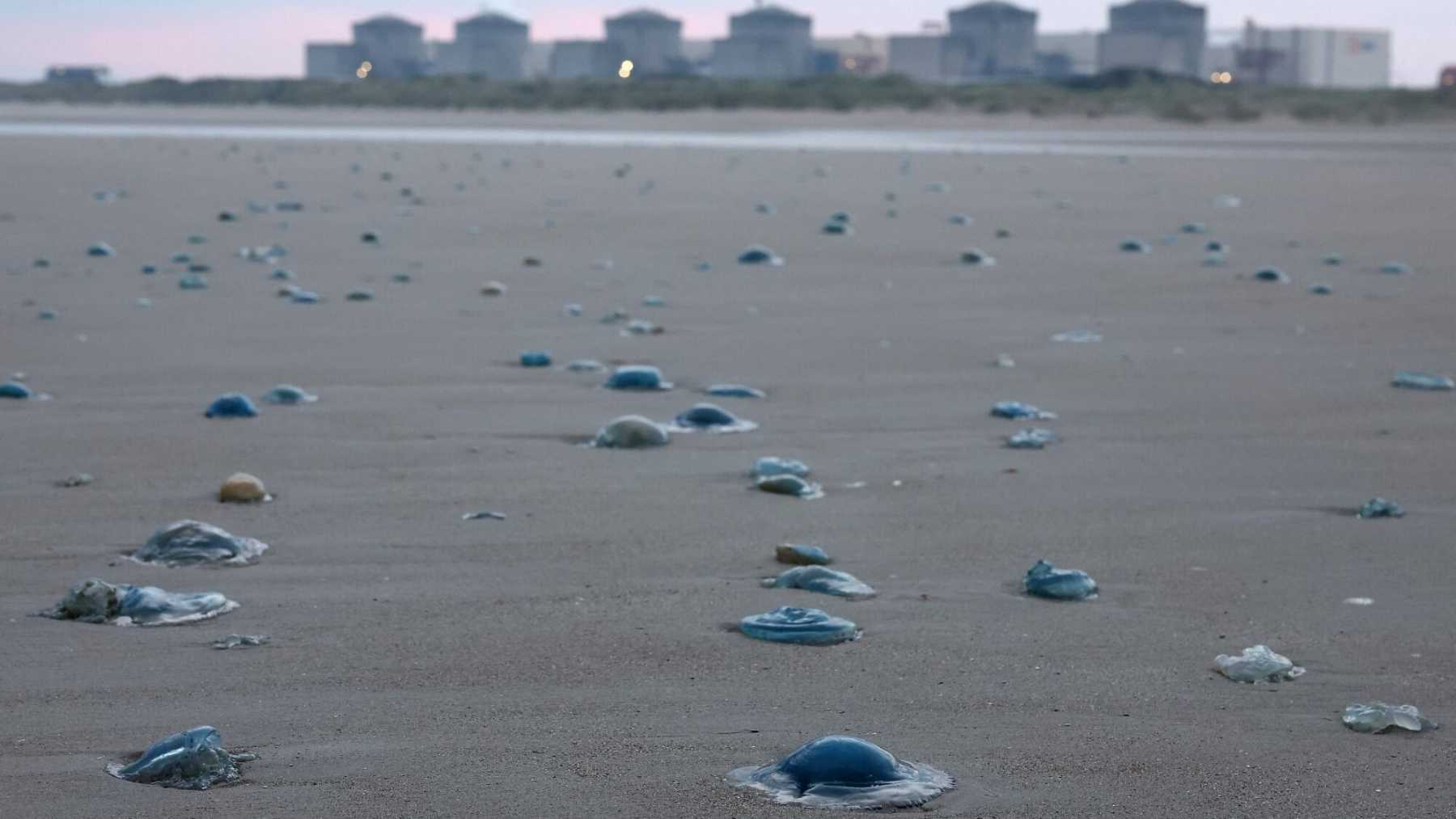
So when the jellyfish came back to Gravelines in late August, nobody at the plant sat around waiting for that. At about four in the afternoon on Wednesday, August 26, local time, the crew shut unit 3 down themselves and dialed unit 2 back while they were at it. Overnight they did the same thing to unit 6 and reduced unit 1 too. EDF says it’s all preventive.
So you had a 5,400-megawatt site with nothing running at full power. Units 3 and 6 were off, units 1 and 2 were loafing along at reduced output, unit 4 had been down since August 10, and unit 5 was partway through its ten-year inspection.
If that sounds like a first for Western Europe’s largest nuclear plant, it isn’t.
The same site went to zero output for about ten days last August, and during the first swarm this month the last reactor still running flat out got throttled as well. What’s new is who pushed the button. It’s also been that kind of summer for the operator, which has already spent it idling inland reactors because the rivers beside them ran too warm.
Gravelines drinks the North Sea
If you’ve never looked at how a coastal plant gets its cooling water, it’s simpler than you’d expect. Gravelines doesn’t sit on a river. It pulls seawater from a canal connected to the North Sea, and everything that water carries hits two stages of screening before it reaches the condensers: coarse bar screens at the front, which EDF calls prégrilles, and rotating drum filters behind them. Pack those drums and the flow drops. Let it drop far enough and the protection system takes the unit off the grid for you, ready or not.
So why not let them trip?
A trip is a hard stop. Control rods drop, steam gets dumped, and the plant has to be checked over and lined back up before anyone talks about restarting. Taking a unit down on purpose gets you to the same place more slowly and leaves a shorter list of things to look at afterward. EDF hasn’t spelled that reasoning out, so I’m inferring it, but the restart times back it up.
Unit 3 gives the cleanest comparison, because it went down in both swarms for the same reason. On August 10 it tripped itself at 7:43 in the evening and didn’t come back until 3:55 in the morning on August 18, a bit over seven days. On August 26 the crew took it down deliberately and it was back at 2 a.m. on August 30, about three and a half days. That’s the same reactor and the same cause, and it cost half as much time.
Unit 6 did better still and reconnected at 2:30 in the morning on Friday, August 28. EDF published the night that one went down but not the hour, so I can’t give you an exact figure. Call it a day and a half.
The fishing fleet has doubled
France 3 Hauts-de-France, citing the plant’s management, reported six boats on the job by the end of August: three working offshore and three more inside the outer harbor around the clock, crewed by fishermen out of Boulogne-sur-Mer, Calais and Dunkirk. The same report put the catch at roughly 110 tons a day (100 metric tons) by late August, up from a few dozen tons a day at the start of the month, and about 3,300 tons (3,000 metric tons) taken out of the water since August 1. It doesn’t say how much of that was netted at sea and how much came out of the intake channel, and I’d want that split before calling the patrols a win. Six boats were pulling a hundred tons a day and the screens still packed twice in sixteen days. The swarm is arguably growing faster than the answer to it.
Four days before all this, a decree published in the Journal Officiel cleared EDF to start preparing the ground at Gravelines for two EPR2 reactors of 1,600 megawatts each. That’s permission for earthworks and site services, and it isn’t a license to build the reactors themselves. The investment decision covering the wider six-reactor program is due by the end of the year. Whoever ends up specifying the intake screens for that pair is presumably reading the same August the rest of us are.
EDF put unit 4 back on the grid at 3 a.m. on Monday, August 31, twenty days after the first swarm knocked it off. In the September 2 update, the only Gravelines reactor still down was unit 5, and that one’s exactly where it should be, in the middle of its ten-year inspection.