
Lake Mead hit another record low this month, which barely counts as news anymore. The lake has spent most of 2026 sliding past the marks set during the 2022 water crisis, and by September 22 it was down to 1,038.14 feet above sea level, the lowest it’s been since Hoover Dam first filled it in the 1930s.
So here’s the question I keep coming back to: Las Vegas pulls 90 percent of its water from that shrinking lake, so why does a metro area of more than two million people still have water coming out of every tap, fountain and misting system in town? A big part of the answer is a machine that finished its job over a decade ago, working under more water pressure than any tunnel boring machine had handled before, at least according to the company that built it.
Back in 2008, the Southern Nevada Water Authority started building a third drinking water intake for Lake Mead. The two existing straws sit at 1,050 and 1,000 feet above sea level, and the lake kept dropping toward both, so the new one had to pull from near the bottom. Getting a pipe down there meant boring a tunnel underneath the lake itself, through ground soaked with the lake’s own water.
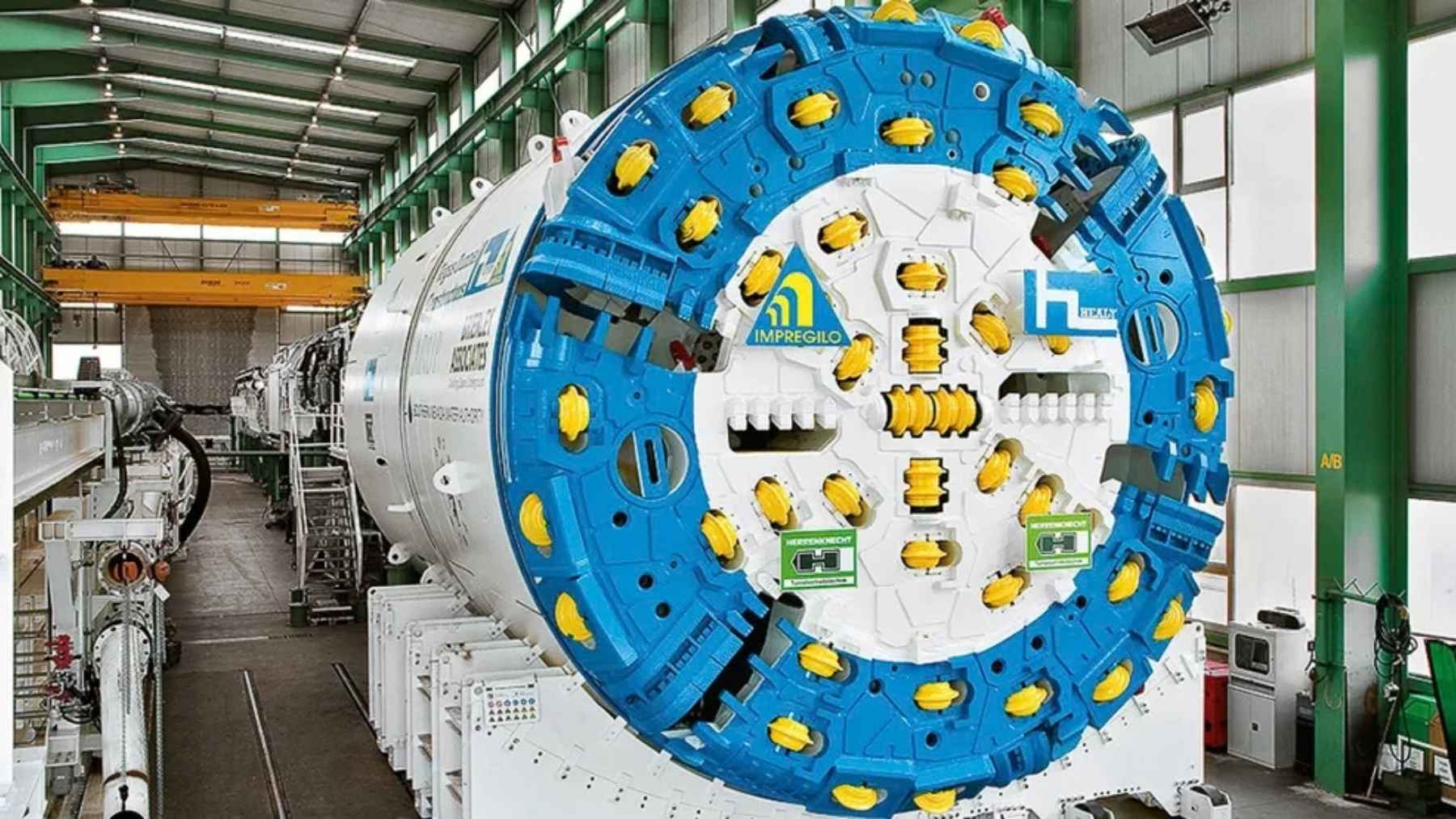
The job went to Vegas Tunnel Constructors, a joint venture of S.A. Healy out of Chicago and Salini Impregilo out of Milan, and to a machine Herrenknecht built specifically for it: the S-502, a tunnel borer the water authority describes as 24 feet in diameter. It went into the ground in late 2011 through a 590-foot launch shaft at the lakeshore, roughly the height of a 50-story building, straight down. From the bottom of that hole it chewed 2.7 miles through rock toward one precise spot on the lake bed, and on December 10, 2014, it broke through.
So how much pressure are we talking about?
Herrenknecht says the S-502 took water pressure of up to 15 bar during the drive, and called it a world record for mechanized tunneling when the machine holed through. That works out to about 218 psi. Your car’s tires carry around 33. A diver would have to sink to roughly 490 feet of open water to feel the same squeeze, and recreational scuba stops at 130.
So where was all that pressure coming from?
The tunnel runs through the Muddy Creek Formation, alternating hard rock, conglomerates and fault zones, and plenty of those faults were filled with water fed straight from the lake overhead. Whenever the cutterhead opened one up, the machine was essentially digging with a couple hundred pounds per square inch of Lake Mead trying to force its way into the hole behind it.
That pressure turned routine maintenance into a diving expedition. Boring machines chew up their cutting tools, and somebody has to get into the chamber behind the cutterhead to swap them out. At 218 psi you can’t just open a hatch, so the project ran saturation operations, the same technique oil companies use for deep-sea work: crews stayed pressurized between shifts so their bodies only had to decompress once, at the end, instead of after every tool change.
Ballard Marine Construction, which handled the hyperbaric side, says the gear was built to a design working pressure of 17 bar, or 247 psi, and describes the job as one of the first tunneling projects anywhere fully set up for saturation work. Borrowing seafloor diving practice to fix a drill under a desert lake is, frankly, my favorite detail in this whole story.
The machine had two ways to dig
The S-502 was a multi-mode machine, and the name means pretty much what it sounds like. In closed mode, the chamber at the front stays full of pressurized slurry that pushes back against the water and carries the spoil out as liquid. In open mode, it digs like a normal hard-rock borer, with a belt hauling the cuttings, which only works where the ground holds itself together.
The crew flipped between the two depending on what the lake bed served up. Herrenknecht says the machine managed 1.5 to 2 inches a minute in open mode and more than 300 feet in a good week, and Tunnel Business Magazine puts the final tally at about 40 percent of the drive in open mode and 60 percent closed. The abrasive ground kept destroying wear parts, so a fair chunk of those three years went to sitting still for repairs. Averaging under a mile a year sounds slow until you remember what was pushing back the whole time.
About that record. Herrenknecht credits the previous mark, 11 bar, to its own machine at Sweden’s Hallandsas tunnel, which finished in 2013 after eight years of digging. Oddly, the company’s own Hallandsas page puts the groundwater there at up to 10 bar, so the old record wobbles by a full bar depending on which Herrenknecht page you read. Either way, Lake Mead blew past it, and as far as I can tell no boring machine has worked above 15 bar since. If one has, I can’t find it.
The tunnel was only half the job
At the far end, the bore had to dock with an intake structure resting on the bottom of the lake. Crews blasted a shaft out of the lake bed with shaped charges, lowered a concrete-and-steel intake of more than 1,300 short tons (1,200 metric tons) into it, and anchored the whole thing with more than 1,000 truckloads of concrete, per the water authority.
Then the machine had to hit that target after 2.7 miles underground, which is arguably the harder trick. Breaking through into a lakebed with the water still sitting on top is its own special category of nervous; a much smaller machine pulled a similar stunt under a California reservoir this year, and that one only had 347 feet to cover.
Water started moving through Intake No. 3 to the valley’s treatment plants in September 2015. The whole design goal was elevation: the new straw keeps drawing with the lake below 1,000 feet, a line the older intakes were never built to survive.
The backup straw is doing the real work now
For its first few years, Intake No. 3 was mostly insurance. Then came April 2022. The lake dropped far enough to expose the top of Intake No. 1, the straw Las Vegas had leaned on since the early 1970s, for the first time since the reservoir filled, and the water authority switched on its Low Lake Level Pumping Station the same week.
That station was finished in 2020 for $522 million, under its $650 million budget, and can move up to 900 million gallons a day. The bigger deal is that it keeps pumping below the lake’s dead pool elevation of 895 feet. Dead pool is the point where the water sits too low to pass through Hoover Dam, so Arizona, California and Mexico would get nothing downstream. Las Vegas, with its deep straw, would still be drinking.
“We invested $1.5 billion in the third intake and the low-level pumping station for a reason,” John Entsminger, the water authority’s general manager, told The Nevada Independent at the time.
Four years on, the insurance policy is simply how the city drinks. The lake now sits about 12 feet below the elevation where Intake No. 1 begins, and the wider Colorado River system held 31 percent of its capacity at the end of August, with Lake Powell upstream trying to stay above the elevation where Glen Canyon Dam quits making hydropower.
Reclamation’s daily record put Lake Mead at 1,038.14 feet on September 22, 2026, its lowest reading since the reservoir first filled, and about 143 feet above dead pool. The S-502 finished its part of the answer back on December 10, 2014, and eleven years later that 2.7-mile hole is the reason the number on the gauge is a problem for Las Vegas instead of an emergency.