
There’s a saying that gets passed around military and prepper circles: two is one, and one is none. Basically, if you’ve only got one of something you can’t do without, you should plan on it breaking at the worst possible time.
The crew emptying Building 3029, an old isotope lab at Oak Ridge National Laboratory in Tennessee, had a pair of mechanical arms to work with. When they started pulling 18 highly radioactive items out of its hot cells in March, the left arm was already out of action, and only the right one worked. Then, as they were pushing to get 15 of those 18 out, the right arm’s hand came loose.
So how do you fix a mechanical arm inside a room no one can walk into, when the only other arm in there doesn’t work either?
Apparently, you get the broken one working by hand. According to UCOR, the contractor running the cleanup for the Energy Department, field supervisors suggested disengaging a control mechanism on the left arm that had been keeping anyone from moving it manually. The team did that right there in the work area. Then workers ran the left arm by hand and used it to repair the right one. Neither arm had to be replaced.
If you’ve ever pushed a stalled car out of an intersection, you’ve done more or less the same thing. You knock it into neutral so the wheels will turn, and you supply the muscle yourself. That’s my read of it, anyway, since the contractor doesn’t say exactly what the mechanism was or what it took to get it out of the way.
UCOR figures a replacement could’ve taken as long as six months, and it says skipping one saved more than $400,000. Its write-up credits “a questioning attitude and innovative collaboration.” Which, as far as I can tell, is corporate for someone asking whether the broken arm was as broken as it looked. It wasn’t, quite.
These arms work through a concrete wall
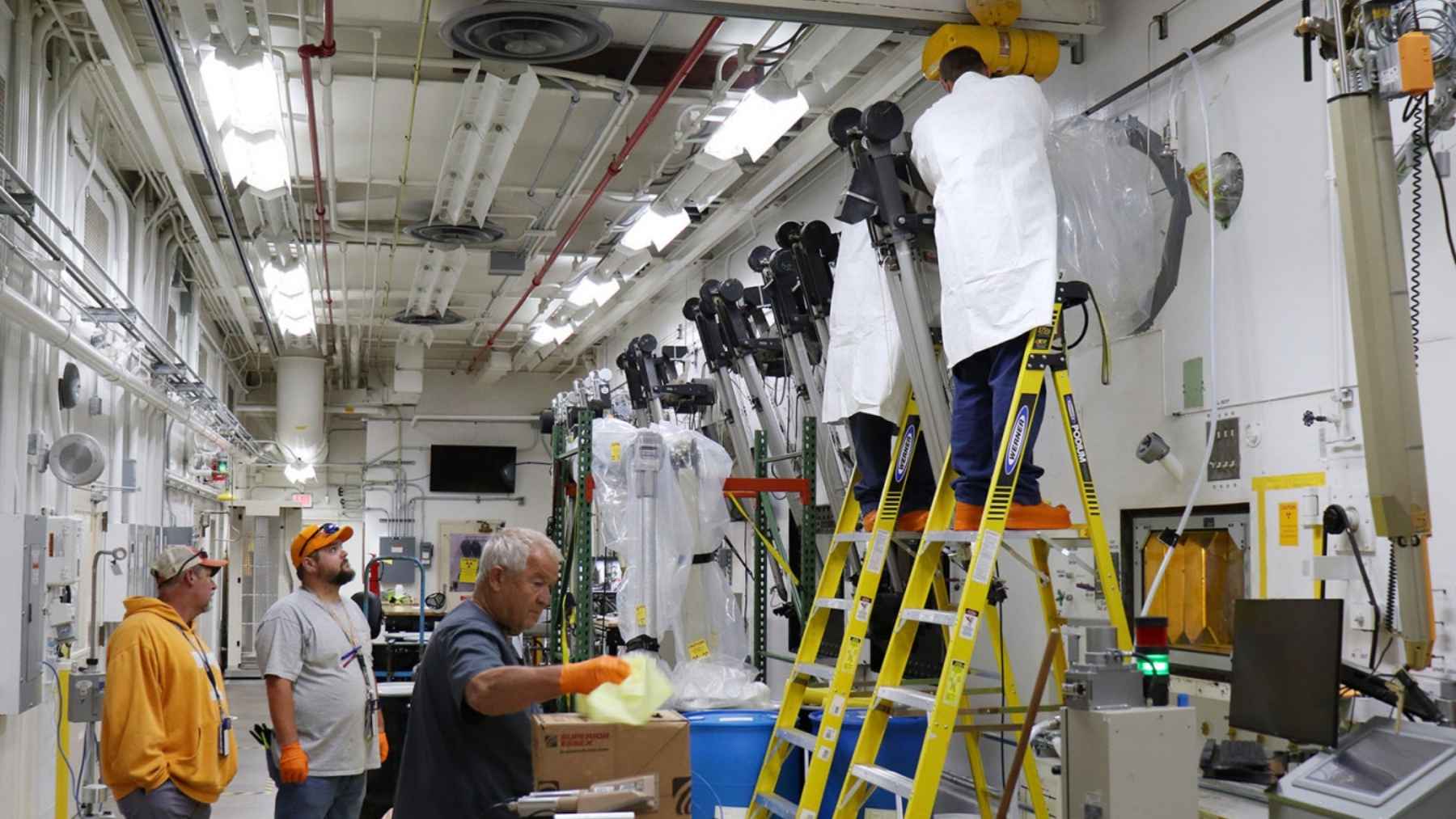
A hot cell is a room with concrete walls thick enough to stop the radiation coming off whatever’s inside it. You can’t go in while that material’s in there, so you work it from outside: you move a handle on your side of the wall, and a set of tongs on the far side copies the motion.
Think of the grabber stick people use to pick up litter, except this one goes through a shielded wall and costs six figures. We’ve seen these arms at work before, in the argon-filled hot cell in Idaho where America cuts open used fuel rods.
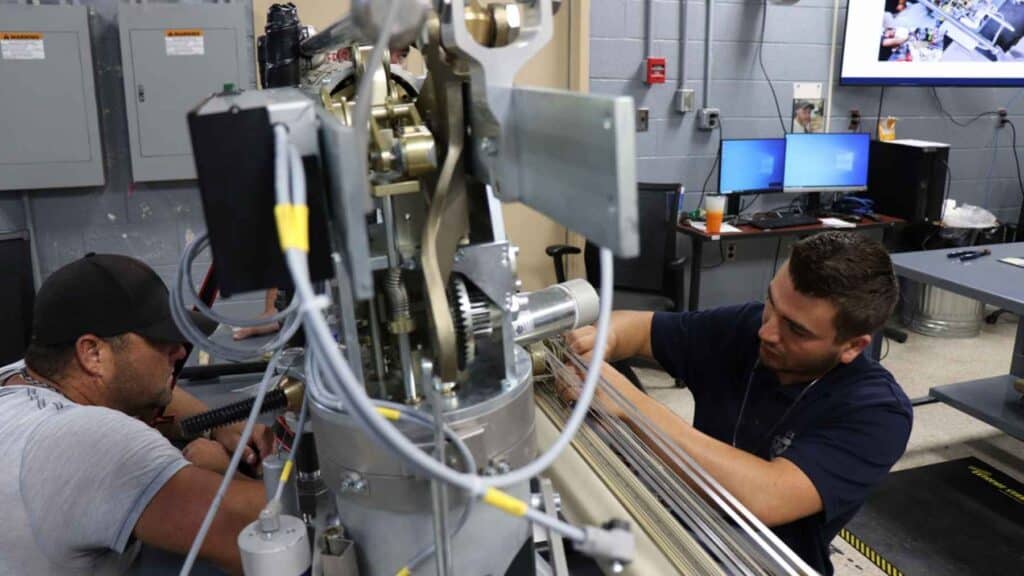
I’d love to tell you how big Building 3029’s arms are and what they weigh. The contractor hasn’t named the model, though, and that’s what I’d need to pull up a spec sheet.
The building itself has four cells, according to a site history NIOSH uses when it reconstructs radiation doses for worker compensation claims. It’s a single-story steel building with about 3,000 square feet inside, and it used to be Oak Ridge’s Source Development Laboratory, where workers turned radioactive cobalt and cesium into sealed radiation sources. In that same history, Cell 2 sits in the middle, between Cells 1 and 3.
The Energy Department says crews pick each item out of the middle cell, then pass it through a small window into the cell next door, where it goes into a heavily shielded metal drum. The photo that ran with the repair story shows the operator side of Hot Cell 2, so my guess is these are the arms working that middle cell. The write-up doesn’t spell it out.
So why not buy a new arm?
Because these things are pretty much made to measure. An Oak Ridge report on the lab’s own hot cell manipulators says only a few companies make them, and each arm gets designed or picked for the work it’ll do and the building it’ll do it in. Even two arms sold under the same model name might not match from one building to the next, according to the report, and the spares are building-specific too.
That report put a new manipulator at roughly $150,000 to $200,000 a few years back. So the $400,000 figure looks an awful lot like the price of two new arms, though the contractor hasn’t said how it got there. Either way, this isn’t the kind of thing you order on Amazon and get by Tuesday.
The report also says the lab tends to run its arms until they fail, and that some breakdowns can only be fixed by pulling the arm out of the cell. So fixing one in place, with the other broken arm doing the work, is frankly a pretty neat trick.
I’d argue the six months matters more than the money, though. Every month those items sit in the cell is another month before Building 3029 can come down, and the Energy Department’s whole pitch for this project is clearing hazards out of the middle of a working research campus.
Figures: Energy Department, UCOR.
So how many items are left?
That’s harder to pin down than you’d think. The Energy Department said on July 7 that crews had tracked the radiation to 18 high-dose items using radiation-resistant cameras, and that 10 of them were out. We covered how they found those items, along with the rest of Isotope Row’s cleanup, when the first of the row’s labs came down last month.
UCOR’s September update is fuzzier. It says the hand came loose while crews were pushing to remove 15 of the 18, which could mean they’d gotten that far or that 15 was the next target. I couldn’t find a newer count from either of them, so I can’t tell you how many are still in the cell.
UCOR posted the fix on September 16, and from the sound of it, both arms are back in business. The Energy Department has Building 3029 slated for demolition once the cells are cleared out.