
Ship launches get all the attention. Someone smashes a bottle of champagne against the bow, the hull slides into the water, and everyone claps.
Keel layings happen years earlier, and they’re a lot less photogenic. A modern submarine gets built in big hull sections, and the keel laying basically marks the point where those sections start coming together as one boat.
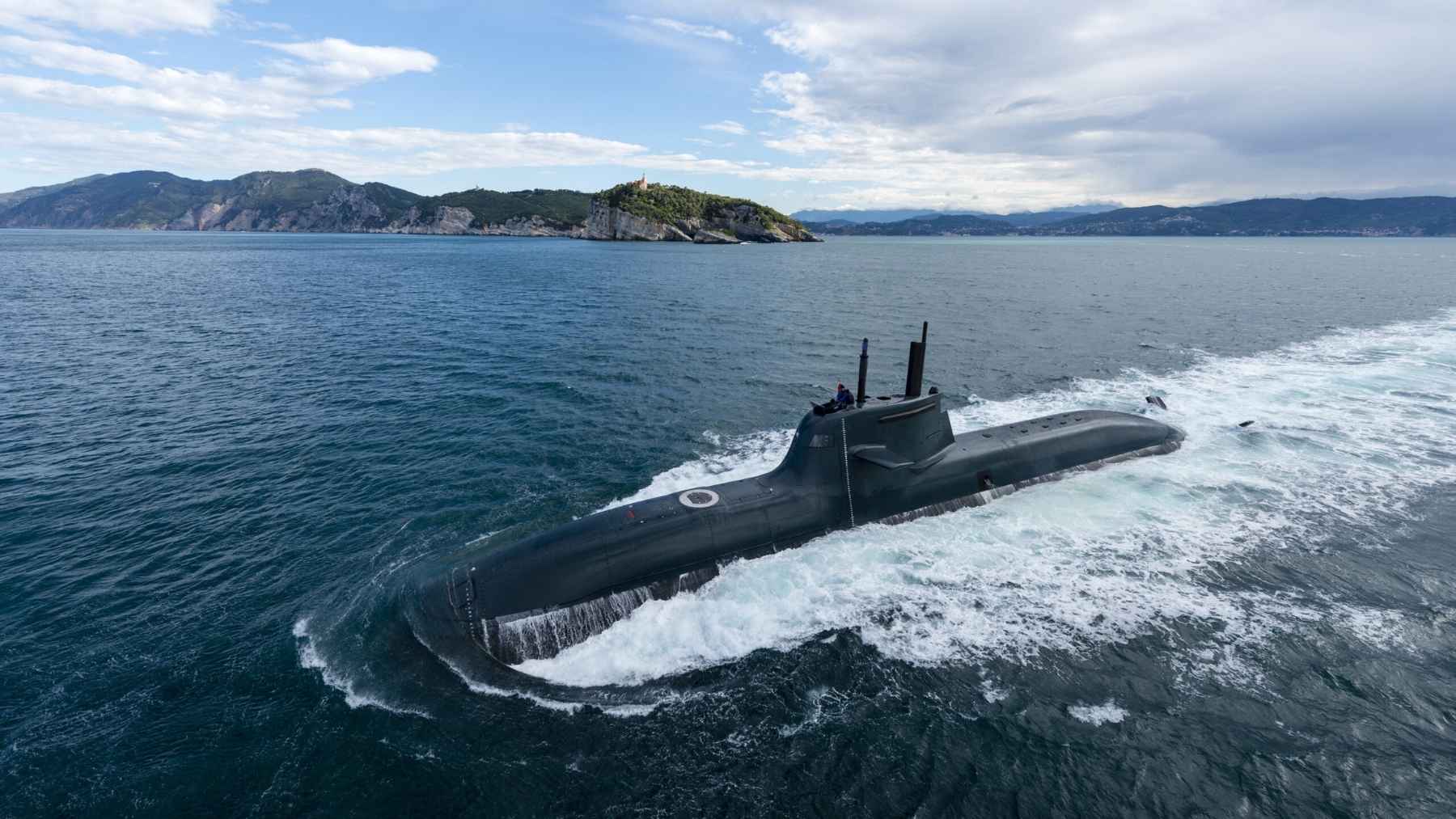
The Italian Navy’s second U212NFS submarine had its keel laid on September 30 at Fincantieri’s Muggiano yard in La Spezia, according to OCCAR, the international defense agency that manages the program for Italy. OCCAR’s announcement also names the boat. It’s Pietro Calvi.
The first boat in the class reached that stage on February 27. Fincantieri is building four in total, and OCCAR says all four are under construction at once.
The NFS is a stretched-out U212A
NFS stands for Near Future Submarine. That’s a slightly optimistic name for a class whose first boat isn’t due until 2029, but I’ll let it slide.
The class is based on the U212A, a German design that Italy already operates. Germany calls its own version the Type 212A, and one of those recently surfaced off Scotland to drop off British commandos.
OCCAR says the NFS gets a longer pressure hull, electric masts that raise and lower, and lower-profile periscopes. Fincantieri adds a new combat management system to that list, plus a lithium-ion battery we’ll get to in a minute.
OCCAR’s fact sheet puts the boat at about 194 feet long and 23 feet across at its widest point, with a crew of 29. It displaces about 1,764 short tons (1,600 metric tons) on the surface.
If you’re wondering why navies talk about displacement instead of weight, it’s because they’re basically the same thing. A floating ship weighs exactly as much as the water it pushes out of the way, and that’s a lot easier to work out than finding a scale big enough for a submarine.
Submarines get two numbers, though, because they flood their ballast tanks to dive. OCCAR only lists the surface figure, and I couldn’t find an official submerged number from OCCAR, Fincantieri or the Italian Navy. It’ll be higher. I just can’t tell you by how much.
The NFS runs on lithium-ion batteries
So why would a navy get this excited about a battery?
A diesel-electric submarine can’t run its diesel engines underwater, because engines need air. So it runs on batteries while it’s submerged, and when those get low, it has to come up near the surface and stick a snorkel out to run the diesels and recharge. That’s when it’s easiest to find.
Italy’s current U212A boats get around some of that with hydrogen fuel cells, which let them stay down for long stretches at low speed. Fincantieri’s and OCCAR’s recent announcements only mention the battery on the NFS, so I can’t say for sure whether the fuel cells carry over. Naval News reported early in the program that the first two boats would keep the U212A’s setup.
Lithium-ion cells store a lot more energy in a given space than the lead-acid batteries conventional subs have relied on for over a century. Cmdr. Alessandro Irvia, a platform officer in OCCAR’s NFS program office, has said the new battery holds almost twice as much energy as lead-acid by volume, according to EDR Magazine. He’s also said it should last around 10 years, compared with about five for lead-acid. That should let the boat go faster or stay down longer before it has to snorkel. OCCAR says the battery should also make the NFS harder to detect.
EDR Magazine, citing Italian Navy material, reports the cells use lithium iron phosphate (LFP) chemistry. That’s the chemistry you’ll find in a lot of cheaper EVs. It doesn’t pack quite as much energy as some other lithium chemistries, but it’s a lot less prone to catching fire, and that’s a pretty important quality when you’re sealed inside a steel tube under the Mediterranean. The battery is arguably the biggest upgrade on the boat, even if it’s the least exciting thing to look at.
The Italian Navy wants a new submarine every year
The program’s picked up some speed lately, at least on paper. On July 23, OCCAR and Fincantieri signed a contract amendment that Fincantieri puts at about €317 million. It adds advanced torpedo countermeasures, which are essentially decoys a sub can fire off to pull an incoming torpedo away. It also covers upgraded hookups for submarine rescue gear and more long-term support for the boats.
The amendment pulled the fourth boat’s delivery forward by two years too, from 2034 to 2032. That gives the Italian Navy one new NFS a year from 2029 on, which OCCAR describes as the Navy’s goal.
I’d call that a pretty ambitious pace for a single yard. Then again, Muggiano already has all four boats in the works, so it isn’t starting from scratch.
So what will the NFS carry?
OCCAR’s fact sheet doesn’t name a single weapon. It talks about a “solid underwater strike capability” backed by countermeasures, and says the design leaves room for long-range strike options later on.
Naval Technology and Naval News both report the boats will carry Black Shark heavyweight torpedoes. Those are the big 21-inch torpedoes subs use against ships and other subs. If you want an idea of what one of those can do, a Canadian diesel-electric sub finished off a retired American cruiser with a Mk 48 at RIMPAC this summer.
Both outlets say that long-range strike option means cruise missiles. No one’s named the missile yet, and OCCAR frames it as a future upgrade, so it’s safe to assume Pietro Calvi won’t carry one on day one.
If you’re keeping track, OCCAR’s current schedule has the first NFS reaching the Italian Navy in September 2029, with Pietro Calvi following in July 2030.