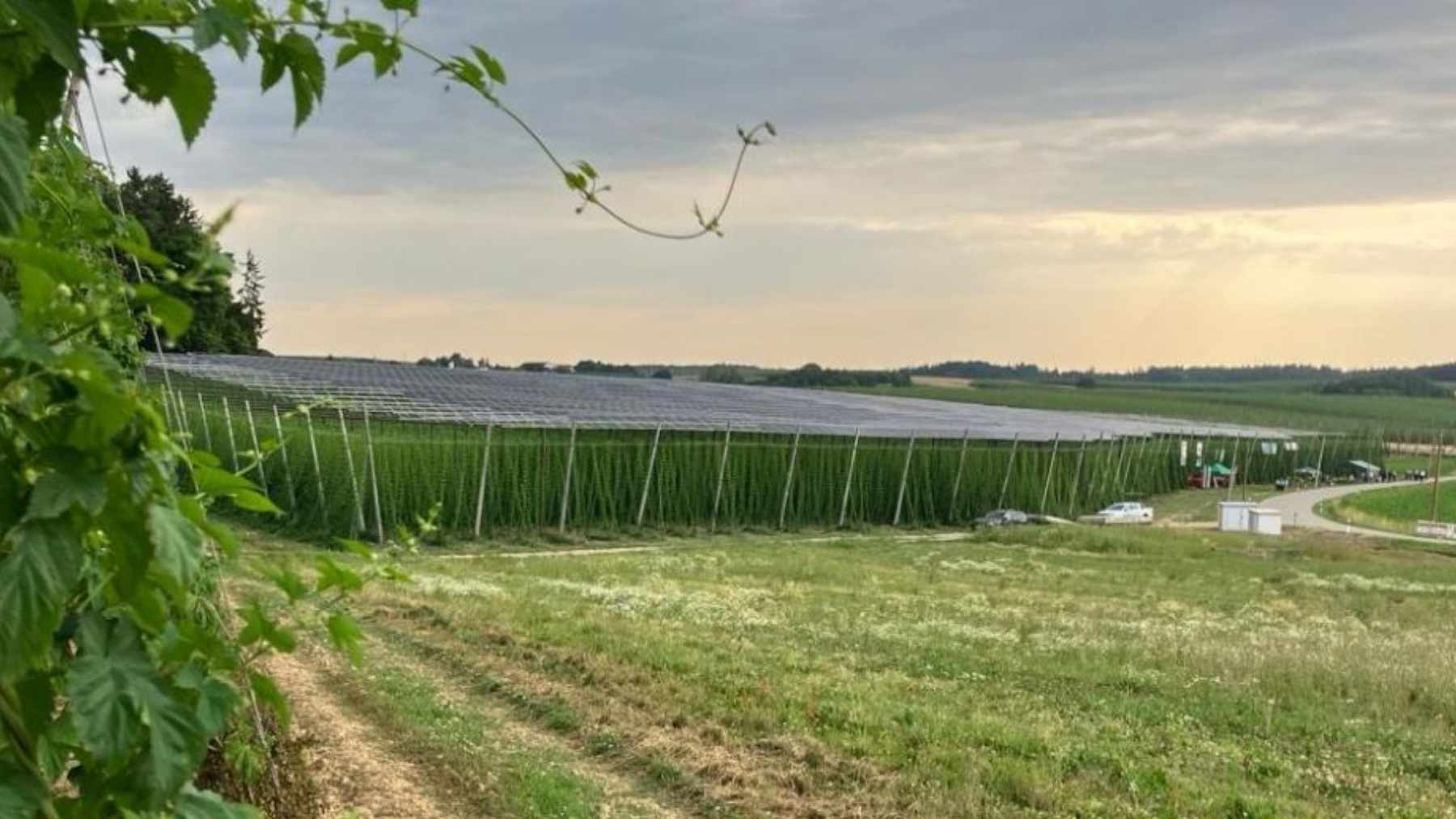

Hops do not stand up on their own. The plant that bitters your beer is a bine, it climbs, and a hop yard is really a piece of structural engineering with about 23 feet of vertical air underneath it. Steel poles, wire, string, and a crop that goes up all of it every spring.
Josef Wimmer, a fourth-generation grower near Osseltshausen in Bavaria’s Hallertau, looked at his and worked out that the poles were doing one job when they could be doing two. So he put solar panels on top of them.
The first version went up in 2023, and Fraunhofer ISE, which runs the research program attached to it, calls it the world’s first agrivoltaic system in hop growing. The second version went up in 2025, because the first one worked beautifully as a power plant and quietly cost him hop cones.
That second part is the useful bit for anyone growing hops in the Yakima Valley, and it took two prototypes and three years of sensors to sort out.
The first version shaded the hops a little too well
The 2023 build sits on roughly 3.2 acres (1.3 hectares) at Wimmer’s farm. Modules are mounted on steel masts at a height of 23 feet (7 meters), and those masts double as the hop poles, which is the whole trick. Installed capacity is 977 kilowatts peak, enough to supply about 200 households, and the varieties growing under it are Hallertauer Tradition and Herkules.
The engineer behind it is Bernhard Gruber, a former Airbus engineer who now designs agri-PV systems for AgrarEnergie and feld.energy. On prototype one he set the panels at a 20-degree tilt, which is close to flat. Flat panels catch more of the midday sun. Flat panels also throw more shade.
Shade was the point. Euronews reported from the farm in mid-July and got the reasoning straight from the grower: “We wanted to shade the hops because hops are a shade-loving plant,” Wimmer said. Fraunhofer’s version is more clinical, describing shading as a way to cut the stress of high solar radiation and reduce the need for irrigation.
Then the bines reached the roof. Once the plants climbed the full 23 feet and hit the panels, they put out bushy growth in the shaded top zone and set fewer cones. Total yield dropped. So did the amount of extract coming off the crop, which is what brewers actually buy.
A hop farm that generates good electricity and bad hops is just a solar farm with an expensive hobby attached.
Tilting the panels to 45 degrees fixed the cones and the price
Gruber spent two years rebuilding the model. Sun path in summer against sun path in winter. Shade tolerance of the plant against the tipping point where cone set falls off. And the shape of the power price curve across a normal day.
Prototype two, installed on Wimmer’s land in 2025, sets the modules at 45 degrees. Steeper glass takes less direct sun at noon, so the array generates fewer kilowatt-hours over the year. The hops get their cones back.
The money moves in the other direction. A flat array does its best work at midday, which in a country with Germany’s solar build-out is exactly when the grid is already swimming in cheap power and producer prices sag.
A 45-degree array starts earning early in the morning and again in the late afternoon and evening, when prices are high. In winter, with the sun sitting low for hours, steep panels catch light that flat ones spill.
Fewer kilowatt-hours, more money per kilowatt-hour. That is a deliberate trade, and it is the kind of thing you only learn by building the wrong version first.
The soil under the panels holds water longer
The research half of this runs under a project called HoPVen, funded by Germany’s federal agriculture ministry and running from November 2023 to October 2026. Fraunhofer ISE and Weihenstephan-Triesdorf University of Applied Sciences handle the science, with the Bavarian State Research Center for Agriculture subcontracted in.
Soil moisture is measured at the surface and at depth. Temperature and humidity are logged between the hop rows at several heights. Every measurement is duplicated in a control field with no panels over it, which is the part that makes the numbers worth anything.
Wimmer told Euronews the ground has been wetter since the modules went up, with less evaporation and rainfall held in the soil for longer. The difference matters most in June, July and August.
First evaluations from Freiburg and Weihenstephan agree that the extra shade on prototype one improved soil health. Whether the steeper prototype two does better is still open. Those trials are still running.
There is one research question in the HoPVen brief that nobody outside farming would think of. Hops get sprayed. Plant protection products land on the modules overhead, and the institute is studying whether that residue causes soiling and corrosion, and what it does to system efficiency. Roofing a crop means the crop’s chemistry now lands on the underside of your power plant.
The math only works if the hop loss stays under 15 percent
Weihenstephan measured the yield hit, and it is real: between 10 and 20 percent less hops. Wimmer’s own accounting, given to Euronews, is that if his losses land between 10 and 15 percent the deal works, because the electricity revenue more than covers the shortfall. He loses a bit on the crop and makes good money on the power.
Gruber puts payback at around 14 years on a system rated to last at least 30. Which sounds fine until you look at what it took to get there. The building permit took almost two years. The farm has to lay about three miles (five kilometers) of cable to reach the substation, and pay for it.
The covered area is now about 12 acres (5 hectares) at roughly 2 megawatts peak, and Wimmer told Euronews he intends to roof about 49 acres (20 hectares) within two or three years, for 8 megawatts peak plus a megawatt of battery storage.
Germany is losing hop farms, not hop acres
The reason a grower bothers with any of this shows up in the German statistics. Federal agriculture ministry figures, drawn from the German hop growers’ association, count 904 hop farms in the country in 2026, 722 of them in the Hallertau.
The number of farms has fallen by around 40 percent since 2006. The planted area has grown about 4 percent over twenty years.
Fewer families, same ground, bigger operations, thinner margins. The 2025 German crop came in at roughly 43,140 metric tons, about 7 percent down on 2024, with 37,250 tons of that from the Hallertau alone.
Heat is doing something specific to the crop on top of the drought losses. A 2023 study in Nature Communications tracked European hop regions and found that after 1995 the Hallertau’s average yield ran 13.7 percent below the earlier baseline.
Alpha acid content, the compound brewers pay for, fell 15.6 percent over the same comparison. The paper’s projections to 2050 reach an 18 percent yield decline and a 31 percent drop in alpha at the harsh end of the range.
Fraunhofer’s own framing is blunter. In the dry years of 2013, 2015 and 2018, hop yields fell by up to 40 percent depending on the variety.
American growers have spent five years pulling poles out
The United States has been running the opposite experiment, and not by choice. Craft beer sales cooled, contracts shrank, and the Pacific Northwest has cut hop acreage every season since 2022.
USDA’s June crop production report puts 2026 acreage strung for harvest at 41,642 acres, against 41,654 the year before. That is the first flat year in a while. The 2025 crop came in at 83.1 million pounds, down 5 percent, on a national value of $447 million, and the Brewers Association notes planted acreage is down close to 31 percent from its 2021 peak.
Set that beside Germany’s 43,140 tons, which is about 95 million pounds, and the picture is a US industry that has spent five years shrinking to meet demand while Bavaria’s growers keep the same ground and hunt for a second income stream on it.
Washington has been circling the same idea. Yakima County commissioners approved a solar ordinance in April that allows medium and large-scale facilities on some farmland, ending a moratorium in place since 2022.
A report co-authored by Washington State University researchers put roughly 87,000 acres statewide in the plausible range for agrivoltaics, while noting that no large-scale system has been built here yet. The commissioners were arguing it out in the fourth year of a Yakima Basin drought.
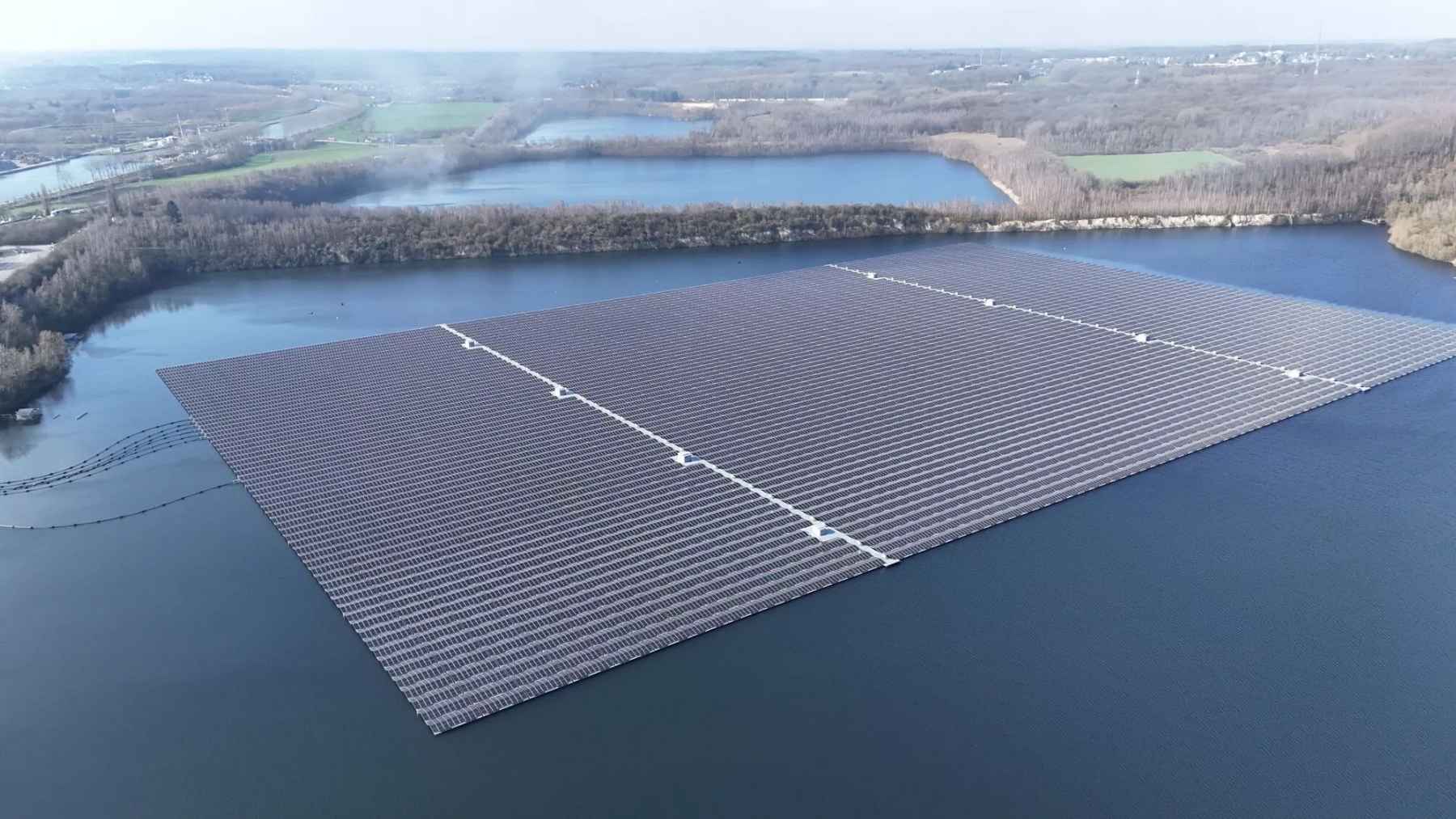
The engineering is not exotic. American farms already shade crops on stilts, as the raised arrays over Arizona vegetable beds have shown, and researchers have been running the light-versus-power trade under glass, most recently with tomatoes grown under semi-transparent solar roofs in Spain. Germany has simply been building odd mounting geometries for longer, including the panels standing dead upright on a Bavarian gravel lake.
The hop yard is the cheap version of this idea
Steel is what kills most agrivoltaic budgets. You are buying a structure tall enough and strong enough to hold glass over a working field, and then paying somebody to put it up. On a hop farm, that structure is already standing, already engineered for wind load, already paid for, already sitting on 23 feet of clearance that a harvester drives through every August.
Wimmer’s system is still a pilot with a sample size of one farm, and the honest reading of the German data so far is that the tilt angle decides everything. Get it wrong and you own a good solar array and a worse hop yard.
The Germans were not the only ones to try it, either. pv magazine reported a French installation growing hops under panels near Luçon coming online the same summer as Wimmer’s first build.
Wimmer is not waiting on the final report. He is putting in the expansion for his son, who is 17 and two years into a farming apprenticeship. On a 14-year payback, by the time the array has paid for itself, the farm will be his.















50 degrees will give more light and better hops but why no easy-pull wool sheep?
The son should be looking at this now, that payback is far too long.