
If you live in Hawaii, you already know what it costs to keep an island’s lights on with oil. The state got 65% of its electricity from burning petroleum in the latest count from the U.S. Energy Information Administration, and no state pays more for power on average.
Spain’s Canary Islands, off the northwest coast of Africa, are in pretty much the same boat. Close to 80% of their electricity still comes from fossil fuels, according to the group that’s now drilling for an alternative, and the islands’ grids aren’t connected to mainland Spain.
But Tenerife, the biggest of those islands, has a volcano right in the middle of it: Mount Teide, which also happens to be Spain’s tallest mountain. On September 16, the island’s government and its partners gathered next to a well in Vilaflor, a town about 4,600 feet up Teide’s southern slope. They announced that the well had reached 9,843 feet and found hot water under high pressure.
Spain’s Ministry for the Ecological Transition, which handles energy, calls it the first geothermal well in the country to get that deep. That’s a big claim, so I checked it. It holds up, although this isn’t the first time someone’s drilled deep in the Canaries looking for heat. I’ll get to that in a minute.
So how hot is it down there?
Hotter than boiling, at least.
The ministry says the drilling turned up fractures under high pressure and temperatures above 212°F, and it reads those as signs of a hydrothermal reservoir. That’s basically a pocket of hot water trapped in the rock. It hasn’t given a final temperature yet, and frankly, a floor of 212°F leaves a pretty wide window.
If you’re wondering how water stays liquid that hot, the answer is pressure. Water boils at 212°F at sea level, but squeeze it hard enough and it stays liquid well past that. Your pressure cooker pulls the same trick, just with a lot less rock on top.
That final reading matters more than you’d think. Water that’s only a little over 212°F usually isn’t hot enough to run a turbine directly, so plants built for it use what’s called a binary cycle. The hot water heats a second fluid with a much lower boiling point, and that fluid’s vapor turns the turbine. Hotter water still means more power, so that final number counts for a lot.
The drillers came from off the island
Carlos Suárez runs ITER, the renewable energy institute owned by Tenerife’s Cabildo. Spanish radio network COPE, which interviewed him in September, reported that nothing on the island could drill that deep, so the job went to a group of specialist companies. The Cabildo is basically Tenerife’s island government, and it works a lot like a county government in the US.
It runs the project through a consortium called Energía Geotérmica de Tenerife. ITER and Involcan, the Canary Islands’ volcano institute, handle the public side, while DISA, a local energy company, and Iceland’s Reykjavík Geothermal are the private partners.
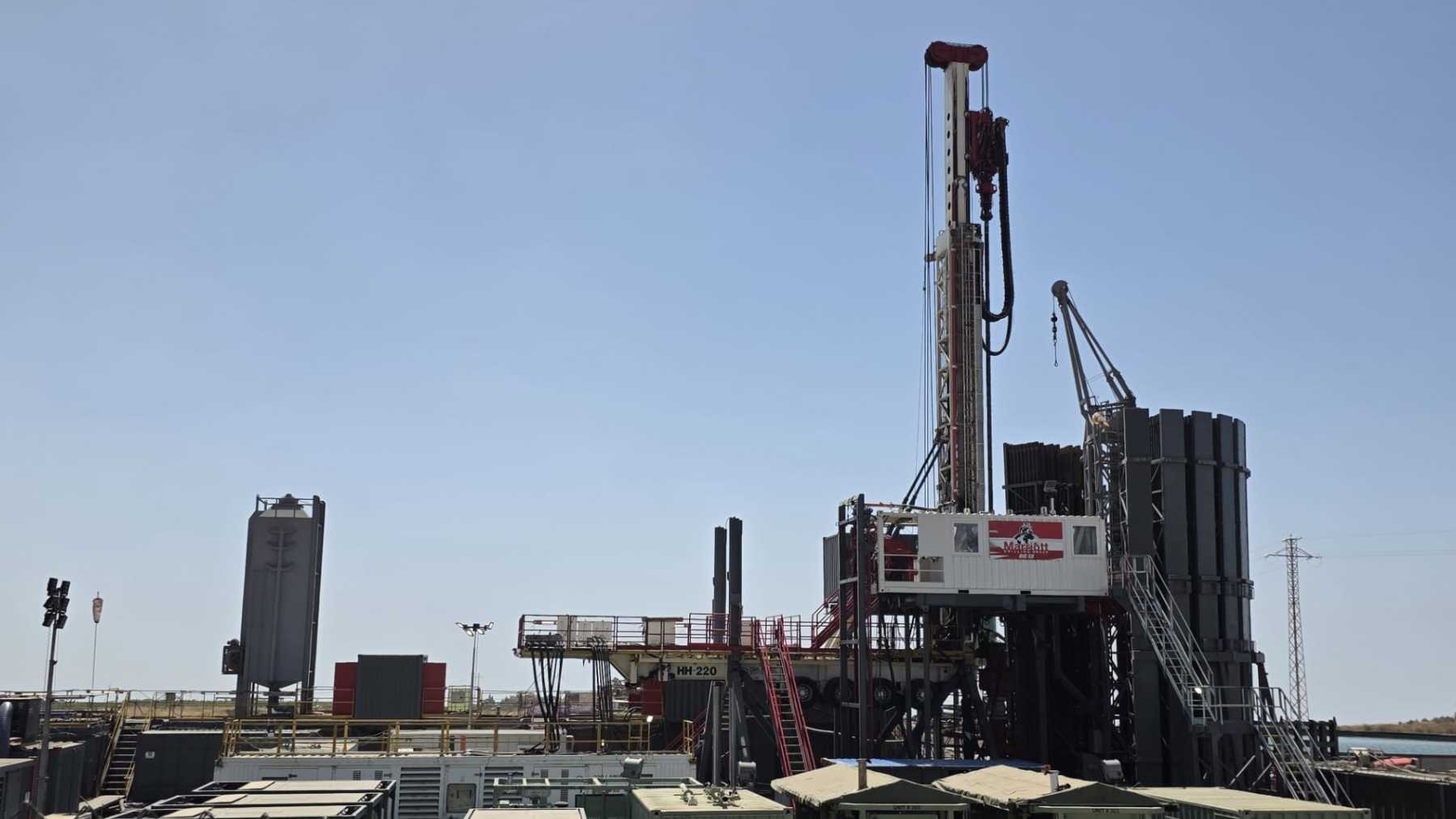
The rig comes from Marriott Drilling, a British drilling company working under Soluciones Geotérmicas Integradas, the main contractor on the job, according to ThinkGeoEnergy. I went looking for the rig’s model and weight, because that’s the first thing I want to know about any machine that can punch a hole nearly two miles deep. I couldn’t find either one published anywhere, and the announcements from the Cabildo and the ministry don’t mention the rig at all.
We do know a few things about the hole. Suárez told COPE that the 9,843 feet are measured along the well, which runs almost straight down, and that the data started looking decisive once the bit got past 7,546 feet. ITER says it took about four months to get to the bottom.
Figures: Spain’s Ministry for the Ecological Transition, ITER, COPE, IGME.
The Canaries have gone looking for this heat before
That earlier attempt happened on Lanzarote, another of the Canary Islands. Decades ago, Spain’s geological survey, IGME, drilled a well called Lanzarote-1 in Timanfaya National Park, and it stopped at 8,865 feet. IGME says that was the deepest hole ever drilled on land in the Canaries, and it didn’t turn up anything usable for energy right away. The Vilaflor well’s 9,843 feet beat that 8,865-foot mark.
So why didn’t anyone follow up? Oil got cheap again, and according to IGME, a lot of that research got shelved. Drilling this deep also costs serious money, and with geothermal, you don’t find out whether you’ve got a usable reservoir until the hole’s already paid for.
This time, Spain’s government is covering half the cost of the Vilaflor well with EU recovery money through IDAE, its energy diversification and savings agency. It’s funding nine deep geothermal exploration projects across Tenerife, La Palma and Gran Canaria, and the ministry says Vilaflor is the furthest along. Frankly, splitting the risk like that is a pretty sensible way to handle a bet where the first hole can come up dry.
So when does the volcano start making electricity?
Not anytime soon, from the looks of things, and nobody involved is pretending otherwise. Magnús Ásbjörnsson, the CEO of Reykjavík Geothermal, urged caution at the September 16 event, according to ITER, even while saying the early signs on temperature, pressure and permeability look good.
Permeability is basically how easily water can move through rock. Hot rock that’s as tight as a brick won’t feed a well, while rock that behaves more like a sponge will. We covered a volcano in central Oregon where the rock hits 629°F about 9,800 feet below the surface, and even there, a Texas company had to crack it open to get water moving through it.
The Vilaflor well hasn’t been through a production test yet. That basically means letting it flow for a while as engineers track how much hot water comes up, how hot it stays and whether the pressure holds. ITER calls that the next step. COPE’s interview with Suárez also laid out two more holes: a second well from the same site at a different angle, and a third somewhere else in Vilaflor.
Then there’s the money. Rosa Dávila, who heads the Cabildo, said the project’s second phase needs a regulated tariff from the ministry. That’s basically a guaranteed price for the electricity, set ahead of time so investors know what a plant would earn. Joan Groizard, Spain’s Secretary of State for Energy, said results from these wells will help shape that kind of rulebook. My guess is that’s where things slow down, and it’s arguably a bigger hurdle than the drilling.
The Icelandic comparison comes up a lot around this project. When the deep drilling started this spring, Ásbjörnsson said in an announcement carried by Iceland’s Mbl and Vísir that Iceland once leaned on imported oil for its power, too, and that “now it is the Canary Islands’ turn to take a similar step.”
Icelandic drillers have been boring into volcanic ground for decades, sometimes a little too enthusiastically, as the crew that hit magma at Krafla found out. Tenerife has a long way to go to catch up, but I’d say it’s off to a decent start.
The Vilaflor well bottoms out at 9,843 feet. On September 16, Spain’s energy ministry said the size and final temperature of the hot-water pocket under it will be pinned down over the coming months, and those two numbers will decide how much power it can produce.