
A US Navy destroyer handles incoming missiles in layers. The outer layers are interceptor missiles, fired from dozens of miles out, and that’s where most of the money and the radar time goes. The innermost layer is a gun bolted to the deck, sitting there for anything that gets past everything else. And on September 28, the Navy posted 38 seconds of footage showing one of those guns getting its aim checked in the middle of the Indian Ocean.
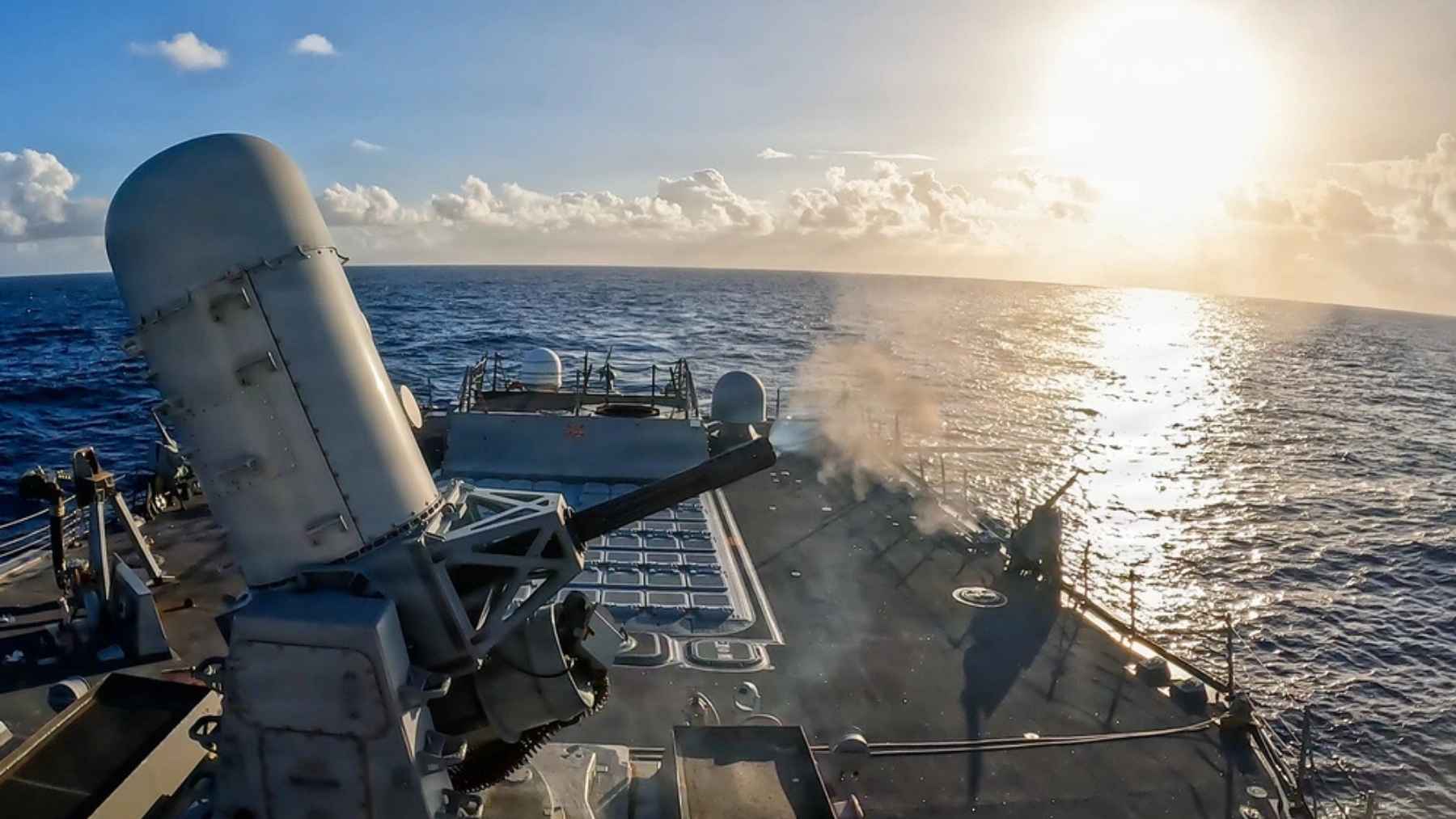
The ship is USS Mustin (DDG 89), an Arleigh Burke-class destroyer forward-deployed with Destroyer Squadron 15, which the Navy calls its largest destroyer squadron and the 7th Fleet’s principal surface force. The clip, shot on September 19 by Mass Communication Specialist 2nd Class Timothy Dimal, shows the ship’s Phalanx Close-In Weapon System firing during what the Navy calls a Pre-Action Aim Calibration fire, or PAC fire.
A PAC fire is basically the naval version of sighting in a rifle before hunting season. You fire the gun under controlled conditions to confirm the rounds actually go where the mount and its radar think they’re going, so the first shots against something real aren’t also the first test of its aim.
So what exactly is this thing?
A gun that brings its own radar
The Phalanx is a 20mm Gatling gun, a radar and a 1,550-round magazine packed into one self-contained mount. The current Block 1B version weighs 13,600 pounds, according to the Navy’s fact file, and the gun at its heart is the M61A1, a six-barrel, electrically fired design that spins its barrels as a cluster. Against missiles and aircraft it fires 4,500 rounds a minute, and against what the Navy calls asymmetric threats, meaning things like small fast boats, it runs at 3,000.
The mount doesn’t need much help from the rest of the ship, either. The Navy describes it as the only deployed close-in weapon system that performs its own search, detection, evaluation, tracking, engagement and kill assessment, which means the gun finds the target, decides it’s a threat, shoots at it and judges whether the threat is gone, all on its own electronics. The rounds it throws are armor piercing discarding sabot, a type built to punch through whatever it hits rather than explode near it.
Do the math on that magazine, by the way. At 4,500 rounds a minute you’re pushing about 75 rounds a second, so 1,550 rounds works out to a little over 20 seconds of continuous fire. The system shoots in bursts rather than one long roar, but the arithmetic tells you what this weapon is for: a few frantic seconds, not a long afternoon.
So why does a ship full of missiles still need a gun?
Partly history, mostly physics. An interceptor missile is the right answer at 20 or 30 miles. Inside the last mile there’s barely time for a person to react, let alone launch anything, which is why the Phalanx runs on its own radar and handles the whole engagement itself. The gun’s the answer to a question nobody wants asked, and you’d rather it answer in 20mm than find out the hard way that it can’t.
And this gun’s already been the answer once. Raytheon, which builds the system, says a Phalanx stopped a Houthi cruise missile that was within seconds of hitting the destroyer USS Gravely, saving more than 300 sailors aboard, and the company describes that as the system’s first at-sea engagement. When your backup plan has actually been used as the backup plan, you keep checking its aim.
The design isn’t young. Production started in 1978, the first system went aboard USS Coral Sea in 1980, and the Block 1B version first went to sea on USS Underwood in 1999, adding an infrared sensor so operators can visually identify small boats, helicopters and drones before shooting. Raytheon says it’s installed on every US Navy surface combatant ship class and on the ships of 24 allied navies, which is a pretty strong run for hardware older than the compact disc.
Mustin, for its part, treats the drill as routine. Navy photos on DVIDS show the same ship running the same calibration in the Indian Ocean back on June 3. I should be clear about what the September footage does and doesn’t prove, though. It documents a calibration fire, not an intercept and not a test of that 4,500-round rate, and the Navy hasn’t said how many rounds Mustin fired. The numbers above come from the fact file, which describes the system as designed.
Lasers are coming for this job, slowly
Close-in defense is exactly where militaries are trying to put lasers, because a laser shot costs electricity and a 20mm burst costs ammunition. The US Army just ordered dozens of 30-kilowatt lasers for drone defense, and Britain plans to mount its DragonFire laser on a destroyer class that already carries a pair of Phalanx guns. I’d guess the gun outlives a few more of those timelines, frankly. Lasers have spent decades being a few years away, and the Phalanx has spent those same decades bolted to ships, getting its aim checked on schedule.
The Mustin clip itself is short and unglamorous, and that’s sort of the point. You don’t film a fire drill for drama. Petty Officer 2nd Class Timothy Dimal shot the footage aboard Mustin in the Indian Ocean on September 19, and the Navy published all 38 seconds of it on September 28.