
Most military cargo drones have the job description of a very brave mule. You load one up, give it a grid coordinate, and it flies ammo, batteries and medical gear out to people who’d rather not drive a truck through a kill zone to get it. The T-150, an electric heavy-lift drone built by a British company called Malloy Aeronautics, has been doing exactly that for the Royal Navy and the US Marine Corps for a couple of years now.
So it’s a little surprising to see the same machine show up with a rocket launcher.
BAE Systems, which owns Malloy, announced on October 21 that a modified T-150 intercepted multiple one-way attack drones at Eglin Air Force Base in Florida. The flights ran from September 21 to 25 as part of a Pentagon experimentation exercise, and the drone did it with a three-tube launcher firing laser-guided APKWS rockets at several targets in a row, without landing to reload in between.
Thomas Lancashire, head of UAS business development at BAE’s FalconWorks division, said the company had “worked at pace with our partners to move from concept to a proven system.” Which is corporate for “this went from a slide to a live range in about 20 months,” and frankly that’s fast by defense standards, where 20 months doesn’t usually get you a finished PowerPoint.
So what actually flew at Eglin?
The version that fired the rockets is called the TRV-150. It’s a T-150 underneath, adapted to US Army requirements by SURVICE Engineering, a Maryland company that builds and sells Malloy’s drones in the United States. FalconWorks developed the rocket kit that bolts onto it.
By Malloy’s own numbers, the T-150 lifts up to 150 pounds, tops out at 67 mph and flies somewhere between 8 and 23 miles depending on how much you hang off it. Published spec sheets put it at about 8.7 feet long and 6.7 feet wide, with four arms and two rotors on each arm, so eight motors total. Malloy doesn’t list an empty weight on its spec page, and I couldn’t find one from SURVICE either, so I can’t tell you what the thing weighs with three rockets and a launcher on board.
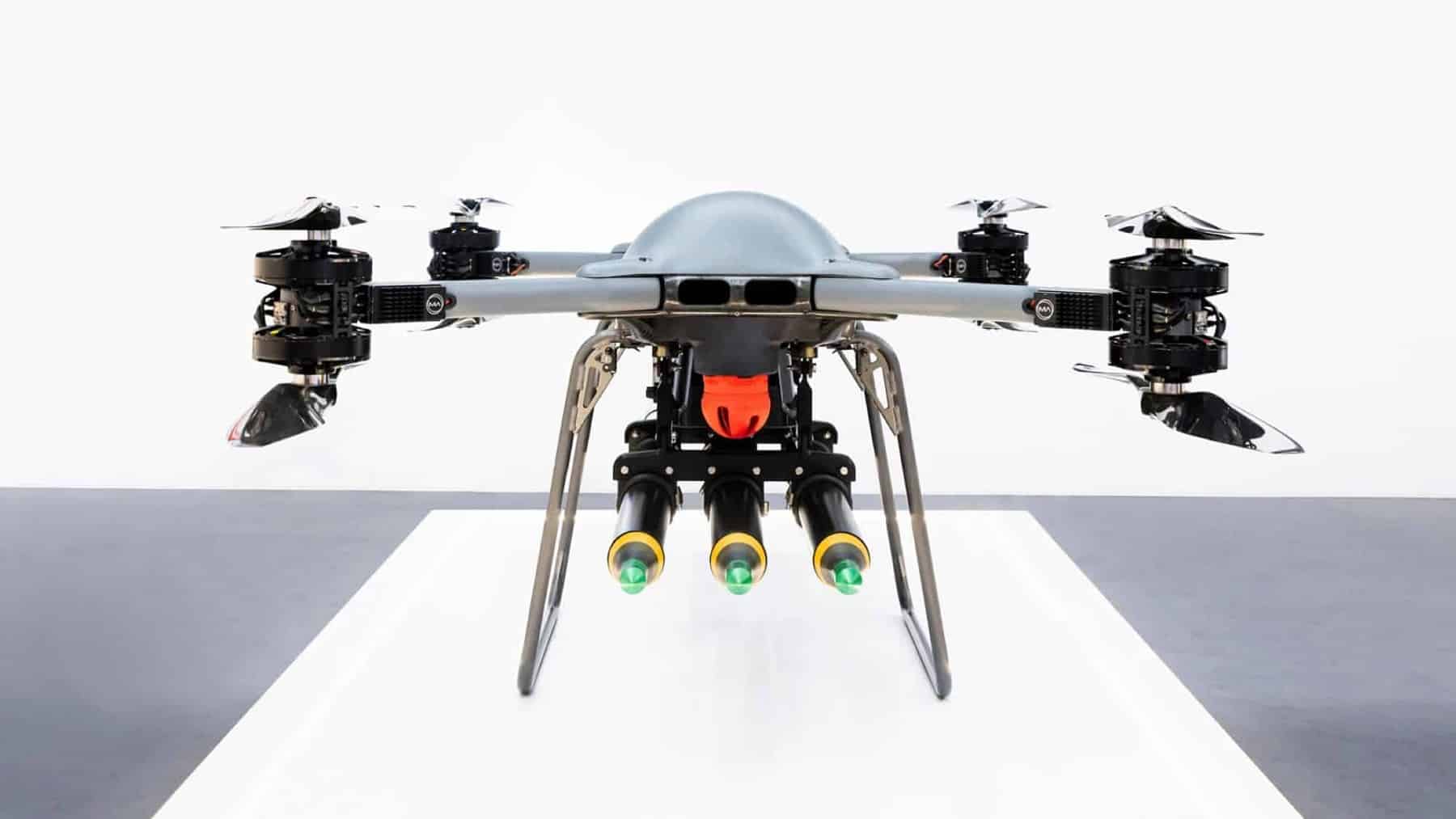
And the launcher is the news here. BAE says the one used in Florida is a production-ready three-pod unit, which means three rockets, three chances at a target, one flight.
The targets were one-way attack drones, the kind that fly into something and explode, and the T-150 engaged them one after another. BAE hasn’t said how many, and it hasn’t said at what range.
That’s a pretty big thing to leave out of a press release about shooting down drones, but we’ll get to that.
It was a delivery drone first, and still is
If you want to know why anyone would put rockets on a cargo drone instead of building a dedicated interceptor, the answer is that the cargo drone already exists and people already know how to fly it.
The Marines ordered 21 TRV-150C systems from SURVICE in April 2023, for about $8.4 million, and the Army describes it as a program of record with both services. In Britain, the Royal Navy cleared the T-150 for front-line use in September 2025, and the drone spent the Prince of Wales carrier group’s eight-month Indo-Pacific deployment last year carrying supplies between ships. Naval Technology counted nine of them on that cruise with close to 150 deck landings between them.
Rob Baltrusch, SURVICE’s chief engineer, describes it as a flying pickup truck, because it has power, data and expansion ports for whatever payload you want to plug in. The pitch for the rocket kit is basically that: same truck, different thing in the bed. BAE said last year that the launcher and rockets come off in about an hour and the drone goes back to hauling boxes.
I’d take the hour figure with some salt until somebody outside BAE times it. But the logic holds up. A battalion that already owns the drone, the batteries and the trained operators gets a counter-drone option without buying a new aircraft, which is a much easier conversation with whoever signs the checks.
The rocket is a lot older than the drone
Now seems like a good time to explain what APKWS actually is, because the name makes it sound more exotic than it is.
Start with the Hydra 70. It’s a 2.75-inch unguided rocket the US has been firing from helicopters and jets for decades, and it’s cheap because it’s dumb: you point the aircraft, you fire, and the rocket goes roughly where the nose was pointing.
APKWS is a guidance section that screws in between the rocket motor and the warhead. It has a laser seeker and little fins, and once the rocket leaves the tube it steers toward whatever spot a laser designator is painting. BAE builds it in New Hampshire.
So you get a precision weapon out of a rocket the military already has in warehouses, for a fraction of what an air-to-air missile costs. US Navy and Air Force fighters used exactly this against Houthi drones over the Red Sea in 2024 and 2025 instead of spending a Sidewinder on every target.
The catch is that laser. Somebody has to hold the beam on the target until the rocket arrives. On a jet, that’s the jet’s targeting pod.
On a hovering cargo drone, it could be a sensor on the drone itself, a second drone, or a soldier on the ground with a designator. BAE hasn’t said which one it used at Eglin, and as far as I can tell that’s the single most interesting unanswered question in the whole announcement, because it’s what decides how fast the system can react and how many threats it can handle at once.
From one tube to three in 14 months
This didn’t come out of nowhere. BAE announced the first single-shot firing of an APKWS from an adapted T-150 in July 2025, and said at the time the rocket hit an airborne drone and ground targets with zero misses. That was one rocket, one flight.
The three-tube launcher first flew and fired on May 20 of this year at Fort Rucker, Alabama. The Army’s own write-up says that test was about the boring but important stuff: whether the drone’s flight control software could handle the yaw and the kick when a rocket leaves an outboard tube on a horizontally mounted launcher. Clark Dutterer, SURVICE’s vice president of business development, told the Army the companies didn’t wait for a requirement: “We self-funded this to go ahead and do that.”
The Army’s plan from there was White Sands in June and then Eglin in September, where the system was slated to be tested in base defense and counter-drone roles against one-way attack drones. Eglin, at least, happened.
BAE hasn’t said how many it hit
What you won’t find in the announcement is a count. BAE says “multiple” and “several” and leaves it there, with no range attached and nothing about who was holding the laser. The kit doesn’t get a price either, which is a slightly odd omission for a product whose whole pitch is being cheaper than the alternatives.
BAE also noted that the photos it released with the announcement come from an earlier trial, not from Eglin. So the image at the top of this piece shows the drone with the three-pod launcher, but you’re not looking at the Florida shoot.
None of that makes the test fake. “Multiple” and “in succession” are specific enough claims that I’d assume at least two drones went down in one sortie, and probably three given the launcher. But we’ve been here before with drone weapons.
We covered an 11-foot drone boat that got a one-way drone launcher bolted to it in August with no count of how many it carries, and a 34-foot drone submarine that fired something while submerged on a Navy range with nobody saying what. Defense companies like the verb and keep the number.
Next stop is a ship’s deck
BAE says the team will now look at taking the armed T-150 to sea, which makes sense given where the unarmed one already lives. The Royal Navy has been landing these on moving ships for a year, and the Marines have had theirs since 2023. A drone that can lift off a frigate, hover a mile out and put three guided rockets into incoming attack drones is, from the looks of things, exactly the kind of cheap outer layer navies are shopping for after the Red Sea.
Whether it works at sea is a different test, and it’s not a small one. Salt, deck motion and a target coming in low over the water are all harder than a Florida range, and BAE says that’s the next thing it wants to try.
BAE Systems put the Eglin results out on October 21, 2026, roughly 20 months after SURVICE says it started paying for the project out of its own pocket in January 2025.