
Demolition’s supposed to be the fast part of the building trade. Wrecking balls, excavators chewing through drywall, a cooling tower dropping in four seconds while half the county films it. It’s loud, it’s quick, and it’s usually done by lunch.
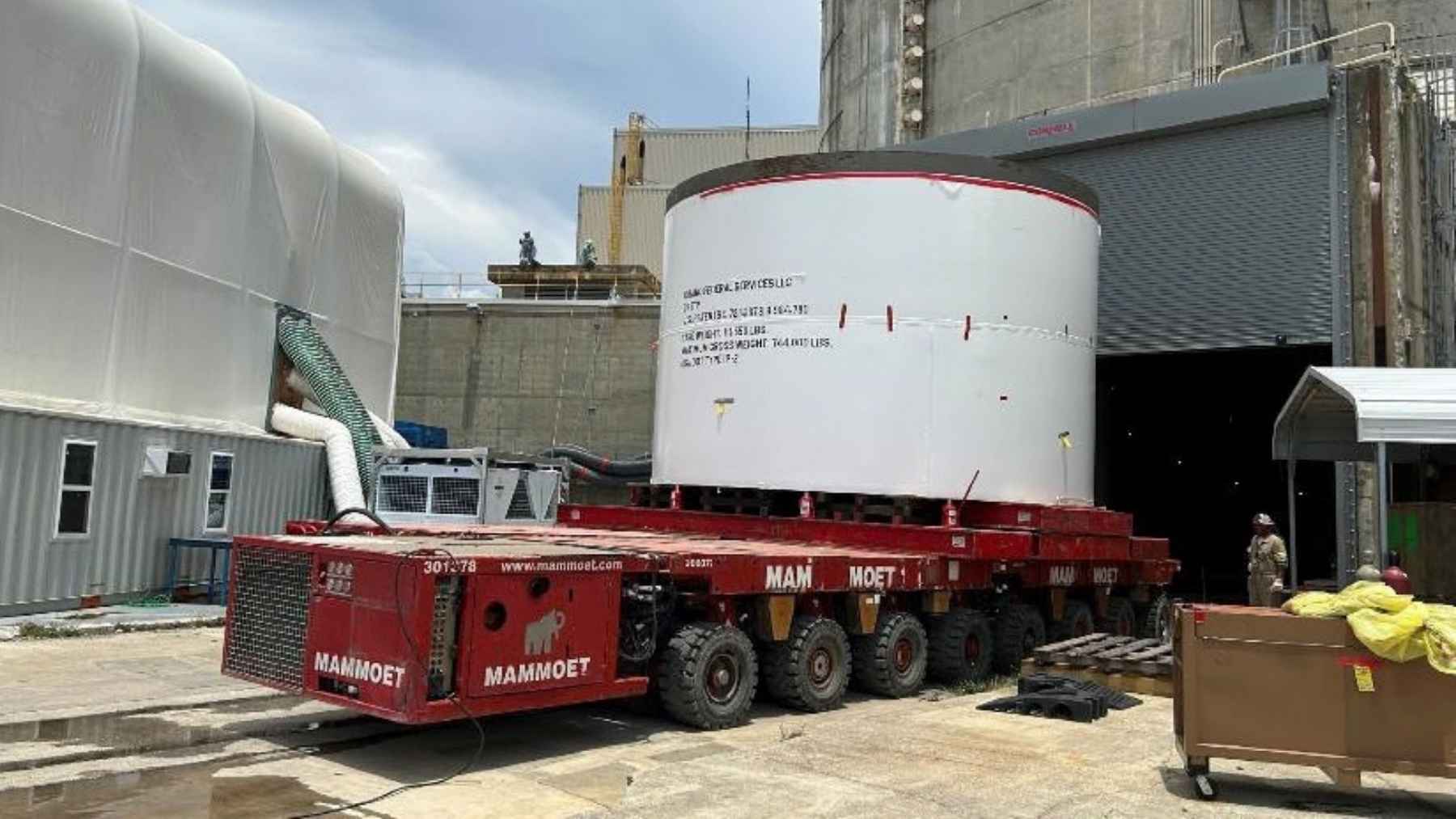
The radioactive center of a nuclear plant doesn’t get that treatment. When the heaviest piece of Florida’s shut-down Crystal River 3 reactor finally left the state, it crossed Texas at an average of 8 miles per hour, hanging between two trailers on a rig about as long as a football field, over a route planned down to which corner light posts had to come off their poles.
Orano, the French nuclear company that dismantled the reactor, wrapped up the last of those deliveries in October 2024, and they’re still probably my favorite set of heavy-haul numbers in the country. The plant itself isn’t far behind its reactor now. The paperwork to close the site’s federal license is sitting in front of the Nuclear Regulatory Commission, and I’ll get to where that stands. First, the clever part: how a nuclear reactor becomes four boxes.
So how do you cut a reactor into three pieces?
A reactor vessel’s basically a giant steel bottle. Crystal River’s stood 35 feet tall, and after 33 years of running, the components inside it were the most radioactive hardware on the property that wasn’t fuel. The fuel itself had left the building years earlier, into dry storage casks elsewhere on site.
The usual way to deal with a vessel like that is to cut everything into small pieces and ship container after container, and Orano says a traditional dismantlement can generate up to 80 transport packages. Its team at Crystal River got that down to four, with a trick that’s pretty elegant: the reactor became its own shipping container.
Crews cut up the internal components underwater and sorted them by how radioactive they were, then stacked them back inside the empty vessel in three layers. The hottest material went in the middle, the milder stuff above and below it. Steel that thick blocks radiation on its own, so the vessel doubled as the shielding around its own guts.
Then the gaps got filled with an engineered grout. Grout’s a flowable cement mix, the same family of stuff a contractor pumps under a sagging slab to firm it up. This recipe was developed specifically to harden around a reactor’s internals and lock everything into one solid mass. Once it set, the vessel and its contents weren’t separate objects anymore. Diamond wire saws then cut horizontally through steel, grout and internals in single passes, splitting the block into a top, a middle and a bottom. The head, the vessel’s lid, had come off earlier and made package number four.
There’s another answer to this problem, and it’s to skip the saws entirely. Portland General Electric famously floated the Trojan plant’s 1,020-ton reactor up the Columbia in one piece and buried it whole. Crystal River traded that single enormous move for three big ones, plus a lid.
Only one of the four needed the serious box
The sorting wasn’t housekeeping. It decided how each package was allowed to travel.
Mildly radioactive material can ship under the Department of Transportation’s industrial packaging rules, which are strict but reasonably ordinary. The hot stuff has to ride in an NRC-approved Type B package, the crash-tested, fire-tested, drop-tested category, the same regulatory family as the casks that haul spent fuel across oceans. Getting a Type B package designed and licensed is a long and, from the looks of things, expensive road, and you’d rather not walk it four times.
Because the angriest layer sat in the middle of the stack, only the middle section needed a Type B package. The top, the bottom and the head all shipped under the ordinary industrial rules. Orano says that’s exactly how its planning models predicted it would fall out.
The layering also made the middle section the monster of the group. The four packages ranged from 65 to 357 tons, and the middle was the 357.
A 303-foot rig, 32 axles and a few unbolted light posts
One barge carried all four packages across the Gulf of Mexico, from the plant on Florida’s west coast to the Texas shore. From there, a heavy-haul company called Edwards Moving & Rigging took each package by road to the Waste Control Specialists disposal site in Andrews County, in West Texas. Orano hasn’t named the port where the barge tied up, so I can’t tell you exactly where the road trip started.
The middle package is where the engineering gets fun. To spread 357 tons over enough pavement, it rode suspended between two 16-axle trailers, one at each end of a 303-foot conveyance. That’s 32 axles under a single object.
Bridges got their own procedure. The transport extended its axles with added outboard wheels (Orano calls them wing dollies), doubling the trailer’s width so the load pressed down on several lanes at once instead of one. Some corners needed light posts and road signs unbolted and set aside until the rig was through.
So why does a drive across Texas add up to 980 miles?
Because at this weight, the infrastructure picks your route for you. Heavy-haul planners work around weight-limited bridges, low wires and tight interchanges, and Orano says the middle and top packages followed a winding 980-mile path across the state, away from the main traffic corridors, at an average of 8 mph. That’s jogging pace. You wouldn’t want to be stuck behind it. Add the barge leg and the company puts each package’s full journey at more than 1,800 miles.
And the reactor’s plumbing traveled separately. Ten rail shipments carried the old coolant system to disposal: a pressurizer, four reactor coolant pumps, four motors, and the vessel’s integrated head assembly with its control rod drives.
The plant behind it is nearly gone
Crystal River 3 was an 860-megawatt pressurized water reactor that shut down for good in 2013, after its containment building was damaged during a steam generator replacement and Duke Energy decided the repairs weren’t worth the money. The decommissioning itself is run by Accelerated Decommissioning Partners, a joint venture of NorthStar Group Services and Orano USA, which took over the operating license in 2020 while Duke kept ownership of the site and the trust fund that pays for the work.
So now it’s down to paperwork. ADP filed its license termination plan with the NRC on October 15, 2025. By that plan’s own accounting, the reactor building was the only structure left standing in the old power block when the document was drafted, and the company told regulators it expected to finish the major dismantling work by the summer of 2026.
You don’t get many industries where the finish line is a government form declaring the land ordinary again, but that’s what a license termination plan is. Crystal River’s is in the queue: the NRC accepted it for a full technical review on February 26, 2026, held a public meeting in Crystal River on May 12, and collected comments on the plan through June 23, 2026.