
Britain has a funny relationship with its kettles. When a big soccer match on TV hits halftime, a huge number of people get up at pretty much the same moment, walk into the kitchen and switch one on. The grid operator actually plans for it, because all those kettles land on the system at once.
So where does all that extra power come from, that fast?
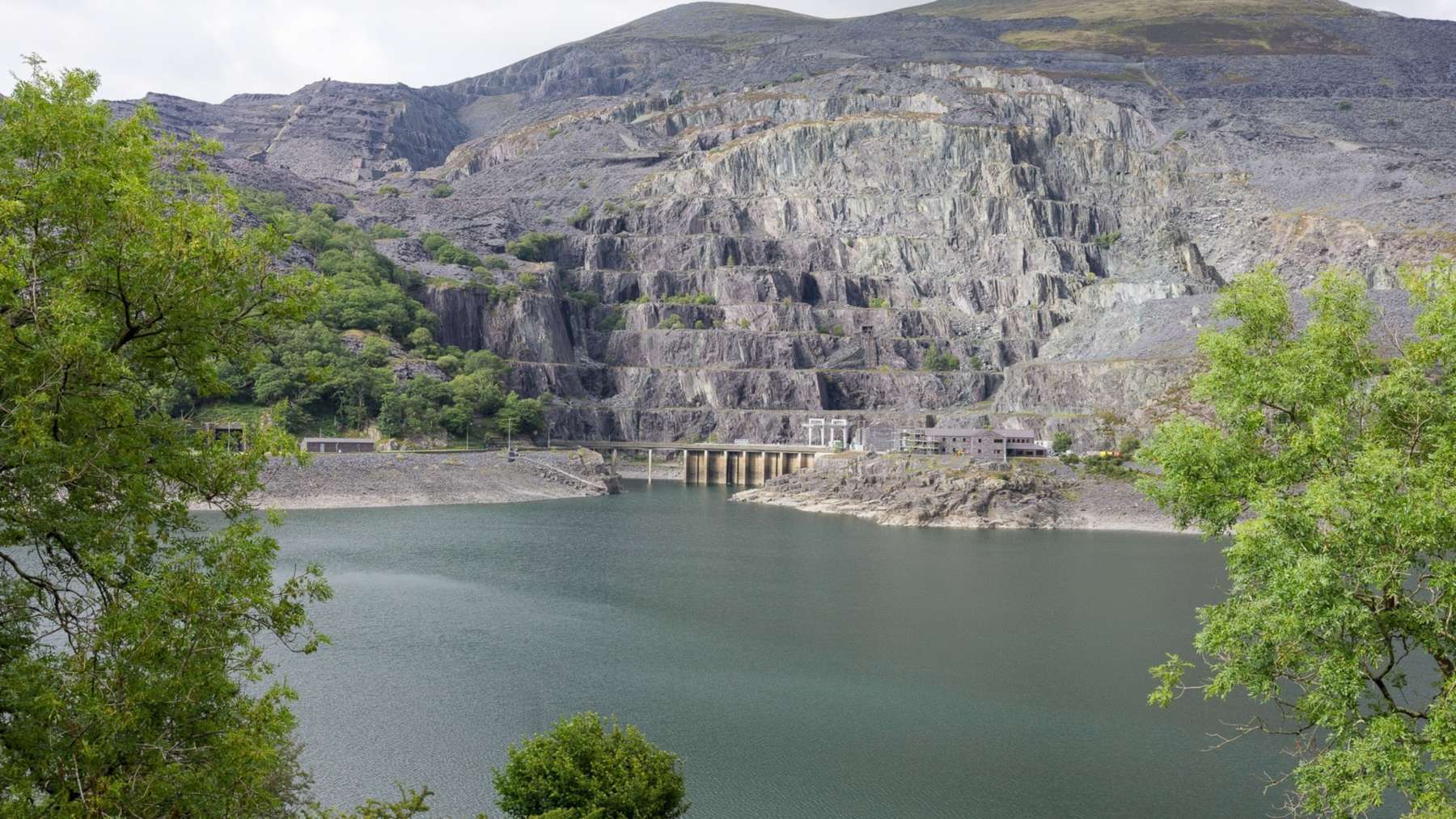
One of the quickest answers Britain has is buried inside a mountain in North Wales. Dinorwig Power Station was built on the site of an old slate quarry, deep inside Elidir Fawr, a mountain in Snowdonia National Park, and the locals call it Electric Mountain. Inside, six reversible pump-turbines can go from standby to 1,320 megawatts in 12 seconds, according to the station’s own data sheet. Most conventional power plants need minutes or even hours to get there, so this is basically the grid’s version of a drag-strip launch.
And after more than four decades of doing that, the first two machines are coming out.
First Hydro Company, the joint venture that owns Dinorwig (75% French utility ENGIE, 25% Canadian pension fund La Caisse), announced on July 28 that it had picked GE Vernova to replace the first two of the station’s six 315-megawatt units. The money was already lined up. ENGIE says the two owners approved a project of around £300 million for those two units in March, and it expects them back in commercial operation in 2028 and 2029. The other four won’t stop running in the meantime.
So how does a mountain store electricity?
Dinorwig’s basically a giant rechargeable battery made of two lakes. Marchlyn Mawr sits up top, Llyn Peris sits at the bottom, and the drop between them is close to 1,800 feet at its maximum. When electricity’s cheap and plentiful, the six machines run as pumps and push water up to the top lake. When the grid needs power, that water falls back through the same machines, and they spin as generators.
Yes, it burns more electricity pumping than it’ll ever get back. ENGIE’s figures say refilling the top lake takes about seven hours of pumping, while running the station flat out drains it in about five. That’s the toll you pay for storing electricity as water, and frankly it’s a pretty good deal when the alternative is a blackout in the middle of the evening rush.
The 12 seconds is the clever bit. On standby, the units sit spinning at full speed and already in step with the grid, with compressed air holding the water out of the turbines so they aren’t churning against anything. When the call comes, the valves open and the water hits machines that are already turning. It’s a bit like leaving the getaway car idling at the curb with the driver already behind the wheel.
I should admit the figures get a little messy here, and I’d rather you hear it from me. The July announcement from GE Vernova and First Hydro says 1,320 megawatts in 12 seconds and up to 1,800 megawatts in under a minute. ENGIE’s own page for the station says 1,728 megawatts within 12 seconds in one paragraph, then lists 0 to 1,320 megawatts in 12 seconds in its technical table a few inches further down. I’m going with 1,320, since it’s the figure both documents share.
It’s the same story with homes. The July release says Dinorwig’s capacity matches around one million UK homes, while ENGIE’s March announcement says around 1.5 million at peak output. Take your pick.
The machines live in a 590-foot cavern
Dinorwig’s machine hall is 590 feet long, 75 feet wide and up to 167 feet tall, and ENGIE puts the power station about 2,460 feet inside the mountain. ENGIE calls it Europe’s largest man-made cavern and says it’s big enough to hold St Paul’s Cathedral. If you’ve never been to London, that’s the giant domed church you’ve seen in pretty much every movie set there.
Digging out the whole scheme meant moving more than 13 million tons of rock. For scale, the hall Australia has carved out for its Snowy 2.0 project runs 823 feet against Dinorwig’s 590, but Dinorwig has been earning its keep for over 40 years while Snowy 2.0 is still getting its turbines installed.
So what’s actually coming out?
Quite a lot. ENGIE defines a unit as one complete generating set: the reversible pump-turbine, the motor-generator above it, and the shaft, rotor, controls and auxiliary equipment that go with them. Each unit can run on its own, which is why losing two doesn’t shut the station down.
Two of those complete sets are getting replaced. ENGIE says the job involves turbine and generator shafts of around 176 tons and motor-generator rotors weighing up to 507 tons. That’s somewhere around 200 full-size pickup trucks for a single rotor, give or take.
Under the contract, GE Vernova supplies new pump-turbines and new motor-generators and refurbishes what the industry calls embedded parts: the spiral case, the stay ring and the draft tube. Those are cast into the powerhouse concrete, so they get fixed in place instead of swapped. If those terms mean nothing to you, the spiral case is the snail-shaped steel shell that feeds water evenly into the turbine, the stay ring is a ring of fixed vanes inside it that holds the whole thing together, and the draft tube is the flared passage that carries the water out the bottom.
The deal came after a scale model of the new pump-turbine passed its tests at GE Vernova’s Grenoble lab in France. That’s standard practice, as far as I can tell, because big hydro turbines are basically built to measure for each site, and you’d rather find a problem in a model than in a 315-megawatt machine nearly half a mile inside a mountain. The station also gets a new control system and new power supply equipment.
What I can’t tell you is exactly when the first unit goes quiet, or how those 507-ton rotors get from the machine hall to daylight. Neither company has published a removal date, and ENGIE has only said the program needs specialist technology and lifting systems built for the job. I’d say that’s a pretty safe bet.
Why not just build a new one?
Because the UK hasn’t finished a new pumped storage plant since Dinorwig opened more than 40 years ago. Several big schemes are lining up in Scotland, including three new ones that want to share Loch Ness with a station that’s already there, but the new ones aren’t built yet.
Meanwhile, Dinorwig and its smaller sister station Ffestiniog, which First Hydro also owns, add up to 2.1 gigawatts. According to ENGIE, that’s about 74% of the UK’s pumped storage capacity and about 5% of all the country’s installed generating capacity. ENGIE has committed up to £1 billion across both stations and says it’s already spent £250 million on rebuilding Ffestiniog and on early work at Dinorwig. The stated goal, per the July announcement, is at least 25 more years of life for the plant.
Rebuilding the machines inside a hole that’s already been dug is arguably the cheapest pumped storage the UK is going to get for a while. The mountain, the lakes, the tunnels and the grid connection are all already there, so the money goes into the machines. Doing it two units at a time is pretty sensible too. You keep most of the power coming while the work’s going on. The Army Corps of Engineers is taking a similar approach with the turbines at Old Hickory Dam in Tennessee, rebuilding one unit at a time while the other three keep generating.
Emmanuel Mercier, who leads GE Vernova’s hydro power business across Europe, the Middle East and Africa, called Dinorwig “a highly strategic facility for the UK power system.” That’s pretty standard press-release language. In this case, it’s hard to argue with.
ENGIE, in its March announcement, said it expects the two rebuilt units at Dinorwig to reach commercial operation in 2028 and 2029, and it plans to keep the other four generating the whole time the rebuild is underway.