
Buying used gear at an equipment auction always comes with a little mystery. You bid, you win, and whatever’s bolted to the machine is yours now. Maybe the engine’s tired, maybe the hydraulics leak, maybe the last owner left half a wasp nest in the toolbox. A Fort Worth company that picked up a fracking blender trailer at a Texas auction last October got a surprise from a different shelf entirely: two radioactive gauges, both loaded with cesium-137.
The NRC laid the whole thing out in an event notification report published on September 21, and it’s a short read with a lot going on. On September 11, the Texas Department of State Health Services heard from Vega Americas, the manufacturer of one of the gauges, that the devices were sitting on a blender trailer owned by J-Mac Completion. The trailer, along with the truck attached to it, had been bought at an equipment auction on October 25, 2025. And J-Mac isn’t licensed to own radioactive material by Texas, the NRC, or any other state.
I keep coming back to one line buried in the middle of the report: J-Mac apparently hadn’t even accessed the trailer until recently, which is when somebody on staff finally noticed the gauges. So the cesium sat in a yard for the better part of a year before anyone knew to care. The report doesn’t say what the company paid for the trailer, and it doesn’t say whether anyone at the auction house knew what was mounted on it.
So what’s a radioactive gauge doing on a fracking trailer?
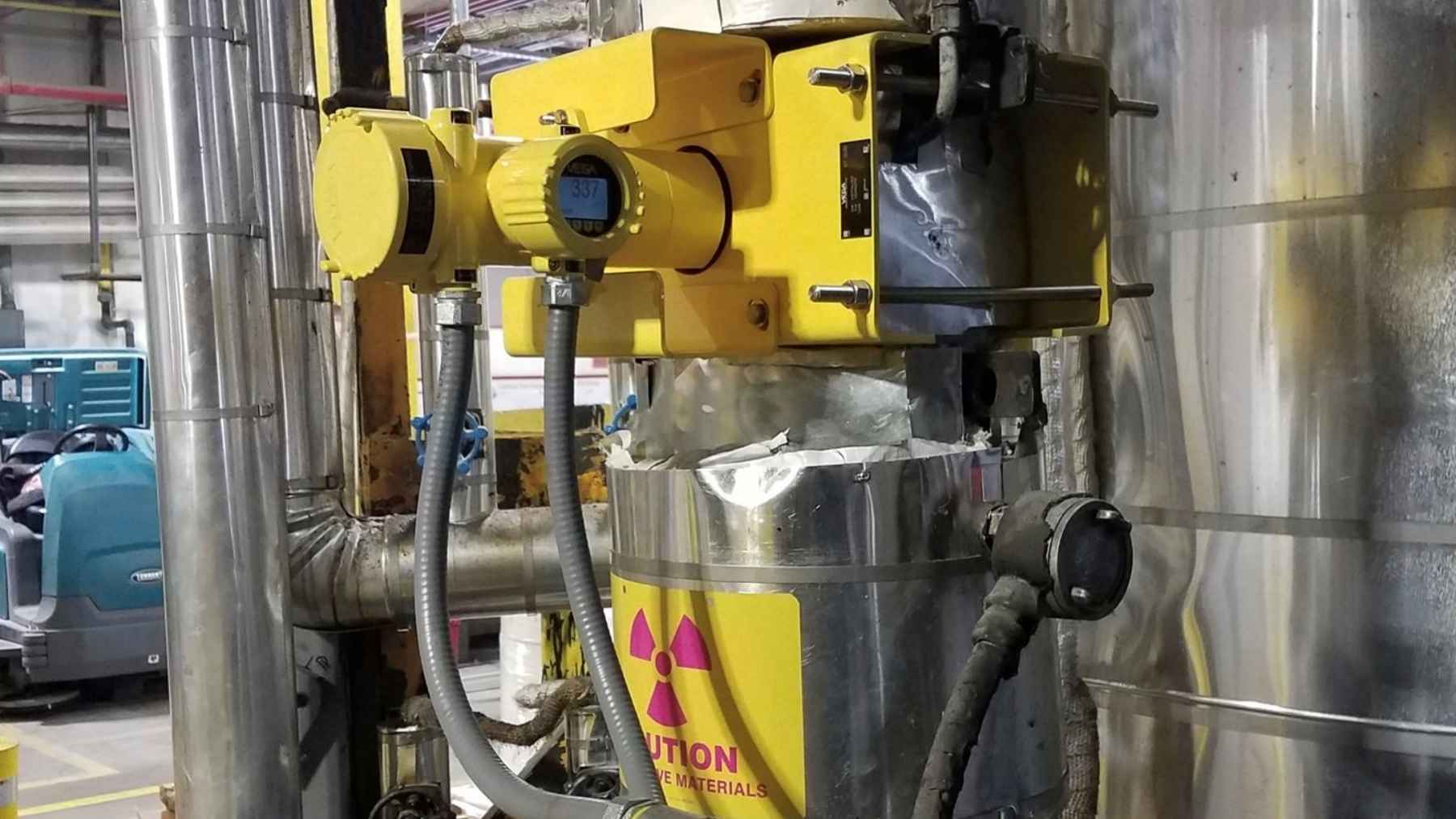
A blender trailer is the machine on a frac site that mixes water, sand and chemicals into the slurry that gets pumped down the well. The crew needs to know exactly how dense that slurry is while it’s flowing, and frac slurry is about as opaque and abrasive as industrial fluids get, so most conventional meters don’t survive it. A nuclear density gauge solves the problem without touching the fluid at all. A sealed capsule of cesium-137 sits on one side of the pipe firing gamma rays through it, a detector on the other side counts what makes it across, and the denser the mix, the fewer rays get through. Nothing wears out and nothing sits in the flow path, which is why you’ll find gauges like these all over the oil patch, on blenders, on separators, on storage tanks.
There were two on this trailer. One is a Vega SHLD-1 holding 52 millicuries of cesium-137 as of January 1, 2020. The other one took some detective work, because it had no visible markings at all. Texas only pinned it down on September 16 as a Thermo Fisher model 5192 carrying 200 millicuries, with its original activity dated July 2018. Identifying a mystery radioactive source by serial-number archaeology, close to eleven months after somebody bought it at auction, isn’t exactly how the system is supposed to work.
How does a cesium gauge end up on an auction block?
Vega’s records, as summarized by the state, trace the SHLD-1 back to NRG Energy, a power company that received it as what regulators call a generally licensed device. The general license setup works pretty much how it sounds. The NRC and state programs let companies keep certain low-activity sealed sources without ever applying for a specific license; the permission basically ships with the device, on the understanding that the owner will track it and hand it off through proper channels when the equipment moves on. If that sounds a bit like an honor system to you, we’re in agreement.
At some point the gauge was built into the blender trailer. The trailer later ended up with Catalyst Energy Services, and in October 2025 Catalyst consigned it to Machinery Auctioneers to get rid of it. J-Mac bought it at auction that same month, cesium and all. The NRC files the episode under a heading that tells you plenty about how often this happens: “found orphan gauges.”
So who dropped the ball?
The report doesn’t assign blame, and I’m not going to either; it says an investigation is in progress. But frankly, gauges riding off on auctioned equipment is a pretty predictable failure mode for a system that depends on busy companies remembering what’s bolted to their trailers years after the paperwork got filed.
How dangerous is this, really?
Less than the phrase “radioactive sources at auction” suggests, honestly. The NRC filed the event as involving less than a Category 3 level of radioactive material, and in the agency’s own description, sources in that range are very unlikely to cause permanent injury to anyone. Unshielded, a gauge of this class could possibly, though it’s unlikely, temporarily injure somebody who handled it or stayed right next to it for weeks. That’s the framework the IAEA lays out in its categorization of radioactive sources, and capsules in gauges like these live inside shielded housings anyway, since that’s the whole point of the design.
The report doesn’t give dose readings or describe the condition of the housings on this particular trailer. It does say that, based on current information, nobody has been exposed. The trailer is parked in an isolated corner of J-Mac’s facility, logged with Texas as incident I-10327.
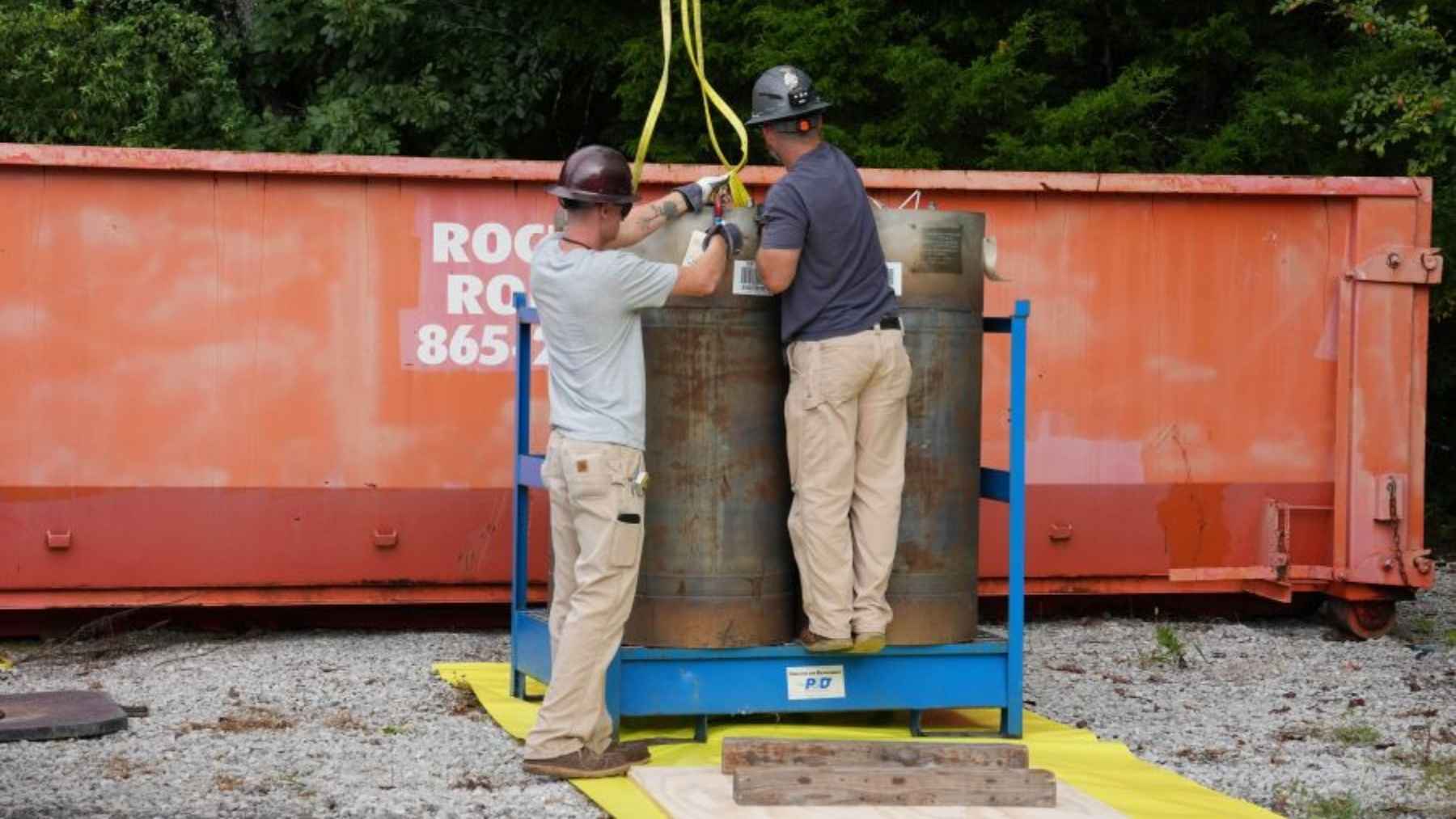
Cesium-137 gets around. It’s the same isotope packed into the capsules that force an 80-ton cask at Hanford to haul a payload that would fit in a pickup bed, and when a source travels the way it’s supposed to, it looks a lot more like a 30-gallon drum wrapped in an inch of lead than a trailer on an auction lot.
Texas confirmed the identity of the second gauge, the Thermo Fisher 5192 and its 200 millicuries, on September 16, and the state’s investigation was still open when the NRC published its report on September 21.