
There’s a decent chance a Mitsubishi is parked somewhere on your street. The three-diamond badge shows up on Outlanders and Eclipse Crosses all over the country, and most people file the brand under “reliable enough family crossover” and never think about where the name came from.
But the company that makes those cars, Mitsubishi Motors, is the young one in the family. It was spun off in 1970 from a much older and much stranger outfit called Mitsubishi Heavy Industries, which has been building Japan’s warships since the 1880s and put the A6M Zero fighter in the sky during World War II.
That older company just handed the Japanese navy something with no crew at all. Two of them, actually, and neither one carries a single sailor.
At the DSEI Japan defense show, an MHI official told the trade outlet Janes the company had built two prototype uncrewed submarines. One runs 10 meters, the other 16. The Maritime Self-Defense Force is testing the 16-meter version now. And in January, the same navy quietly took a completely separate machine into service: a batch of small, torpedo-shaped drones built to work close to shore. It showed off six of them and then said almost nothing else.
The 16-Meter Robot Mitsubishi Is Testing for the Fleet
The 16-meter hull is the one to watch. At roughly 52 feet it’s longer than a standard city bus, and per the numbers that MHI official gave Janes, it weighs 30 metric tons and can stay out for more than a week at a stretch. The 10-meter prototype is the lighter sibling: 20 tons, with a seven-day endurance.
Both run on lithium-ion batteries. Both carry a sensor fit built for one job, which is watching things. There are two sonars, an electro-optic/infrared camera and a satellite-communications antenna, and that’s the loadout of a machine meant to find submarines, ships and seabed activity, not to shoot at them. The official declined to give range or diving depth, so nobody outside the program has those figures.
The design goes back to 2023, when Japan’s defense-procurement agency, ATLA, first rolled it out at that year’s DSEI. Naval News, which got an early look at the prototype, described it as modular: a 10-meter main body that stretches toward 16 once a mission module is bolted on, 1.8 meters across, pushed by four steerable thrusters instead of a single propeller. So the two prototypes aren’t rivals. They’re the short and long configurations of the same idea.
Those mission modules are where the versatility lives. ATLA has talked about a heavy-payload module for dropping sensors and communication nodes on the seabed, an ocean-observation module for surveys, and a surface-launch module that could push smaller drones out at the top of a dive. MHI is the prime contractor, and ATLA’s own people build and test the thing at a facility in Yamaguchi.
Six Black Drones, and Not Much Else
The January delivery is the other half of the story, and it’s a different kind of machine entirely. The JMSDF confirmed on January 20 that it had taken a newly developed small UUV into service, then posted images of at least six of them, black and torpedo-shaped, lined up at a location it declined to name.
It did not release specifications. What analysts had to go on was the shape and the width. The drones look to be about 533 millimeters across, the same diameter as a modern heavyweight torpedo, which is why naval analysts told Newsweek the things can probably be fired from and recovered by a submarine’s torpedo tube. That’s an inference drawn from the hardware, though, not a spec sheet from the navy.
What the navy did spell out is what they’re for: underwater reconnaissance, keeping watch over sea lanes, and protecting ports and undersea infrastructure. The design and the language both point at surveillance rather than weapons.
One thing the coverage sometimes blurs is that this isn’t Japan’s first home-built underwater drone. The navy already runs the MHI-made OZZ-5 for hunting mines, and last June a Mogami-class frigate ran a mine-countermeasures trial with an indigenous surface drone and one of those UUVs. The new part is the size and the launch method: a submarine-deployable drone small enough to leave through a torpedo tube. The program dates to 2019 and split the work between two builders, Ishikawajima-Harima for one design and Mitsubishi for the other, so which of them built the six on display isn’t actually confirmed.
Japan Isn’t Only Chasing Range. It’s Running Short of Sailors.
Most navies want uncrewed submarines for the obvious reasons. Take the people out and the hull no longer needs air, food or escape hatches, so it can spend that volume on batteries and sensors and go places you’d never send a crew.
Japan has all of those reasons and one more that it says out loud. When ATLA walked Naval News through the program, it framed the drones partly as an answer to demographics. An aging population and a falling birth rate are making it harder to crew submarines, and harder to train the people who would. A robot that patrols on its own doesn’t need a watch bill.
That’s a genuinely different starting point. The US and China are building undersea drones mostly to reach farther and hide better. Japan is building them, in part, because it may not have enough hands to run the boats it already has.
It also explains why the endurance numbers are where they are. Seven days is a lot for a battery-only boat, but it’s not months. ATLA has said it wants to move the bigger drone off pure lithium-ion and onto air-independent or diesel-electric power to stretch that out, which is the same jump the US Navy’s Boeing Orca made to hit ocean-crossing range.
The Undersea Race Japan Just Showed It Can Build Both Ends Of
None of this is happening in calm water. China has been building extra-large uncrewed submarines in the 15-to-20-meter range and testing far bigger ones, part of a broader push to wire the Pacific seabed with sensors that we dug into in its plan to make American submarines visible. The US Navy, meanwhile, just got the hard half of the torpedo-tube trick working, launching and recovering a drone from a submerged attack sub without a diver in the water, which we covered when L3Harris put the Iver4 900 to sea with Virginia-class boats.
Japan’s contribution is quieter, but it points somewhere specific. Tokyo can now build both ends of that range itself: a small torpedo-tube drone for close-in work, and a bus-length, long-endurance machine for the open ocean, both domestic, no foreign kit required. That matters for a country that has made a point of building its own submarines, and that was the first navy to put lithium-ion batteries into operational boats in the first place.
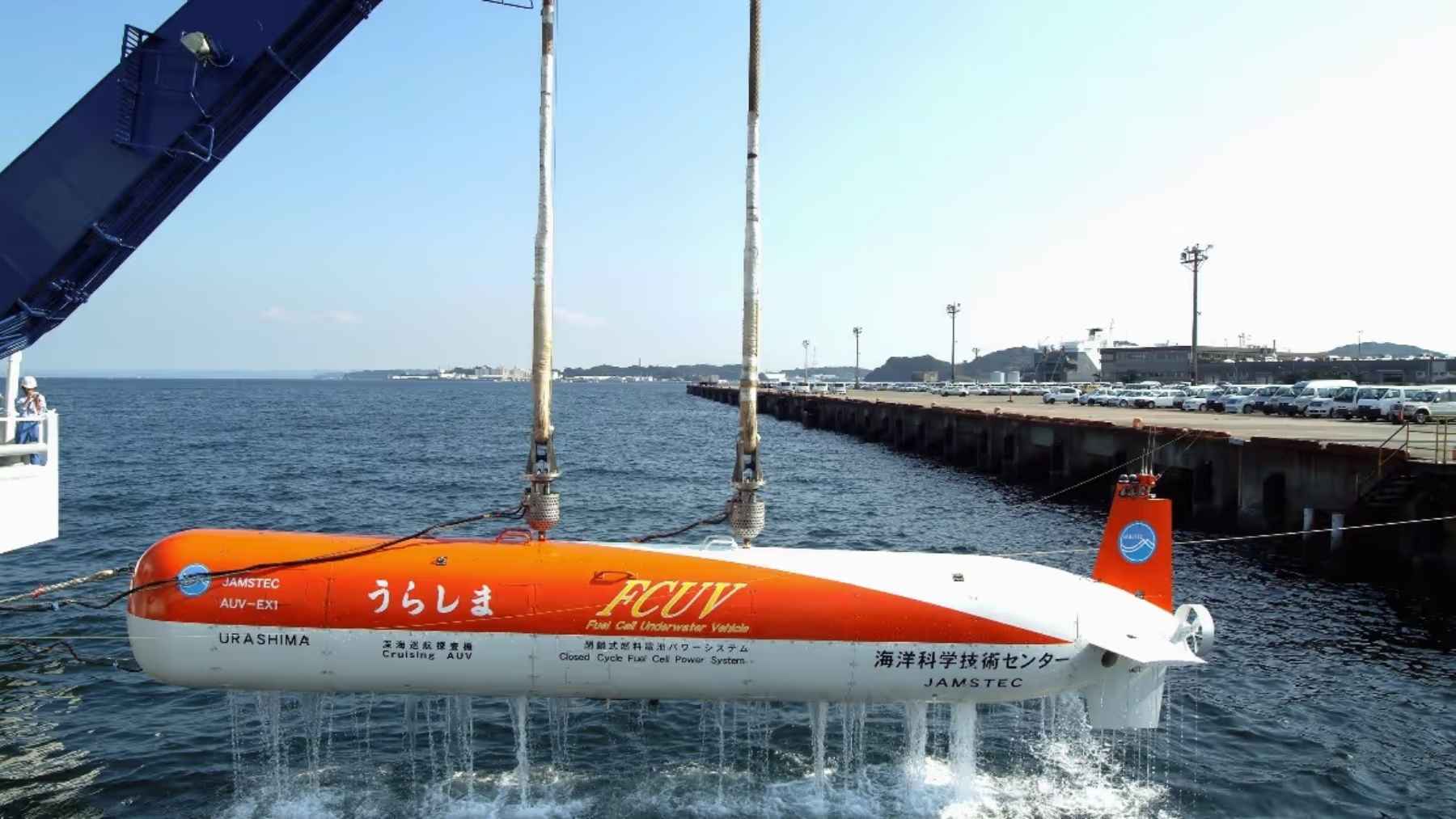
It’s the same instinct behind Japan’s other big underwater bet, a deep-sea drone meant to go 6,000 meters down and pull rare earths off the seabed that China currently controls. Different mission, same read: Tokyo would rather build the robot than buy it.
What’s Solid and What Isn’t
There are real limits on what anyone can say here yet. MHI’s 16-meter boat is still a prototype in testing, with no confirmed range or diving depth. The six small drones showed up with a photo op and almost no data, and even their torpedo-tube capability is an educated guess off the hull diameter. Nobody outside the program can tell you how well any of it actually works.
But the direction is hard to miss. The company whose badge sits on a crossover in your neighbor’s driveway spent the last century building Japan’s warships, and the newest thing it’s building for the navy doesn’t need a crew at all. It’s just doing it without asking anyone else for the parts.