
The usual picture of deep-sea mining is a giant tractor crawling along the ocean floor, sucking rocks up by the ton and pumping them four kilometers to a ship on the surface. That picture is accurate. It’s how the company furthest along in this business intends to operate, and it’s the version we’ve written about before.
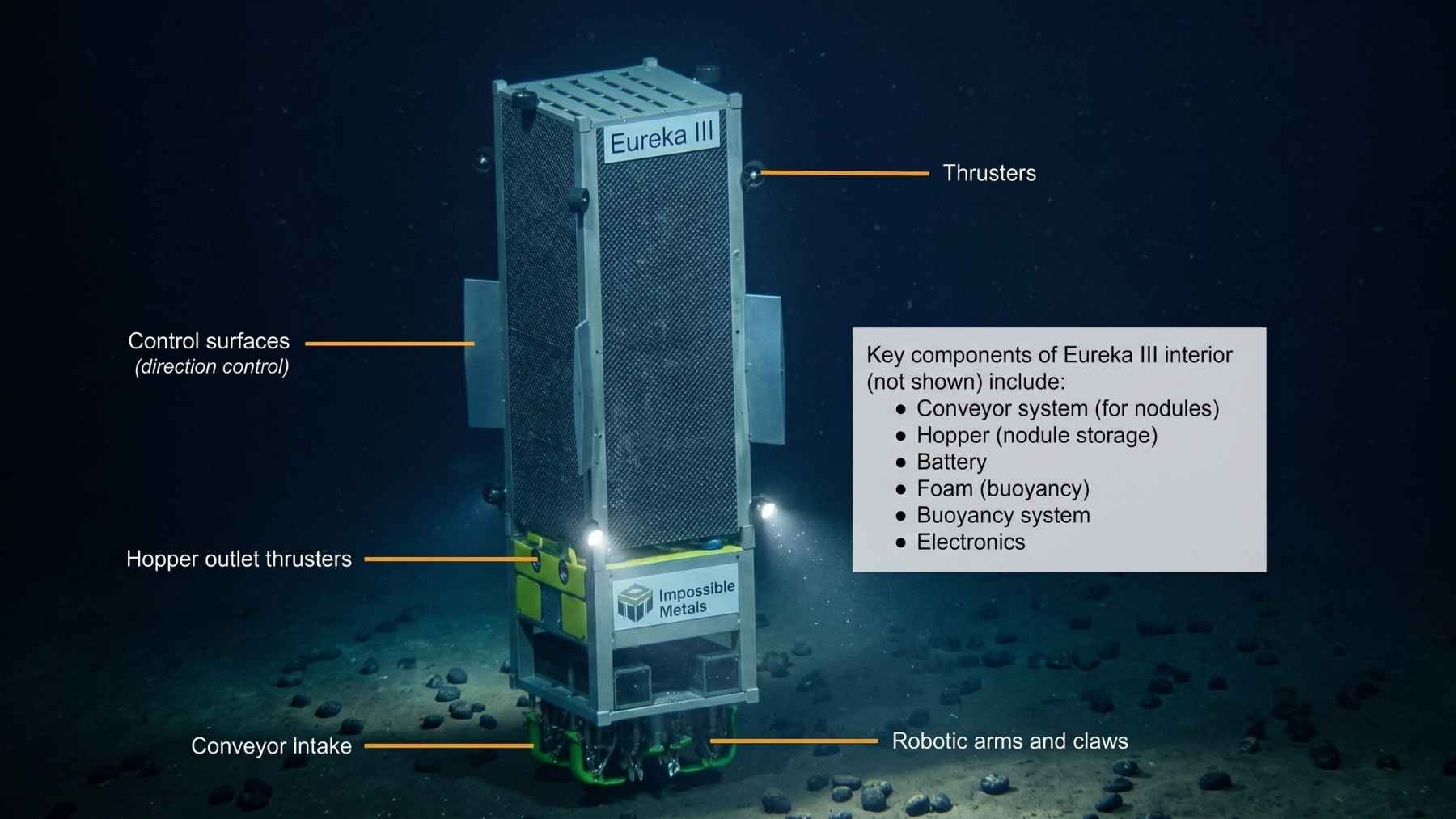
A California outfit called Impossible Metals is betting on the opposite of a vacuum. Its collector, Eureka III, is roughly the size of a 20-foot shipping container. It hovers above the seabed instead of landing on it, and it uses cameras and 16 robotic arms to pick up nodules one at a time.
It’s also built to leave a large share of them behind on purpose, including the ones with visible life attached.
That design would be a footnote if the same company hadn’t dragged Washington into the deep-sea mining question. Impossible Metals is the reason the U.S. is now moving toward its first offshore mineral lease sale in more than three decades, and the federal government has floated holding it as early as this August. So the surgical robot isn’t just an engineering curiosity. It’s the calling card of the firm that reopened American seabed mining, even though the robot itself hasn’t passed its big ocean test yet.
The robot is built to leave rocks on the floor on purpose
Start with the machine, because it’s the whole pitch. Eureka III is what the company calls a selective harvesting vehicle, and “selective” is the operative word. Older seabed collectors drive along the bottom and scrape or suction whatever is in their path. Eureka III doesn’t touch down at all.
It stays buoyant above the floor, scans it with computer vision, and reaches down with individual arms to grab nodules it decides are worth grabbing. The company says the system can spot nodules with living organisms on or beside them and skip those. In its own words, the collector “hovers over the seafloor… to pick up the nodules individually.”
The jump in hardware is real. Eureka II, the previous version, had three collection arms. Eureka III has 16. It’s the first production-sized vehicle the company has built, and it’s meant to eventually work in fleets rather than one machine at a time.
Purpose-built seabed robots are suddenly everywhere. New Zealand recently dropped a 16-ton machine that walks on two rotating steel corkscrews to shave invasive seaweed off its own seabed. Impossible Metals wants to do something far more delicate: pick up individual rocks four kilometers down without stirring up the floor underneath them.
Then there’s the part that sounds backwards for a mining machine. During its planned test, Eureka III is set to run in two modes. One collects 90% of the nodules in its path. The other collects only 50%. The company’s actual business math assumes it collects about 70%.
Leaving 30% or more of the payload on the seafloor isn’t a bug. It’s the environmental argument, on the theory that a floor that keeps some of its rocks keeps more of the life clinging to them.
That last part is the company’s design goal, not a proven result. Whether hovering and skipping half the nodules actually protects the ecosystem is exactly what the test is supposed to measure, and the measuring isn’t being done by the company. More on who’s holding the stopwatch shortly.
To see why any of this matters, it helps to look at the machine on the other end of the spectrum. The industrial-vacuum approach we looked at earlier, the one furthest along commercially, is essentially a big collector that crawls the seabed and sends nodules up a riser pipe by the thousands of tons.
That method is faster and cheaper per rock. It’s also much harder on the seafloor it drives across. Impossible Metals is arguing the opposite trade: slower and pricier per ton, but lighter on the bottom.
Why anyone is vacuuming the Pacific floor in the first place
The rocks everyone is after are polymetallic nodules, potato-sized lumps scattered across the abyssal plain that grew one atomic layer at a time over millions of years. They’re valuable because of what’s packed inside: nickel, cobalt, manganese and copper, the core ingredients of most EV batteries.
That’s the connection to your driveway. The same metals that go into an electric car’s battery pack sit on the seafloor in concentrations that, by some estimates, beat a lot of land deposits. And right now the refining and much of the supply of those metals runs through China, which is the political nerve this whole industry is pressing on.
It’s why you’re seeing a scramble for any source that isn’t a conventional China-linked mine, from bacteria eating century-old mining waste in Ontario to robots crawling the deep Pacific. The seabed is just the most extreme version of that search.
The company that dragged Washington into this
Here’s where Impossible Metals stops being one more startup with a robot. In April 2025 it asked the U.S. Bureau of Ocean Energy Management to open a commercial leasing process for critical minerals off American Samoa. It was the first such request in more than 30 years. The agency hadn’t run a competitive mineral lease sale since 1991.
That same month, President Trump signed an executive order directing the Interior Department to fast-track seabed mining permits on the U.S. outer continental shelf and in international waters. According to a Congressional Research Service overview, the machinery moved quickly after that.
BOEM identified roughly 18 million acres off American Samoa for possible leasing. In early 2026, NOAA hired a contractor for a roughly $20 million survey to map more than 30,000 square nautical miles of that seabed, with fieldwork starting that February.
By spring, the Interior Department had signaled it could hold the first lease sale as early as August 2026, and U.S. Geological Survey scientists had already pulled up nodule samples from federal waters off American Samoa. No lease has actually been issued yet. But the process Impossible Metals kicked off is now the furthest-along seabed mining effort in U.S. history.
The big test that keeps sliding
For all the momentum on the regulatory side, the robot at the center of it hasn’t done the one thing that would settle the argument: mine at depth, in the open ocean, while independent scientists watch.
The plan was to run Eureka III in Germany’s licensed exploration area in the Clarion-Clipperton Zone, a stretch of Pacific seafloor roughly 4,200 meters down. Germany’s federal geoscience institute, the BGR, would handle the environmental monitoring from the research vessel SONNE while the company ran the collector from a separate ship, according to trade outlet Ocean Mining Intel.
The test site was deliberately chosen to overlap a control area where an older tractor-style collector, GSR’s Patania II, ran back in 2021. That way, the two very different techniques could be compared on the same patch of ground.
The catch is the timing. That test was supposed to happen in early 2026. It isn’t happening in 2026. The company postponed it in February 2025, and its own description of the program now says the test will take place in 2027 or 2028. Environmental groups jumped on an earlier line from the company that the technology wasn’t ready.
There’s a modeling result the company points to while the sea test waits. An outside firm, DHI, ran a sediment plume model for the small test and predicted that the disturbed sediment would stay within about five meters of the seafloor, with more than 93% of it settling back inside the mined area. That’s an encouraging number. It’s also a prediction, not a measurement, which is the whole reason the real test matters.
A new CEO, a rival with a signed deal, and a fight it hasn’t won
In May 2026 the company changed leaders. Founder Oliver Gunasekara, who had been CEO and the public face of the American Samoa push, stepped aside for Granger Whitelaw, a serial entrepreneur brought in to scale the operation. The company reframed itself around precision over traditional scale-based approaches, which is a tidy way of restating the whole surgical-versus-vacuum bet.
The bet is far from safe, because the vacuum camp is ahead. The Metals Company, the industry’s most advanced player, signed a commercial agreement in May 2026 with offshore contractor Allseas for what the two call the first offshore nodule recovery operation, and it plans to move metal by the megaton. Impossible Metals, by contrast, is still raising money to scale and still owes the world a working sea test.
The pushback is loud, too. American Samoa itself enacted a moratorium on deep-sea mining in its own waters in July 2024, citing threats to marine life and its tuna fishery. The federal lease area Impossible Metals is chasing sits just beyond those protected territorial waters. Greenpeace USA characterized the federal lease bid as a reckless, desperate move to prop up a struggling industry.
And scientists estimate that more than 90% of the species in zones like the CCZ have never been formally described, which makes “low impact” a hard thing to prove in either direction.
So the state of play is a little strange. The more palatable machine, the one that hovers, sees, and leaves half the rocks and the life behind, belongs to the company that opened the door in Washington but hasn’t proven its hardware in the deep. The less palatable machine, the vacuum, is the one with the signed contract and the head start. And the metals both of them are chasing still mostly run through the country everyone is trying to route around.
Whether a robot with 16 careful arms can compete with a machine built to swallow the seabed whole is a real question, and it won’t get answered in a press release or a plume model. It gets answered four kilometers down, on a test that’s already slipped twice. As it stands, the most advanced thing about America’s newest seabed miner is the paperwork.