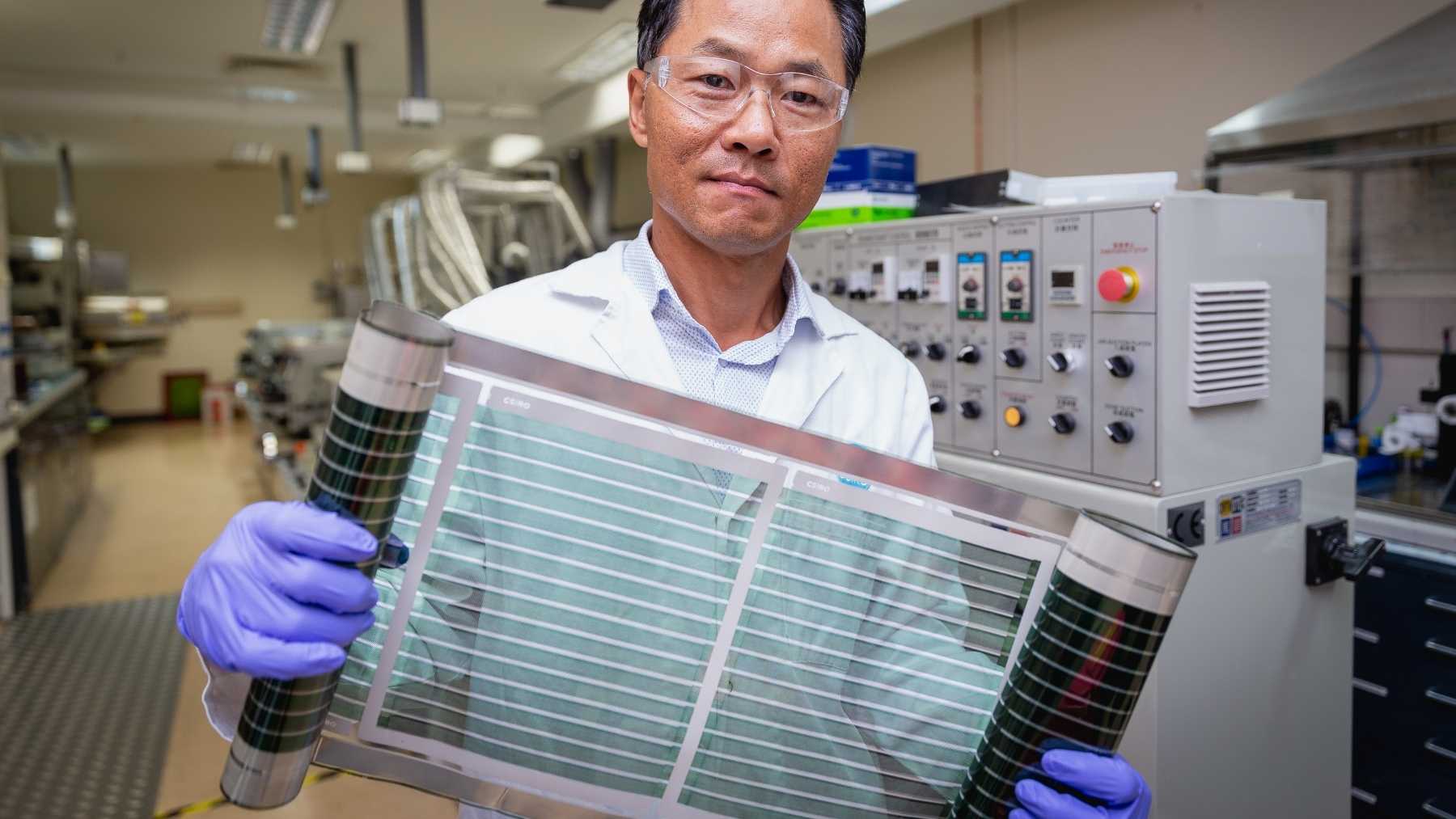

The solar panel you’re picturing right now is probably a slab of dark blue silicon behind a sheet of glass, bolted to a roof and heavy enough that nobody moves it once it’s up there. That’s the version doing the heavy lifting on rooftops across the US and Australia, and it isn’t going anywhere.
But in a lab in Clayton, just outside Melbourne, Australia’s national science agency has spent more than a decade building a completely different kind of solar cell, one that comes off a roll, prints onto plastic film, and weighs almost nothing.
The agency is CSIRO, the Commonwealth Scientific and Industrial Research Organisation, and the pitch is exactly as odd as it sounds: solar cells printed onto thin plastic in roughly the same way the country prints its plastic banknotes.
The cells are flexible enough to roll up, light enough to clip to a backpack, and made without any of the gold that usually hides inside a high-end solar cell. In March 2024 the team published a result in Nature Communications that set an efficiency record for a fully printed cell. It’s a real milestone. It’s also nowhere near ready to replace the panels on your roof, and CSIRO is the first to say so.
The cells come off a printer, not a furnace
Conventional silicon solar starts with sand that gets purified and melted at temperatures well over 2,000°F, then sliced into rigid wafers. CSIRO’s approach skips all of that. The cells are built around perovskite, a class of light-absorbing material that can be mixed into an ink and run through an industrial printer the same way a newspaper or a polymer banknote gets printed. CSIRO’s printed solar program spells the process out: every layer of the device is printed from inks, onto a long continuous roll of plastic, using a technique called roll-to-roll.
Two things make that interesting. First, CSIRO swapped out the gold and silver electrodes that show up in a lot of perovskite research for cheaper carbon-based inks, which knocks a chunk off the cost without tanking performance. Second, the whole thing runs in ambient room conditions instead of a vacuum chamber, which is a big part of why it can be done on a printer at all. Skipping the furnace also means far less energy goes into manufacturing than into melting and purifying silicon.
To dial in the recipe, the team built an automated system that cranks out and tests more than 10,000 cells a day, the kind of brute-force screening that would be impossible by hand. The record itself came out of an international effort, with researchers from the University of Cambridge, Monash University, the University of Sydney and the University of New South Wales pitching in.
11% doesn’t sound like much, and that’s the catch
Here’s the honest part. The record CSIRO set was 15.5% efficiency on a single small cell and 11% on a larger module measuring 50 square centimeters. A decent silicon rooftop panel converts somewhere around 20% or more of the sunlight hitting it, so on raw efficiency, printed perovskite is still playing catch-up. Perovskite cells also trail silicon on lifetime when they’re produced at scale, something Dr Anthony Chesman, who leads CSIRO’s Renewable Energy Systems Group, has openly acknowledged.
So why is 11% a headline at all? Because the previous benchmark for a fully printed flexible cell sat at around 1 to 2%. Going from 2% to 11% on a module you can print on a roll is the difference between a science-fair curiosity and something an actual manufacturer might look at. The efficiency gap with silicon is real, but it matters a lot less once you stop trying to use these cells for the job silicon already does well. The numbers behind the record put the leap in context:
A panel you can roll up goes places a glass one can’t
Strip away the efficiency contest and the appeal gets obvious. A rigid silicon panel is about as portable as a kitchen counter. Great on a roof, useless if you need power somewhere a roof isn’t. CSIRO’s film can be rolled up, packed into a shipping container, and unrolled on site, which opens up a list of jobs silicon was never going to take: mining operations in the middle of nowhere, disaster relief, construction sites, defense, and wearable electronics.
The agency has shown the film embedded in a backpack and talks about printing it in different colors and even semi-transparent versions for building facades. These aren’t the only researchers reimagining what a solar surface can be either; a separate team recently built a black metal panel that turns seawater into drinking water using nothing but sunlight.
The most extreme test so far happened off the planet entirely. In March 2024, CSIRO’s printed flexible cells launched into orbit aboard Optimus-1, billed as Australia’s largest privately built satellite, made by Space Machines Company. The point was to see whether film this light could survive the brutal conditions of space and still generate power, which would be a serious advantage over heavy silicon arrays for future missions.
CSIRO space program director Dr Kimberley Clayfield framed it as a possible lightweight energy source for satellites and exploration, assuming the orbital performance holds up to what the lab has already seen on the ground.
The $6.8 million machine outside Melbourne
For years this was a lab project, and lab results have a way of staying in the lab. That changed in October 2024, when CSIRO opened a AU$6.8 million (US$4.47 million) Printed Photovoltaic Facility at its Clayton site, co-funded with the Australian Renewable Energy Agency through the Australian Centre for Advanced Photovoltaics. The federal Minister for Industry and Science, Ed Husic, did the honors at the opening.
The facility’s whole reason to exist is to bridge the gap between a working cell and a product a company can actually manufacture. It runs a pilot-scale roll-to-roll line that prints, coats and laminates in a single continuous pass inside a climate-controlled clean room, and can produce modules around 30 centimeters (roughly a foot) wide, cut to whatever length is needed. Chesman called it a critical link between research and industry fabrication.
The same building is also set up to work on printable materials for batteries and hydrogen, so flexible solar isn’t the only thing that might come off those rollers. What CSIRO doesn’t have yet is the part that turns all of this into a business: commercial partners. The agency has spent the past two years openly fishing for them.
It isn’t trying to beat the panels on your roof
It’s worth being clear about what this technology is and isn’t, because “solar cell breakthrough” headlines tend to imply your roof is about to get cheaper. It isn’t. Chesman has been blunt that printed flexible solar is “not intended to replace silicon rooftop panels, but rather to complement them.” Silicon still wins on efficiency, lifetime and cost-per-watt for the big, stationary, decades-long job of powering a house, the same job Tesla’s glass roof tiles were chasing, with mixed results. Printed film is going after the gaps silicon leaves open.
There’s also a hard industrial reality behind the push. According to figures from Wood Mackenzie cited by PV Tech, China is on track to control more than 80% of the world’s solar manufacturing capacity through 2026. Australia isn’t going to out-scale that on silicon. A printable technology that runs on existing printing equipment and cheap carbon inks is a way to carve out a niche the giants aren’t focused on, rather than a head-on fight CSIRO would lose.
None of this lands as a revolution you’ll notice next week, and the 2024 milestones it rests on are the same ones still doing the talking, a sign of how slow the road from a record cell to a real product can be. What CSIRO has actually built is a way to put solar where a sheet of glass can’t follow: onto a tent, a backpack, a mine site, the skin of a satellite.
Whether that grows into an Australian manufacturing industry or stays an impressive pilot line comes down to whether enough partners decide a foot-wide roll of printable sunlight is worth betting on. CSIRO has the printer running and the door open. The rest is up to whoever walks through it.















#WASA* 🇭🇲 , #NASA 🇺🇸
**BBC***🇷🇴🇪🇺🇭🇲
17/07/2026 Perth WA 🇦🇺