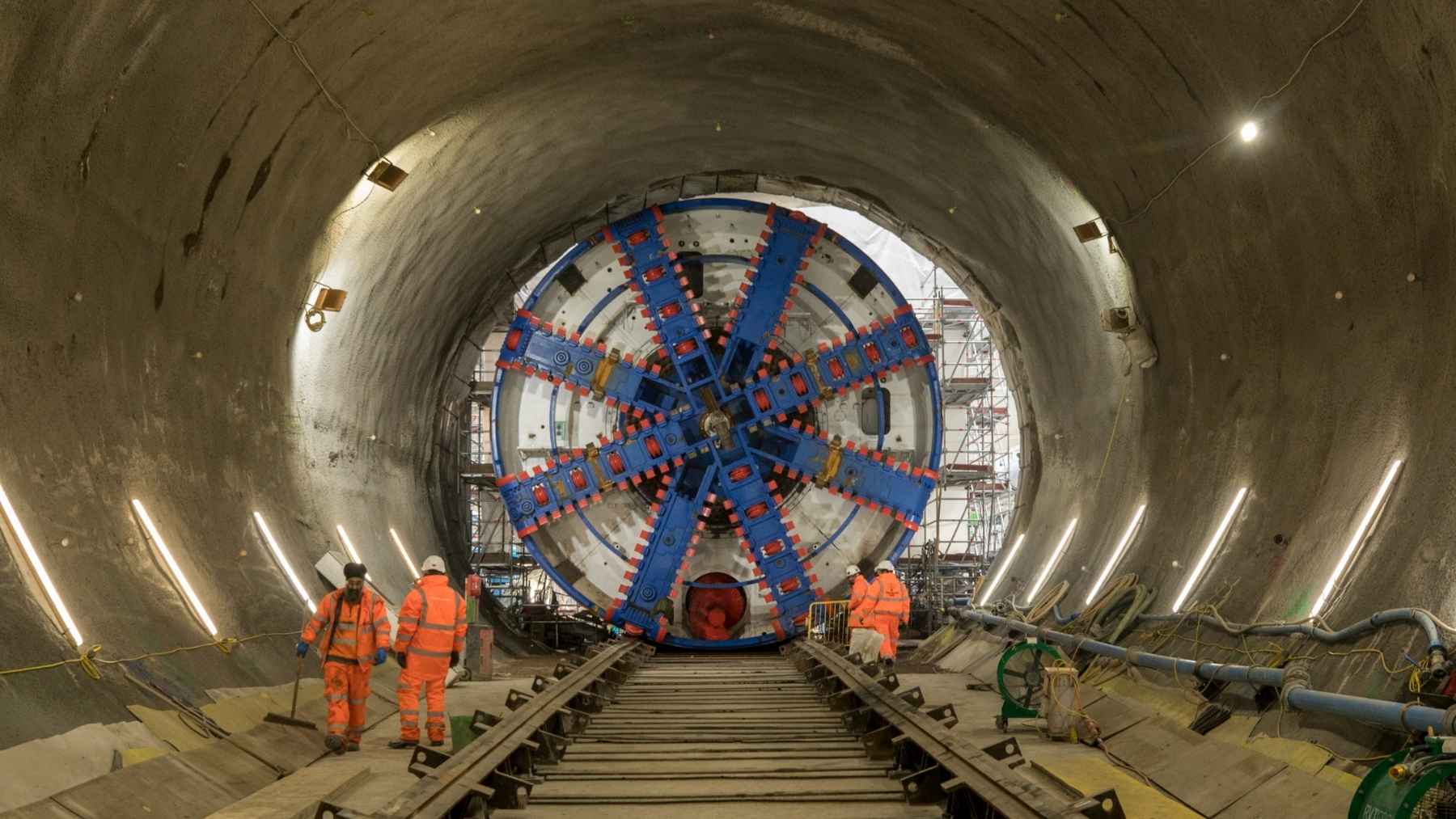

When a tunnel makes the news, it’s almost always because of the machine. Something the length of two football fields, built in Germany, lowered into a pit in pieces and bolted back together at the bottom. Two of them are grinding under London right now, named Madeleine and Karen.
Those machines only build the long tubes. They can’t build the short passages that connect one tube to the other, and those are the passages you’d be walking down if a train ever caught fire underneath a city.
To build 11 of them under west London, HS2’s contractors didn’t bring in a cutting machine at all. They brought in a refrigerator.
HS2 announced in April that all 34 cross passages on its Northolt tunnel are finished. Eleven of them, every one in the western half of the drive, were mined out of ground that engineers had deliberately turned to ice first.
Cross passages are the one part the machine can’t build
A twin-bore tunnel is two parallel tubes. Trains run one way in one and the other way in the other, and when something goes wrong in one tube, the other tube is the way out. Moving people across is the entire job of a cross passage.
The catch is that nothing about them is automated. A boring machine works behind a shield, holding the ground up with pressure while it bolts a concrete ring into place behind itself. A cross passage has no shield and no ring. Crews cut a hole in the side of a finished tunnel and mine sideways.
On the Northolt tunnel that sideways distance runs anywhere from 20 to 66 feet, per HS2. The tool is a mini-excavator. Every meter of ground they take out gets sprayed with concrete before they take out the next one.
In London clay that’s fine, because clay stands up on its own. The eastern half of the Northolt drive is clay, and those cross passages went in with no ground treatment whatsoever.
The western half is sand, and the water table sits on top of it.
Brine at 26 below, until the sand becomes the wall
Saturated sand does not stand up. Cut into it and it comes at you: water first, then the sand, then whatever the sand was holding up, which in this case is a chunk of Ealing.
The usual fixes weren’t available. Jet grouting and permeation grouting both got ruled out, partly because there was no surface access to work from and partly because the soils were too fine, according to Geoengineer.org’s write-up of the contractors’ own account of the job.
So they froze it.
The concept is almost stupidly simple. Drill a ring of pipes around the outside of the hole you want. Push coolant through the pipes. Each pipe grows a cylinder of frozen ground around itself, the cylinders keep growing until they touch, and where there was wet sand there is now a continuous wall of frozen earth.
Then you dig the tunnel out of the inside of it.
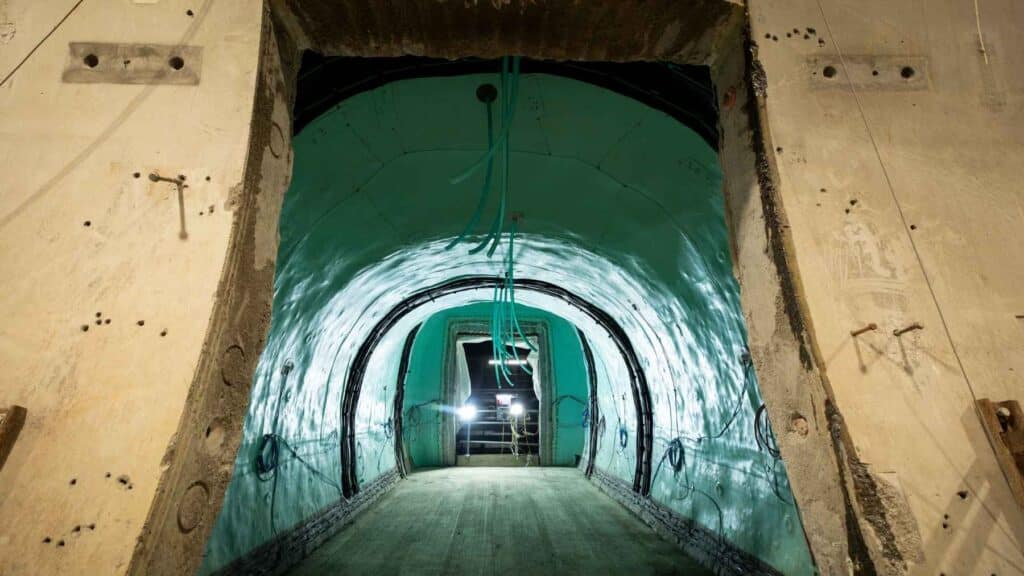
On HS2 the coolant was brine, chilled to roughly minus 32 Celsius, or about 26 below zero Fahrenheit, and pumped around a closed loop. The finished freeze wall came out about 2 meters thick, call it 6.5 feet, and it only had to hold at minus 10 Celsius (14°F) to be strong enough to mine against.
Nothing gets injected. The brine never leaves the pipes, the soil chemistry is untouched, and when the job ends the groundwater goes back to doing exactly what it was doing before. That closed loop is a large part of why the technique keeps winning jobs in places where a regulator would have opinions about grout.
The freeze pipes went in through purpose-built segments in the tunnel lining, drilled at an angle from inside the finished tube. And because the boring machines had wandered off their design line by up to 150mm on the way through, roughly six inches, every freeze pipe layout had to be drawn for its own specific location instead of copied off a standard.
The concrete had its own argument with the ice. Shotcrete does not naturally want to bond to a frozen face, and the standard rule was that crews couldn’t go back into the excavation until the sprayed lining hit 10 MPa, which takes 24 hours. By testing what the stuff was actually doing in place, the team proved 2 MPa was enough, and 2 MPa arrives inside three hours. That’s most of a day clawed back per cycle, eleven times over.
Miners have been doing this since the 1880s
None of it is new. It’s called the Poetsch process, after F. H. Poetsch, the German engineer who worked it out to deal with water in Belgian coal mines in the late 1800s, as PBS’s NOVA laid out. Science ran a letter about it in 1885. The method has barely moved since.
Mining runs it at depths no railway will ever need. Alan Auld, a WSP consultant who has spent 40 years designing shaft and tunnel linings, points to British Coal’s Selby complex: ten shafts, the deepest at 1,043 meters, with the freeze itself carried down as far as 305 meters to punch through water-bearing sandstone. German coal shafts went past a kilometer with freezes 600 meters deep. Saskatchewan’s potash mines have frozen down past 700.
Two coolants, and the choice is money against speed. Brine sits between minus 25 and minus 35 Celsius and runs in a loop, so you pay for the plant and the power. Liquid nitrogen goes in at minus 196 Celsius, which is 321 below in American, freezes ground in a hurry and then vents to the atmosphere, so you pay for every drop.
The best part is what happens at the end. You switch it off. The ground thaws, the water comes back, and the site returns to whatever it was. The pipes usually just stay down there forever.
America’s biggest freeze job happened under Boston
Boston ran into a nastier version of the same problem. At the I-90 and I-93 interchange near South Station, sections of highway had to end up underneath live rail lines, and the ground under those tracks was not something you could excavate from below.
So contractors froze it with hundreds of brine pipes and then hydraulically shoved precast concrete tunnel boxes through the frozen block, a technique called tunnel jacking. Trains kept running the whole time.
David Mueller, who worked those operations for the ground-freezing specialist Moretrench, told NOVA the crews had to install the freeze system from inside the tracks themselves, and that the tunnel roof ended up something like 10 feet below the trains. He rates the Big Dig as one of the largest ground-freezing jobs ever attempted in the US, and possibly the largest outright.
New York did a smaller and arguably worse one. The East Side Access tunnel under Northern Boulevard in Queens measured 100 feet, end to end. Stacked on top of it were a subway carrying five tracks, four lanes of road, and an elevated railway carrying three more. Clearance under the subway box: roughly 10 feet.
They froze that too, carefully, because freezing wet soil makes it swell and there was a railway sitting on top of it. Michael Horodniceanu, then president of MTA Capital Construction, gave NOVA the flattest possible summary of the whole discipline: “It sounds exotic, but this is done every day.”
Right now there’s brine on the Hudson riverbed
Which brings this back across the Atlantic, and to this month.
The $16 billion Hudson Tunnel Project is building two new rail tubes between New Jersey and Manhattan, due to open in 2035. The New Jersey end is hard rock. The Manhattan end is the opposite problem: the tubes have to come through the bulkhead into 20th-century landfill along 12th Avenue, which isn’t really ground so much as an inventory of things people dumped there.
Jim Starace, chief of program delivery at the Gateway Development Commission, told the International Railway Journal in an interview published July 13 that the answer is jet grouting plus ground freezing. Over a thousand boreholes take the grout. For the freezing, brine pipes get laid on the riverbed and chilled until the ground around them goes solid.
Starace’s description of what the boring machines will meet when they get there: “Essentially it’s like drilling through a giant soil ice cube.”
Crews have already built a platform out over the water on the Manhattan bank to run that operation. The first two machines arrived in New Jersey in 96 pieces each and are supposed to start boring before the year is out. The finished crossing gets cross passages of its own: six on the Palisades stretch, nine under the river.
Not every megaproject bothers with any of this, mind you. Denmark decided the ground was too much hassle and is casting its Baltic tunnel in a factory before sinking it onto the seabed in 73,500-ton chunks. Different physics, same complaint about dirt.
Freezing is nobody’s cheap option. It’s slower than pumping the water out, it costs more than grouting, and it needs a refrigeration plant running without a break for months, which means power without a break for months. The reason the industry keeps paying for it is that in wet sand under a city, there frequently isn’t a second answer.
So the next time a tunnel project releases a hero shot of a 650-foot machine, remember what isn’t in the frame. Somewhere back up the tube there’s a shed full of compressors pushing brine at 26 below into the dirt, and it doesn’t get to stop until the concrete is in.