
Bottled water is about the cheapest liquid you can buy at a gas station. Most of what you pay goes to the bottle, the cap, the label and the truck that hauled it, not the water inside. So when a research team says it can pull drinking water straight out of the ocean for less than that, the claim earns a second look.
A joint team from the Institute of Process Engineering at the Chinese Academy of Sciences and Shenzhen University put exactly that claim in a study published in Advanced Materials on June 21. Their solar desalination prototype has been sitting outdoors in the weather, running on nothing but sunlight, and the team’s math says the water it makes will undercut store-bought bottled water on cost after two years of operation.
Most of the coverage stopped right there. But the claim comes with fine print, and the fine print happens to be the most interesting part of the story. It also involves spinach.
The “sponge” is a nanoforest built from soda-bottle plastic
Solar evaporation is the low-tech cousin of desalination. Reverse osmosis, the technology behind the world’s big desalination plants, forces seawater through membranes using serious amounts of grid electricity. Solar evaporation skips the grid entirely: sunlight heats the water, the water turns to vapor, the vapor condenses clean. Ancient idea, brutal to do well.
The bottleneck has always been the light-absorbing material. The best absorbers are ultrafine nanoparticles, and nanoparticles behave badly in water. They stick together in blobs, and the blobs seal off the paths the vapor needs to escape.
The Chinese team’s fix was structural. They used polyethylene terephthalate, which is PET, the same plastic your water bottle is made of, as a kind of thread. Guided by Hansen solubility parameter theory, they bound PET polymer chains to hollow, multi-shelled nanospheres until the whole assembly locked into a rigid three-dimensional lattice the researchers call a nanoforest.
So yes, the material threatening to make bottled water look expensive is partly built out of bottle plastic. Chemistry occasionally has a sense of humor.
The 3D shape is what earns the numbers. Light entering the lattice ricochets between the nanospheres instead of bouncing back out, and the structure ends up trapping 90.2% of broadband sunlight, according to the South China Morning Post. A nanoconfinement effect inside the material also lowers the energy it takes to flip water from liquid to vapor, cutting the evaporation energy requirement by 45.7%.
Add it up and the material hit an evaporation rate of 38.14 kilograms of water per square meter per hour, a figure the Chinese Academy of Sciences describes as a record, 8.5 times higher than anything previously reported from flat, two-dimensional membrane systems. “The excellent photothermal conversion and water transport capacity deliver such outstanding evaporation performance,” said Prof. Wang Dan, the study’s corresponding author.
It spent a year outdoors making 5.3 gallons a day
Lab numbers are cheap. The outdoor test is where this one separates itself.
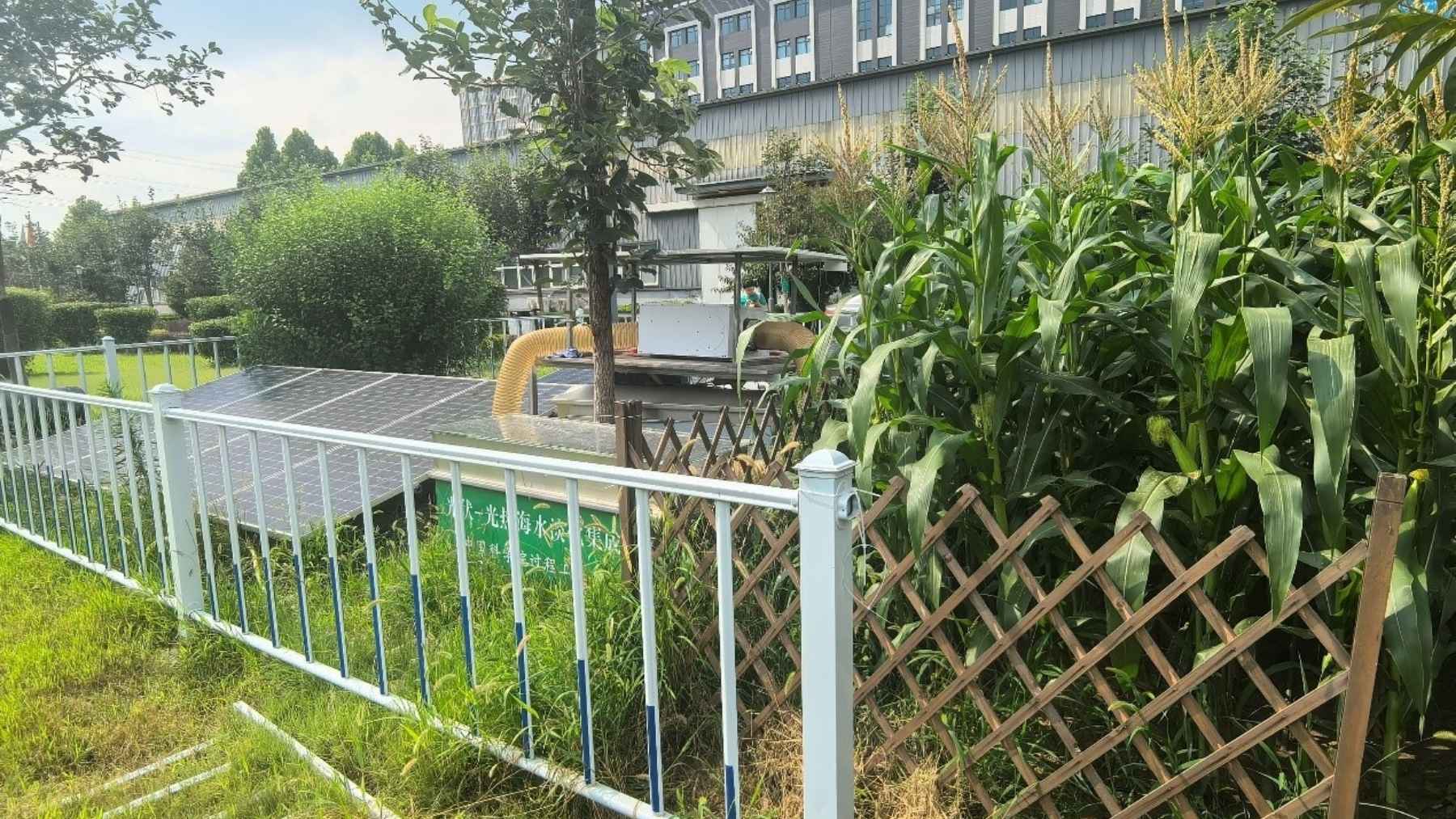
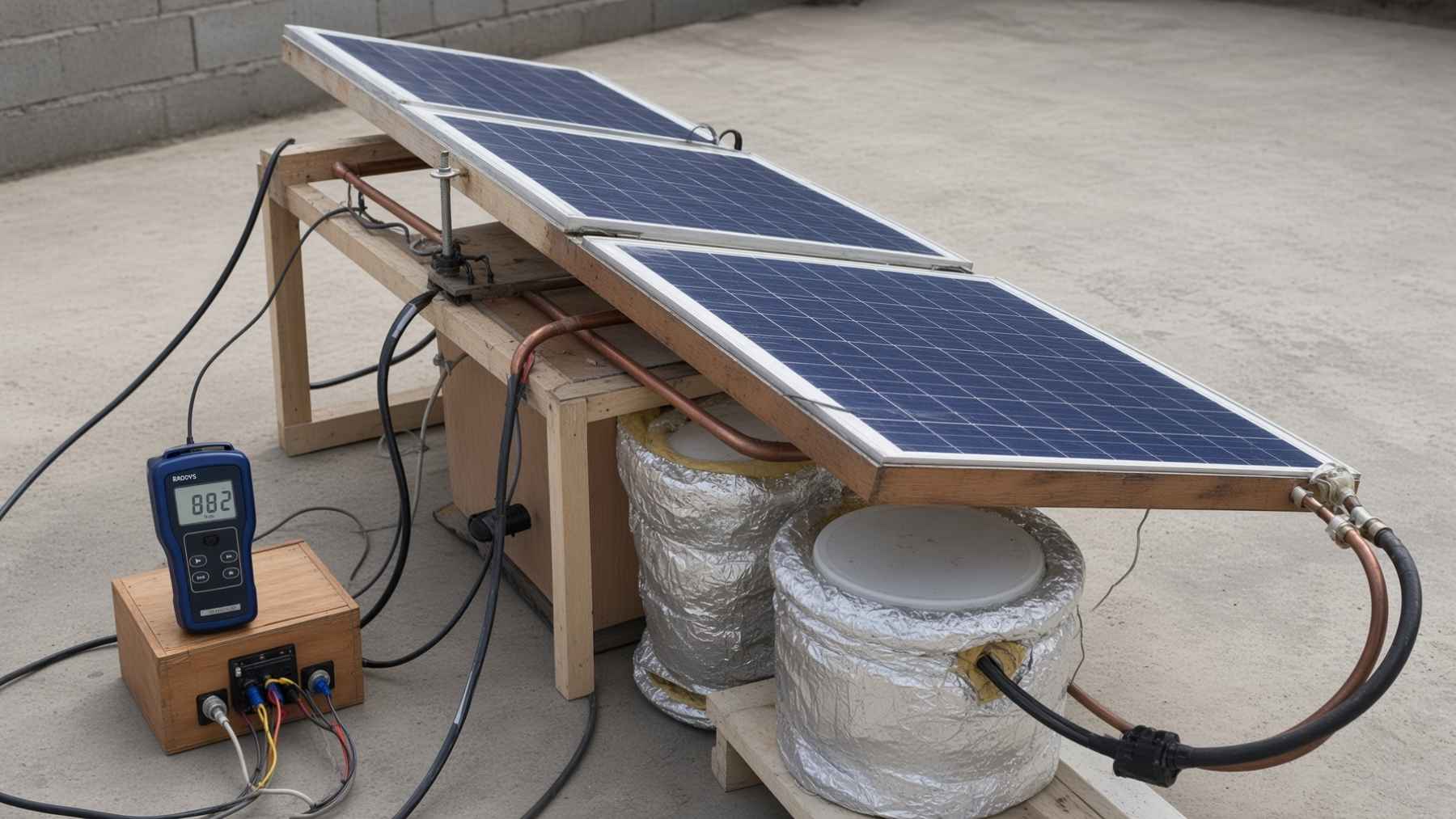
The team scaled the material into a demonstration rig with about 8 square feet (0.75 square meters) of evaporation area. As Interesting Engineering describes it, the complete machine inventory is the photothermal lattice, a condensation box, and one small fan powered by a little photovoltaic panel to move the vapor along. No pumps, no membranes, no grid connection anywhere.
Running on natural sunlight alone, the rig produced 20.16 liters of fresh water per day, about 5.3 gallons. That covers the basic daily drinking needs of roughly ten people, and the output cleared World Health Organization drinking water standards.
Then they piped it into a garden. The desalinated water irrigated a 54-square-foot (5-square-meter) experimental plot through a complete growth cycle of spinach, corn and Chinese cabbage. And per the same SCMP report, the prototype has now logged a full year of stable outdoor operation without paying a cent for utility power.
If a solar rig quietly making seawater drinkable sounds familiar, it should. A University of Rochester lab recently showed a laser-etched black metal panel that turns seawater into drinking water with no membranes and no brine. Different material, different mechanism, same no-grid philosophy. Two serious groups landing here within weeks of each other tells you where the field is headed.
Thirty days spinning in seawater, and nothing fell off
Durability is where solar materials usually go to die. Sunlight degrades polymers, salt water accelerates the job, and a photothermal absorber that sheds its nanoparticles is both broken and, in a drinking-water device, a contamination problem.
So the team ran an accelerated aging test. The material spent 30 days continuously exposed to seawater while being spun at 450 revolutions per minute the whole time, the kind of abuse no coastline will ever replicate. Under the microscope afterward, researchers found no detectable particle detachment. Light exposure produced no active free radicals either, the early chemical warning that a polymer is starting to break down.
That result matters more than the flashy evaporation figure. Particle shedding and material fatigue are precisely how this class of device tends to fail once it leaves the lab, and a year of real weather plus a month of forced abuse is a more honest audit than most prototypes ever face.
About that “cheaper than bottled water” line
Now the fine print, because the cost claim is real but narrower than the headlines suggest.
First, it’s a projection, not a receipt. The researchers estimate that after two years of operation, the cumulative cost of the water this system produces would drop below the cost of commercial bottled water. No unit has run for two years yet. The clock sits at one.
Second, it compares production cost against retail price. A bottle’s shelf price carries plastic, filling lines, freight, retail margin and marketing. Stacking a device’s raw production cost against all of that is a bit like comparing your cost of brewing coffee at home against the counter price at Starbucks. Home coffee wins that fight every time, and Starbucks is doing fine.
Third, this is a laboratory prototype with no commercial version behind it. The CAS write-up itself hangs the economics on a condition: the material has to prove stable over the long haul first. The team told SCMP the cost advantage “would become even more pronounced” with scale or longer operation, which is true of nearly every technology that hasn’t been scaled yet.
None of that sinks the work. It locates it. The study’s own title points at distributed solar desalination: not billion-dollar megaplants, but small self-sufficient rigs on remote islands and dry coastlines where grid power doesn’t reach and trucked-in bottled water is the current plan.
Industrial-scale desalination is a different universe, and a busy one. Saudi Arabia is desalinating seawater to feed the largest green hydrogen plant ever built, and Gulf states are testing whether a big enough solar farm can wring rain out of desert air. This little lattice isn’t competing with any of that.
What it has already done is rarer than it sounds: survive a year of actual weather, off-grid, while feeding a vegetable patch. The two-year cost claim still has a year left on the clock. The spinach has already voted.














What happens to the salt and other desolved solids?