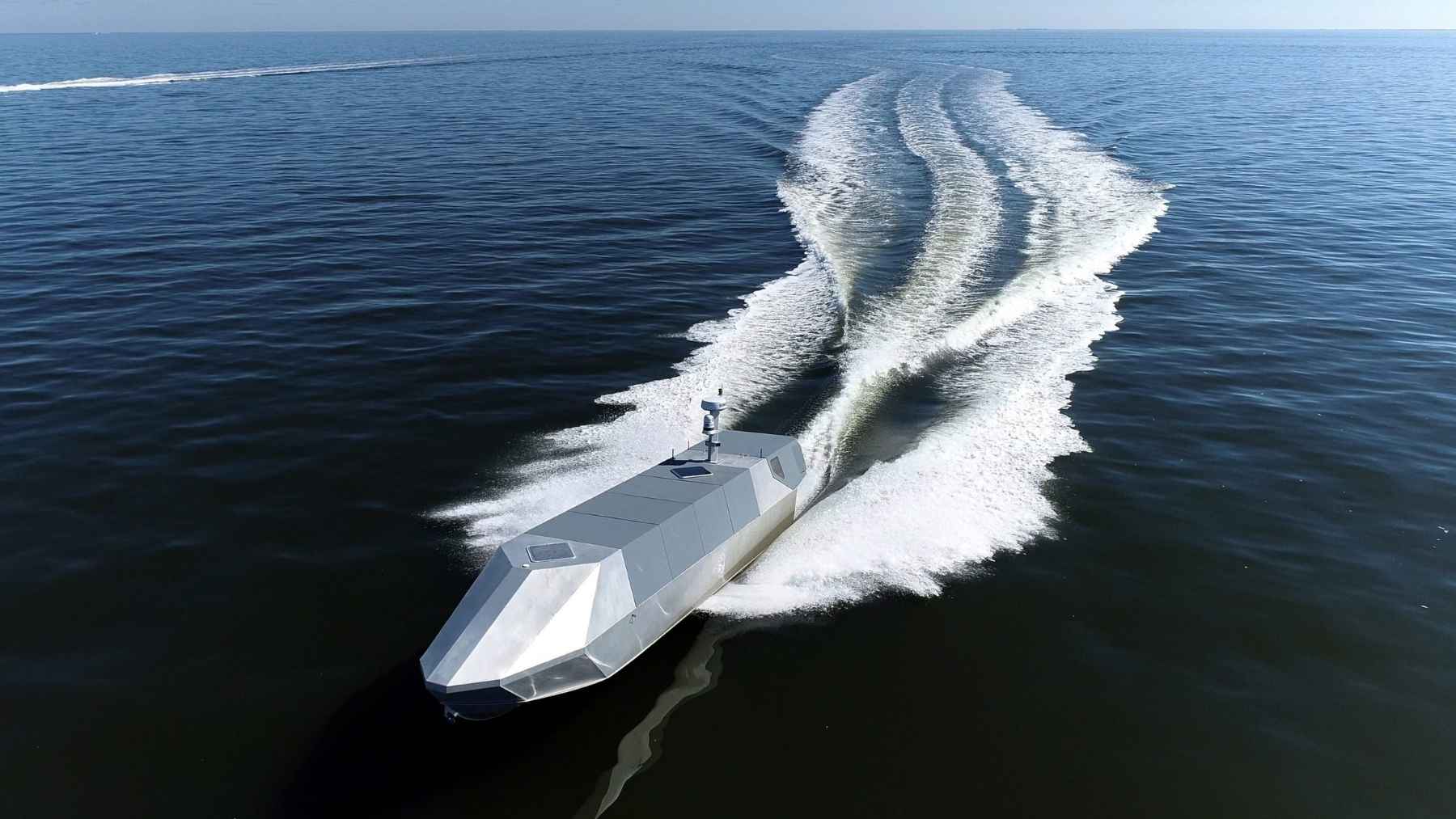

The aluminum boat riding a trailer behind somebody’s pickup, twin outboards hanging off the back, is about as ordinary as boats get. You buy the hull from a regional builder, drop it down a public ramp, and tank it up at the same fuel dock as everyone else’s weekend runabout. Leidos built one of those, pulled out the wheel, the seats and the crew, packed the space with autonomy software, and has spent this spring running it through sea trials off northern Australia as a machine designed to attack in a pack.
It’s called Sea Archer, and right now there are exactly two of them on the planet, one built in the United States and one built in Australia. That makes it one of the rarest boats afloat. It is also engineered to become one of the least rare boats imaginable, which is the entire point.
The 37-foot (11.2-meter) hull is meant to be simple enough that an ordinary aluminum boatyard can turn one out in under three months, and Leidos has been upfront that nobody has bought a single one yet. The Australian effort is funded out of the company’s own research budget, with no Australian Defence Force contract behind it, and Powerboat News reported the boat working through sea trials in Northern Territory waters in June.
Two boats now, a boatyard full later
Leidos set itself an unusual clock on Sea Archer: design it, build it and test it inside a single year. That job went to the company’s naval architecture division, with a brief that read more like a constraint list than a wish list. The boat had to use simple, rugged, proven parts. It had to be buildable in any boatyard. And it had to run on diesel, because diesel is the fuel the U.S. military already moves around the world. “If you run on diesel, you can refuel at just about any armed forces forward resupply,” USV program manager Drew Mutch told Leidos.
So power comes from twin Cox Marine V8 diesel outboards, and the hull underneath them is a Gibbs & Cox design that has been around for roughly 30 years, which is a polite way of saying the company didn’t gamble on an exotic shape. The clever part is the fuel math. To hit a 1,500-nautical-mile range (about 1,725 miles), the design carries fuel making up a full third of the boat’s weight, roughly twice the fuel fraction of other long-range vessels, and it does that without tipping over or wallowing.
Owners can stretch the range another 20% by giving up some payload space for extra tanks. Top speed is 40 knots, it can carve a tight 180-degree turn, and the whole thing fits inside a standard 40-foot shipping container and launches off a boat ramp with two people and a trailer.
That last bit is the foundation of the production pitch. Naval News reported that Leidos has identified somewhere between 14 and 16 Australian aluminum boatyards capable of building Sea Archers, each in under three months, at a target cost the program has put near a million dollars a boat.
Leidos has said that once production starts, it expects to crank these out at an initial rate of around 10 a month. Kevin Quarderer, the company’s international director of science and technology in Australia, put the contrast plainly to Naval News: plenty of people are doing uncrewed boats in the glossy-brochure stage, and this one is already in the water and operating.
You can’t shoot down a swarm
Every design choice on Sea Archer points at one bet, and it’s a bet the war in Ukraine has been arguing for two years now. Cheap, crewless boats in numbers can do real damage to expensive crewed ones, which is why a handful of Ukrainian sea drones have kept Russia’s Black Sea Fleet hiding in port. Leidos took that lesson and built a boat around it. “Any vessel can be targeted by a group of missiles,” Mutch said, “but you can’t launch enough missiles to stop a swarm of USVs.”
The logic is uncomfortable for anyone who has spent decades thinking about naval power as a small number of very capable, very costly hulls. A destroyer is a magnificent thing, and also a single point of failure an adversary can find, track and plan against. Spread the same firepower across dozens of cheap boats scattered over the water, and the problem flips onto the other side. You don’t have to buy the whole thesis to see why navies keep circling it. The U.S. version of this argument is already in the water too, with startups like Saronic bolting serious weapons onto much larger robot ships. Sea Archer is the small, swarmable end of the same idea.
Figures: Leidos, Naval News, Powerboat News, Defence Connect.
One ton of payload, and a choice of what goes in it
The space where a crew would normally sit is a reconfigurable enclosed bay rated for more than 900 kilograms, roughly a ton. Leidos lists four jobs for it: intelligence, surveillance and reconnaissance, logistics resupply, electronic warfare, and strike. In its current sea-trials setup the boat is carrying a Furuno radar and the autonomy software, with the heavier mission gear due to come later this year. What makes the bay interesting is less the cargo than the brain steering the boat around with it.
That brain is LAVA, short for Leidos Autonomous Vessel Architecture, and it is not new code written for a small boat. It is the same autonomy the company has run on its 132-foot Sea Hunter and Seahawk, the medium drone ships that sailed portions of the Pacific in 2024 with nobody aboard. Between them, those two larger vessels have logged more than 200,000 nautical miles and 14,000 hours at sea, including a nonstop seven-month deployment in the western Pacific.
Leidos says LAVA now runs across a dozen different USV designs in its stable, so Sea Archer is a miniaturized version of a system that has already spent years proving it can run a boat without a human babysitting it. The shrink-it-down approach is one Australia knows well, having just handed the U.S. Navy a container-shipped drone submarine built on the same launch-from-a-boat-ramp philosophy.
Kongsberg wants to put a cruise missile on it
The strike role is where Sea Archer gets genuinely spicy, and also where the honest qualifiers pile up. At the Indo-Pacific 2025 show in November, Leidos Australia and Kongsberg Defence Australia signed a memorandum of understanding to explore fitting Kongsberg’s Naval Strike Missile to Sea Archer and a bigger sibling called Longbow, per Leidos Australia. An MOU to explore something is not a contract to build it, and the pairing is still at the proof-of-concept stage, with integration trials planned in both the U.S. and Australia across 2026.
The missile itself is a known quantity. Kongsberg says the Naval Strike Missile is a sea-skimming, precision-guided cruise missile that can reach targets more than 185 miles (300 km) away, with autonomous target recognition and terminal maneuvers built to slip past defenses. It entered Royal Australian Navy service in 2024, and the U.S.
Marine Corps already fires a land-based version, which is part of why the American-built Sea Archer has been through testing with the Marines. The Longbow variant is the heavier-lifting end of the family: more than 3,000 kilograms of payload, better than three tons, on four OXE diesel outboards rated at 300 horsepower each, with a range past 2,750 nautical miles. One Sea Archer configuration shown at the trade show carried 16 launchers for loitering munitions, which gives you a sense of the math the company is selling.
Nobody’s signed a check yet
All of this lands in the middle of an Australian spending spree on machines that drive themselves. Canberra stood up a Maritime Autonomous Systems Unit this spring, an outfit that operates nothing but uncrewed vehicles, anchored by Anduril’s Ghost Shark drone submarine and a wider push into autonomy across air, land and sea. A 2024 surface fleet review recommended buying six large optionally crewed surface vessels, each with 32 missile cells, and Leidos has positioned Sea Archer as a candidate that can be scaled up or down to fit. Quarderer described that as sitting in the Goldilocks spot.
Not everyone in Australia is sold on the armed-robot-boat part. In Defence Connect’s reporting, a defense analyst said he remained skeptical of putting anti-ship missiles on uncrewed surface vessels at all, while still wanting the Navy to run trials and find out what the things are actually good for. That is the cleaner read on where Sea Archer stands. It is two boats, a company’s own money, a stack of MOUs, and a lot of interested navies, not a fielded fleet. The trials happening off Darwin right now are how Leidos turns the brochure into something a customer might sign for.
The strange thing about Sea Archer is the gap between what it is and what it’s for. Today it is one of the two rarest powerboats on Earth, a hand-built oddity running laps off northern Australia. The point of all that engineering is to make it disposable, common, the kind of thing a regional boatyard stamps out by the dozen and a couple of sailors launch off a ramp and refuel at the marina. If it works, the most interesting thing about Sea Archer, that only two exist, becomes the least interesting thing about it.