
If you own solar panels anywhere it snows, you already know the ritual. A storm rolls through, the array goes dark, and you either wait a week for the sun to burn the snow off or you climb up there with a long-handled squeegee and take your chances.
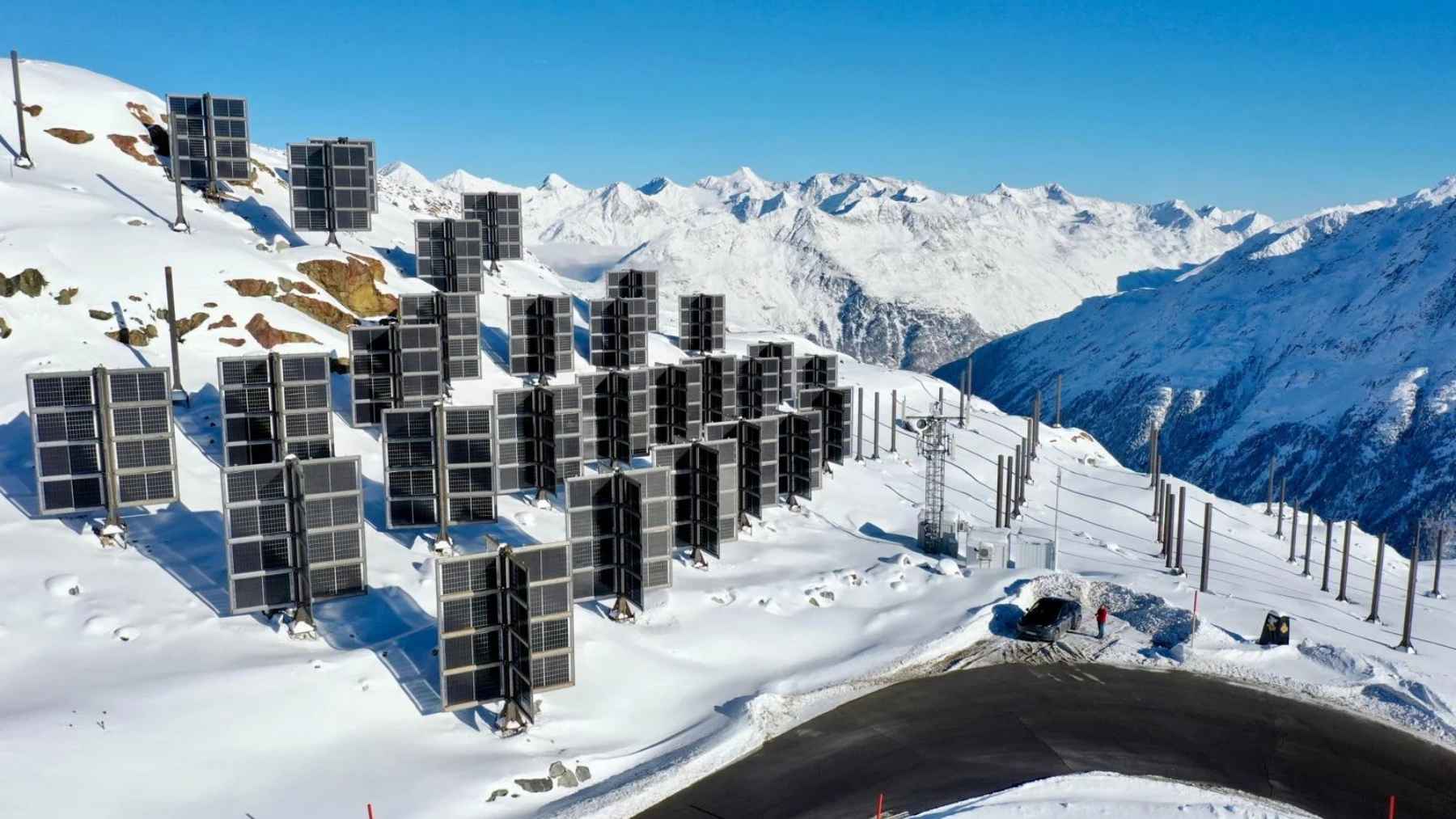
Now put that problem on a glacier at 9,350 feet, where a hard winter can dump 26 feet of snow, and hang a ski resort’s entire electric bill on the other end of it. That is the situation on the Tiefenbach glacier above Sölden, in Austria’s Ötztal valley.
The fix a Tyrolean startup came up with was to stop tilting the panels. The modules stand dead vertical on a steel cross about 20 feet tall, anchored into rock with no concrete anywhere, and nobody ever cleans them. The wind cleans them, because the cross is shaped specifically to make the wind do it.
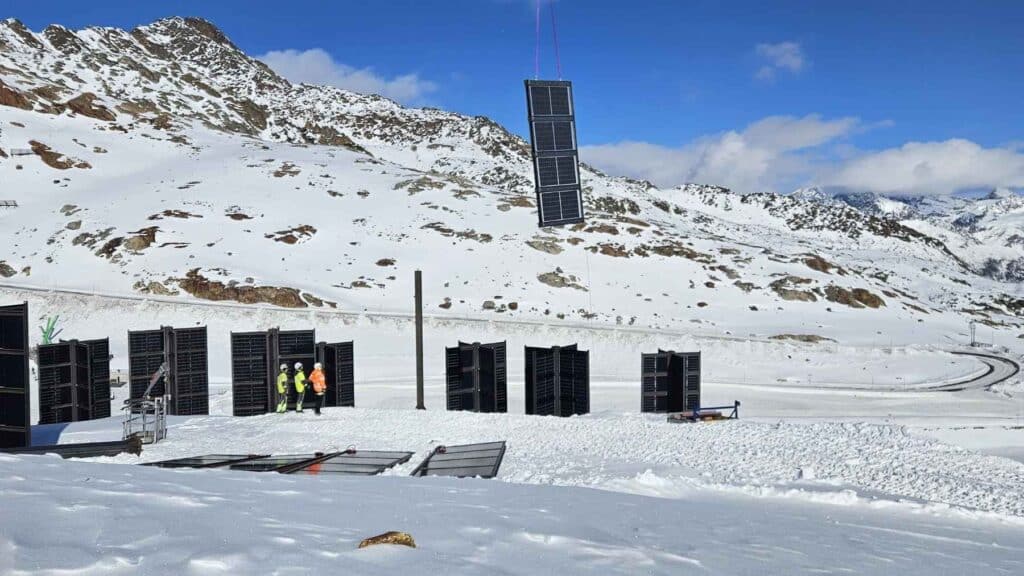
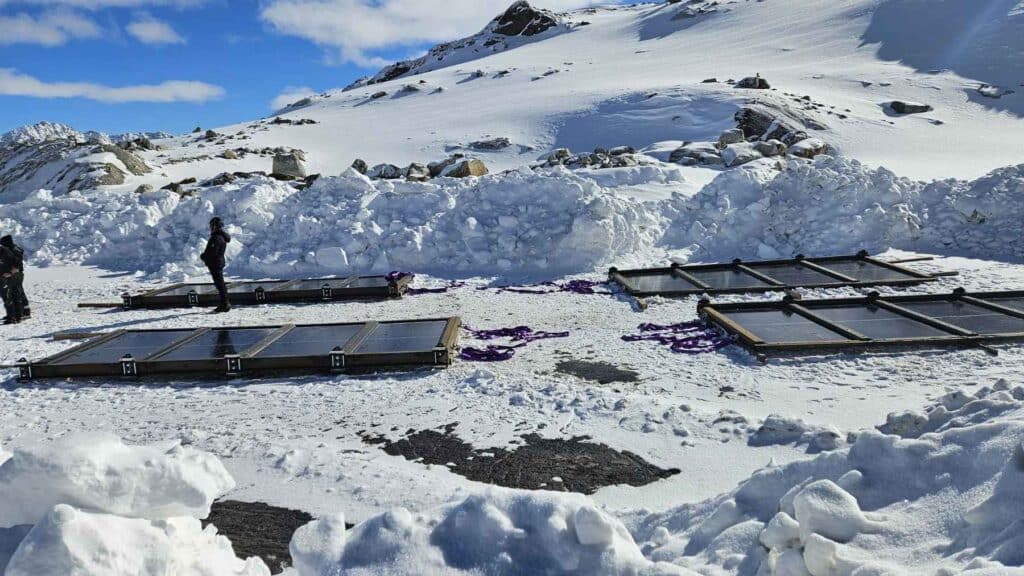
Sixty of those crosses are already up there feeding power straight into the ski lifts, according to Bergbahnen Sölden’s own project page. Another 740 have to be planted and wired before October.
The first version of this came back more than 60% broken
Helioplant’s three founders, Florian Jamschek, Thomas Sönser and Alexander Ploner, did not sketch a cross on a napkin. They got there by watching the conventional approach get taken apart in front of them.
High-altitude solar has mostly been built as what the industry calls a line installation. Long rows of modules on racks, tilted steep so snow slides off, held a few feet clear of the ground so drifts can pass underneath.
Jamschek told German public broadcaster ZDF that on those early builds the gap under the racks was only about 2.5 to 3 meters, roughly 8 to 10 feet. That number turned out to be the whole problem. Wind squeezing through a gap that size speeds up, picks up loose snow, and packs it in underneath.
More than 60% of those units ended up damaged and unusable, Jamschek says. A panel with snow on it makes nothing until spring. A panel with a bent frame makes nothing ever again.
The shape is borrowed from avalanche hardware
What Helioplant built instead is a cross with four wings on a central column, each wing carrying 15 or 16 bifacial modules depending on how steep the ground is. The company’s spec sheet puts each unit at roughly 6 meters tall and 4.5 meters wide, so about 20 feet by 15.
The lineage has nothing to do with solar. Alpine farmers and avalanche crews have been planting wooden crosses upslope of buildings for generations, purely to stop drifts from piling against a wall. Jamschek told ZDF that is exactly where the idea came from.
A cross in light wind does not just stand there. It throws the airflow into a vortex, and the vortex strips the snow off the structure and away from it. So you never get a drift piling against the panels. You get a crater, scoured out to roughly 13 feet from the column.
And the crater is not just damage control. The gap under the wings is deliberately tuned so a thin layer of snow survives on the floor of it, and fresh snow is one of the best reflectors on the planet. Bifacial modules have cells on both faces. The hole the machine digs for itself doubles as a mirror aimed at its own back.
The test field numbers are the company’s own, and they are good
Helioplant has been measuring this since 2022, which is worth saying out loud before quoting its figures, because they are its figures.
Its published spec sheet lists four test fields, and Sölden is the strongest: 12 elements at 2,850 meters returning 1,480 kilowatt-hours per kilowatt of installed capacity across a year, with 587 of that landing in the six winter months. The Gondo site on the Swiss side of the Simplon, about 2,300 feet lower, managed 1,350 with 542 in winter.
Winter is the entire argument. Alpine arrays put out roughly four to five times more electricity in December, January and February than panels down in the flatlands, Swiss public broadcaster SWI swissinfo.ch reported in March. That is precisely when a ski resort’s snowmaking compressors are screaming and the grid is at its tightest.
Bergbahnen Sölden is not a passive host renting out a hillside. It commissioned the plant for €14 million, about $16 million, and Austria’s Climate and Energy Fund put in another €4 million, per ZDF. The lift company says the finished array should cover up to 100% of its own electricity in summer and about a third of the three ski areas’ annual demand, which works out to roughly 28 GWh.
Run that backwards and skiing in Sölden burns something on the order of 84 gigawatt-hours a year. Gondolas, mountain restaurants, and above all snowmaking.
The plant has until October
The build window is short and it does not move. Assembly gets May through October, with final grid connection scheduled for October 2026, after which the thing runs continuously.
The operator’s published status has about half the foundations done across all 800 elements, 350 masts standing, and those 60 units already exporting. Two new energy centers are going up for load distribution and control, and the whole array ties into the lift company’s own medium-voltage network rather than the public grid.
That last detail is the business case. Jakob Falkner, managing director of Bergbahnen Sölden, told ZDF the numbers work because the power feeds their own network, and that the independence matters even more than the arithmetic.
The construction is also unusually cheap for high alpine work, and not by accident. No concrete: four anchors into rock hold each cross, and the structures show up largely pre-assembled. The access roads, cabling and transformer stations were already up there serving the lifts. A greenfield alpine solar farm has to build every bit of that from zero.
800 trees make a forest, and that is the catch
The self-cleaning trick has a scaling problem, and it was documented by people with no money in the company.
Researchers at EPFL in Lausanne and the WSL Institute for Snow and Avalanche Research ran the Helioplant geometry through a snow-transport model called snowBedFoam and published the results in Cold Regions Science and Technology. It is the first time anyone has aimed a detailed snow-drift model at a PV structure.
Their headline finding: “grouping units together reduces the erosion capacity of the cross structure.” The paper calls it the forest effect. One cross standing alone scours beautifully. Crowd 800 of them together and they shelter each other from the wind, and the wind is the entire cleaning mechanism.
The row facing the prevailing wind erodes hardest. Everything behind it gets less. Their guidelines are specific: keep the ground gap above 0.6 meters, about 2 feet, line the crosses up as close to zero degrees off the prevailing wind as possible, and space and stagger the rows to claw back the scouring the crowd steals. At 45 degrees, a dead erosion-free patch forms in the lee.
None of that says the design fails. The same paper notes the geometry consistently eroded snow around the test installations. It says the design has spacing homework that a 12-unit pilot cannot answer and an 800-unit plant has to.
Helioplant is upfront about the other cost of the shape. A cross with four wings shades itself, which is the entire reason SolarEdge is on this project. Jamschek told pv magazine the tree-like structure makes module shading worse, and that the answer is giving every single module its own power optimizer so one shaded panel cannot drag its whole string down with it.
Then there is the money. Christof Bucher, a professor of photovoltaic systems, told swissinfo that electricity out of alpine solar runs two to four times more expensive than the lowland version, once you count what it takes to build and maintain hardware at that altitude.
Environmental groups also argue the arrays scar the landscape and hurt biodiversity. That is a large part of why big Alpine solar keeps stalling in Switzerland, and why one Swiss startup gave up on mountainsides entirely and bolted its panels between live railway tracks instead.
Six thousand ski resorts, allegedly
Sölden mostly sidesteps that fight. The steel is going onto a glacier ski area that already has lift towers, buildings and cable running to all of it. Nobody is pretending it is wilderness, and the resort’s own marketing cheerfully calls the thing a power plant forest.
Jamschek puts the addressable market at roughly 6,000 ski resorts worldwide, with inquiries arriving from Switzerland, South America and New Zealand. Treat that number as the sales figure it is. Plenty of those resorts have the wrong aspect, the wrong balance sheet, or a planning board that will never sign.
Solar keeps getting redesigned around problems that have nothing to do with electricity. German researchers just built panels that pass for terracotta roof tiles and eat a 5% output hit to do it. Others are working out whether a big enough array can brew its own rain over a desert. Sölden’s version pays its tax in self-shading and buys a snow crater with it.
What is not up for debate is the calendar. Bergbahnen Sölden has to plant 740 more steel crosses on a glacier and get the last one wired before the snow comes back in October. Then the design has to prove that 800 of them standing together still keep themselves clean. Twelve of them already did. A forest is a different animal.