
Every few months, someone unveils a power cable that sounds like a movie pitch. A line buried under the Sahara to keep British lights on. A 2,600-mile run from the Australian outback to Singapore. The promise is always the same: sink a fat enough wire under the ocean and you get to borrow another continent’s sunshine on demand. Most of these never make it past the press release.
The cable that actually holds the world record for the longest of its kind is a lot less cinematic, and it has been quietly moving electricity since the end of 2023, 475 miles under the North Sea between England and Denmark. It is called Viking Link, it cost £1.7 billion (about $2.2 billion), and on a good day it shifts a gigawatt and a half between two national grids without anyone on either coast noticing.
A gigawatt and a half, moved by a cable that weighs 27 pounds per foot
On paper the thing is almost dull, which is part of why it works. Viking Link is a single high-voltage direct current connection running at plus or minus 525 kilovolts, rated to carry up to 1,400 megawatts. It ties the Bicker Fen substation in rural Lincolnshire to the Revsing substation in southern Jutland, and it is owned 50-50 by Britain’s National Grid and Denmark’s grid operator, Energinet.
The whole route is 475 miles long, but only about 400 of those miles are actually on the seabed. The rest is buried underground, threading across Lincolnshire farmland on one end and the Danish coast on the other.
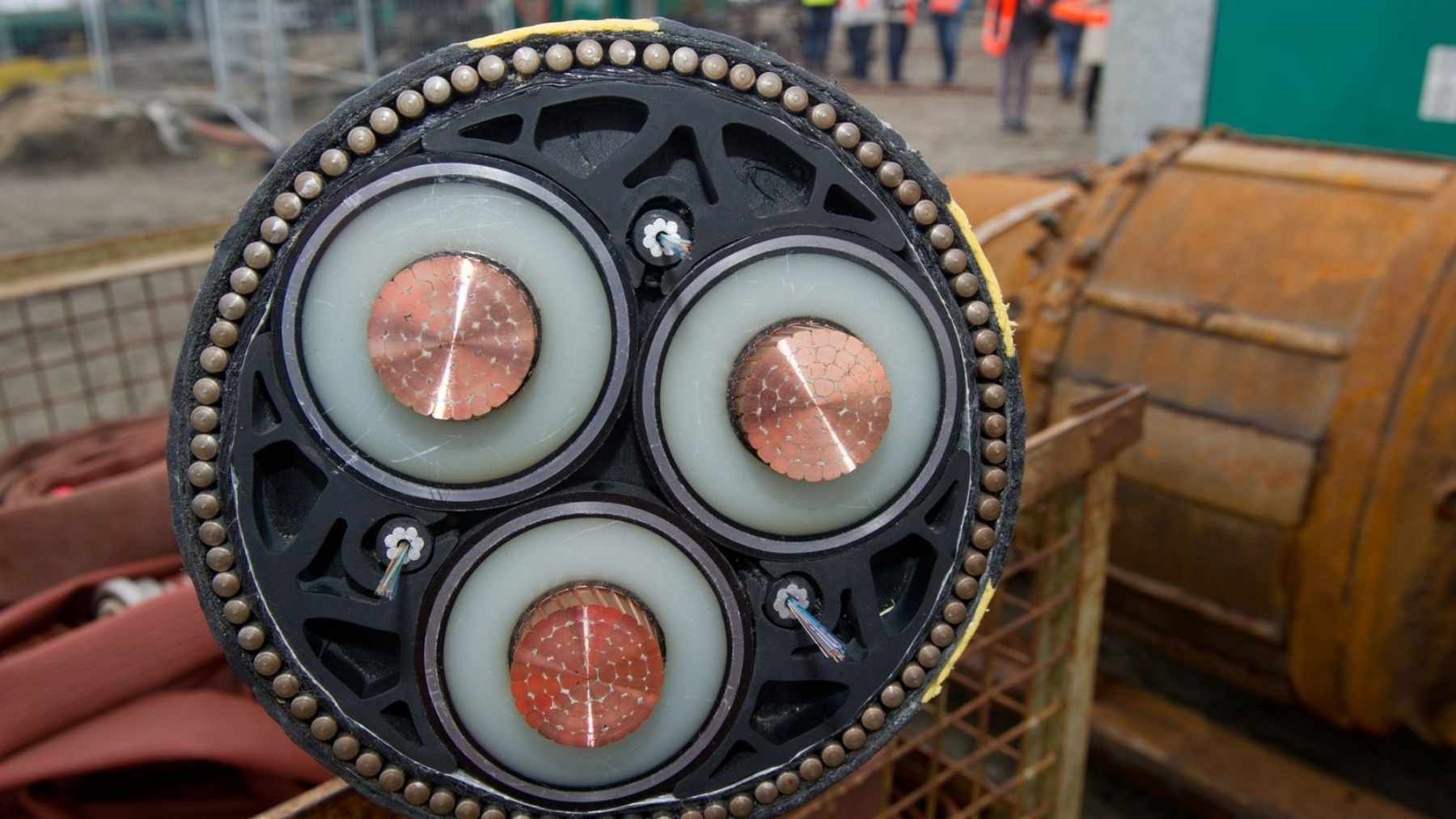
The cable itself is the unglamorous star here. It is made of copper, steel, paper and plastic, and each meter of it weighs roughly 40 kilograms, which is about 27 pounds for every foot you lay down. There are two parallel runs of it, and on its way across the floor of the North Sea it physically crosses an older interconnector, the NorNed cable between Norway and the Netherlands.
According to National Grid, when it is running flat out it can move enough power for up to 2.5 million UK homes, and the company expects it to shave more than £500 million off British power bills over its first decade. It was switched on, at reduced power, on December 29, 2023.
Why Britain and Denmark bothered
The reason two countries spent five years and the better part of $2.2 billion on a wire is timing. Denmark and the UK sit an hour apart, and their electricity demand peaks at slightly different moments, so when one grid has surplus wind it can dump it onto the other instead of curtailing turbines and wasting it. Energinet has framed it around breakfast, of all things: by the time Britain is waking up, Denmark is already an hour into its day, and that small offset is enough to make trading power back and forth genuinely useful. So far the flow has run mostly from Denmark into Britain, somewhere between half and nearly all of the time, depending on the weather.
It also matters because the North Sea is filling up with wind that needs somewhere to go. Britain’s Dogger Bank, the biggest offshore wind farm in the world, is going up on a sandbank not far from the same stretch of water, and Denmark has been a wind powerhouse for decades. A link like Viking gives both grids a release valve. When the wind is blowing hard on one side and the lights are still on, the surplus has a buyer instead of becoming a curtailment problem. In its first year of full operation, the operators expect it to keep about 600,000 metric tons of carbon out of the air, which they put at roughly 280,000 cars’ worth of driving.
It holds a very specific world record
Viking Link is in the Guinness World Records, and the exact wording of the title matters more than you’d think. It is recognized as the longest land and subsea HVDC interconnector on the planet, a certificate a Guinness adjudicator handed over at the Bicker Fen converter station in 2024. That phrasing is doing real work. Viking Link is the longest if you count the full route, land plus seabed combined.
If you only count what is actually underwater, though, National Grid already owns a longer one. The North Sea Link to Norway, energized in 2021, runs around 720 kilometers and still holds the record as the world’s longest purely subsea interconnector. Viking Link’s undersea section is shorter than that; it wins the overall title because of the long underground stretches on either coast. None of that takes anything away from the achievement. It just means the headline number, like most headline numbers in this business, has an asterisk attached if you read the fine print.
The far bigger cable to the Sahara didn’t get built
Which brings us to the cable that was supposed to make Viking Link look small. For years the splashy proposal in British energy was Xlinks, a plan to run roughly 2,400 miles of subsea cable from a vast solar, wind and battery complex in the Guelmim-Oued Noun region of southern Morocco all the way up to the coast of Devon. At 3.6 gigawatts it would have carried more than twice Viking Link’s power, supplied something like 8% of Britain’s electricity, and, had anyone built it, become the longest undersea power cable in the world by a wide margin.
It was not a fringe idea. The project was chaired by former Tesco boss Sir Dave Lewis, attracted backing from heavyweights including TotalEnergies, Abu Dhabi’s TAQA and Octopus Energy, and was formally designated a Nationally Significant Infrastructure Project by the British government in 2023.
Then, in June 2025, the government pulled the rug. Energy minister Michael Shanks told Parliament it was “not in the UK national interest at this time” to keep considering support for the scheme, leaving it without the price guarantee its financing depended on. Xlinks said on its own project page that the decision left it without a route to sell the power, called itself “bitterly disappointed,” and started looking at shopping the idea to Germany instead. The desert cable still exists, on paper. The 475-mile one to Denmark exists in the water.
It still isn’t running flat out
Here is the honest part nobody puts on a poster. Viking Link did not switch on at its full 1,400 megawatts, and it still doesn’t run there most of the time. It came online capped at 800 MW because the Danish grid behind it, specifically the high-voltage network in West Jutland, could not absorb the full load without risking overloads on its own lines. That cap has been stubborn.
As recently as mid-2025, market analysis of the link’s actual flows found it still running on an 800 MW base, with operators only pushing it to the full 1,400 MW in specific situations, such as when flows on the Danish-German border reverse. The fix is a reinforcement of Denmark’s west-coast 400-kilovolt grid that Energinet has been building for years, with the key stretch targeted for the end of 2025. Until that grid work is finished and proven out, the record-holder mostly runs at a little over half the number on its spec sheet.
That gap, between the rated number and the number it actually hits, is the whole story of grid infrastructure. A cable is only as useful as the wires and substations behind it, and those are the parts that quietly decide whether a record-breaking line lives up to its spec sheet. It is the same reason a job like swapping out all 287 towers on a Tasmanian line that has been live since 1949 never trends on anyone’s feed. The steel and the converter stations are unglamorous, expensive, and the difference between a press release and a working machine.
The lesson of Viking Link isn’t that the Sahara dream was stupid. The engineering on these long subsea cables genuinely works, and the losses over distance are smaller than most people assume. It’s that a cable only counts once the converter stations are wired, the grid behind it can carry the load, and someone keeps signing off on the next mile of trench. The flashy 2,400-mile version made better headlines. The 475-mile one made electricity.
Image Credit: AFP