
Back in March, the Pentagon released periscope footage of a torpedo going off under the stern of an Iranian frigate in the Indian Ocean. It was the first time a U.S. Navy submarine had sunk an enemy warship with a torpedo since the Second World War, so the clip traveled. Most of the attention landed on the submarine.
The detail that got past almost everybody showed up in the follow-up reporting. U.S. officials told CBS News that the USS Charlotte fired two Mk 48s at the IRIS Dena on March 4. The first one missed. The second one sank the ship, and Sri Lanka’s navy pulled 32 survivors out of the water.
The torpedo that missed is still down there. It weighs 3,744 pounds, which is most of two tons of hardware sitting on the seabed. Going by the Navy’s own budget paperwork, it cost around $4.2 million, and nobody is going back for it.
That number is the whole commercial argument behind a weapon a company in Rhode Island says it will start building in volume this year. It’s called Copperhead, it’s shaped like a box instead of a tube, it’s built to be carried into the fight by a robot submarine rather than a crewed one, and if it misses, the plan is to go get it back.
A torpedo that misses is a $4.2 million hole in the water
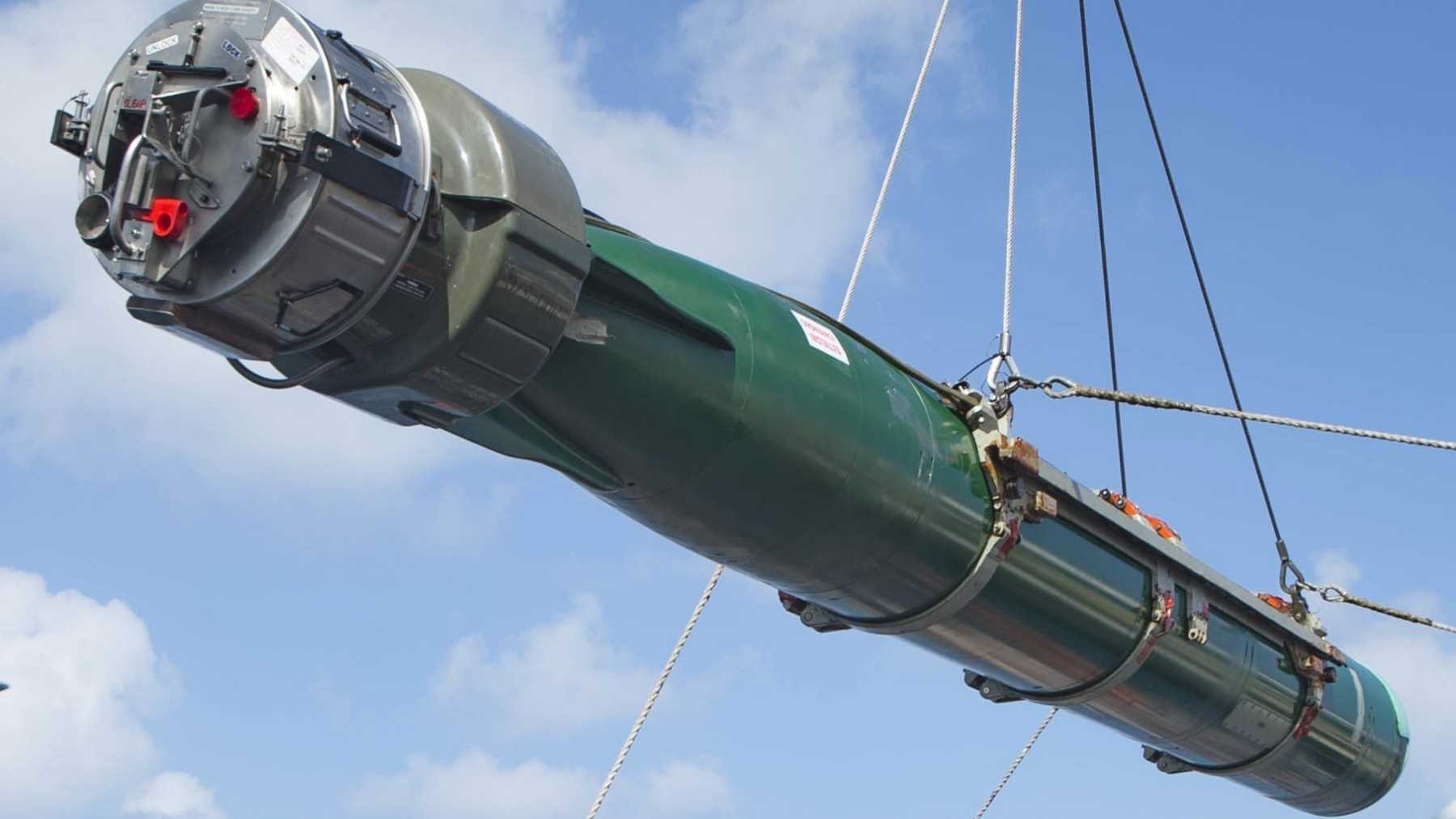
The Mk 48 is the only heavyweight torpedo American submarines carry, and it has been since 1972. It runs 21 inches across and about 19 feet long, and it kills by going off underneath a hull instead of hitting it, which lets the water do the structural work. That’s what the March video shows.
The Navy publishes the rest on a public page. Its own fact file puts the Mk 48 at 3,744 pounds with a 650-pound high-explosive warhead, running on liquid propellant, built by Lockheed Martin and SAIC.
Sit with that split for a second, because it’s the whole story. The warhead is 17 percent of the torpedo. The other 3,094 pounds is guidance, sonar, fuel and propulsion, and every single time you pull the trigger you throw all of it away to deliver 650 pounds of explosive.
It is also very expensive and the Navy does not buy many. The FY2025 budget request asked for 79 of them at $333.147 million, which works out to roughly $4.2 million a copy.
Nobody inside the Navy is pretending that math works in a long fight. The service has spent two years chasing a cheap heavyweight torpedo of its own, under a program called RAPTOR, with a target price of $500,000 or less.
Capt. Chris Polk, the Navy’s undersea weapons program manager, pitched it as a deliberately limited weapon that keeps the same explosive punch and drops everything else. The Strategic Capabilities Office finally put out a solicitation for it in November.
So the demand signal is real, and it predates Anduril’s product by a year.
Here’s the part of Copperhead that’s actually novel, and it isn’t the speed or the software. A Mk 48 that misses is gone. So is a Mk 54. There’s no procedure for fishing one out and firing it at something else next week.
Anduril says Copperheads can be recovered, refurbished and reused. Go back to that 17 percent and you can see why that matters: the expensive part of a torpedo was never the explosive, it was the ton and a half of machinery wrapped around it.
Anduril’s torpedo is a box because boxes are cheaper than tubes
Every torpedo you have ever seen a picture of is a cylinder. Copperhead isn’t. It has a faceted, rectangular body, and that was a deliberate call to make the thing simpler and cheaper to produce.
Dr. Shane Arnott, now senior vice president of Anduril’s maritime division, gave The War Zone the whole logic in four words when the family was unveiled. Square hull forms, he said, are “easier to stamp out” than cylindrical ones. Everything else about this weapon follows from that sentence.
There are four members of the family. The Copperhead-100 runs 12.75 inches in diameter and just under nine feet long, the same tube class as the Mk 54 lightweight torpedo. The Copperhead-500 is 21 inches and a little over 13 and a half feet.
That puts the 500 in the Mk 48’s diameter class while running more than five feet shorter, and both Copperheads are substantially lighter than the legacy weapons they’re sized against.
The plain 100 and 500 are sensor trucks. They take active and passive sonar, magnetometers, side-scan sonar or chemical detection. Bolt a warhead in instead and you get the 100M and the 500M, which is where the yellow band around the hull comes from on Anduril’s own product page. Arnott’s shorthand is that the 500 is roughly in Mk 48 territory and the 100 is roughly in Mk 54 territory.
Sprint speed for both is over 30 knots. What drives them, Anduril hasn’t said. How a box handles pressure at depth, Anduril hasn’t said either, and neither has anybody else, because there’s no independent testing to point at.
Nor will the company tell you what one weighs. The Navy puts 3,744 pounds on a public web page; Anduril gives you a product name. The 100 and the 500 are payload classes, not curb weights, and the only figure the company has offered on the total is that it comes in substantially under the torpedo it’s sized against.
It isn’t built to launch from a submarine. It’s built to launch from another robot.
This is the bit that separates Copperhead from every torpedo the Navy owns. Anduril’s pitch is that Copperhead-M is “the first torpedo capability built to be carried by autonomous systems.” The carrier it has in mind is its own.
A Dive-XL, the company’s autonomous submarine, can reportedly haul dozens of Copperhead-100Ms or several of the bigger 500Ms. It runs on batteries, ships inside a commercial container, and Anduril rates it at over 2,000 nautical miles.
That’s the same platform Anduril builds for Australia as the Ghost Shark, which went from a signed contract to a purpose-built Sydney factory in seven weeks last fall. Both that plant and Anduril’s 150,000-square-foot facility at Quonset Point, Rhode Island, are set up to build Copperheads.
The company has also floated air-launching them from cargo planes or large drones, though nothing public suggests that has been tried.
Targeting runs on Lattice, Anduril’s autonomy software, and the company’s framing is careful: the operator sets the engagement criteria and a pre-approved safety volume, and inside those limits the machine picks which target it goes after. Arnott’s argument for the software-defined seeker is that when an adversary changes its acoustic signature, you answer with a patch instead of a new torpedo.
Whether any of that survives contact with a real Navy weapons safety review is a separate question, and one nobody has answered in public.
The production number is the part nobody outside Anduril has checked
Arnott told DefenseScoop the production system is aimed at “very high hundreds to thousands” of these a year. Set that against 79 Mk 48s in a budget request and you can see why the pitch lands in a room full of admirals.
Now the honest column. Copperhead was unveiled in April 2025 and Anduril has not started building it at scale. When Secretary of War Pete Hegseth toured the Quonset Point floor on February 9, the company said it was rapidly turning out Dive-LDs for the Navy and would begin scaled production of Copperhead and Dive-XL later this year. It has not announced that it started.
There is no disclosed customer. Arnott declined to say whether any government had bought one, declined to give a unit price, and noted that Anduril paid for the initial development itself. Nearly a year and a half on, that hasn’t changed in public.
The April 25 video is worth the same scrutiny. It’s 16 seconds of a Copperhead-500M running just under the surface. The company’s claim attached to it is that the vehicle beat its own internal speed records and threw hard maneuvers in high seas. Anduril didn’t say when the test happened, didn’t say where, and no outside party has verified any of it. An internal record is a record against yourself.
Anduril also isn’t alone in this lane. Vatn Systems builds 12.75-inch torpedo-shaped drones in Bristol, Rhode Island, in a plant rated for 2,000 vehicles a year, and its CEO has publicly promised tens of thousands of units annually by the end of 2026.
Two startups an hour apart are selling the Navy the same idea. Neither has shown a delivery log.
So what does the Navy actually do with a $4.2 million miss?
Nothing. It writes it off. Which is what makes the Copperhead argument interesting rather than just loud: the case for it doesn’t rest on the weapon being better than a Mk 48, because Anduril isn’t claiming it is. It rests on it being cheap enough that firing one at an enemy drone stops being an embarrassing line item.
The Navy has been on the other side of this trade before. Boeing’s Orca drone submarine ran three years late and $242 million over budget, according to a 2022 GAO report, and the service nearly killed it before turning around and committing to buy 16. Anduril’s counter-argument is a factory that already exists, in a business park where General Dynamics Electric Boat builds real submarine hulls.
But Ghost Shark had a customer with a signed check for A$1.7 billion, which is why it went from contract to factory in seven weeks. Copperhead doesn’t have one anybody will admit to. Until somebody orders a few thousand boxes, the number stays exactly what it has been since April 2025: a claim about a factory, made by the company that owns the factory.
 @billb ROOKIE3 months ago