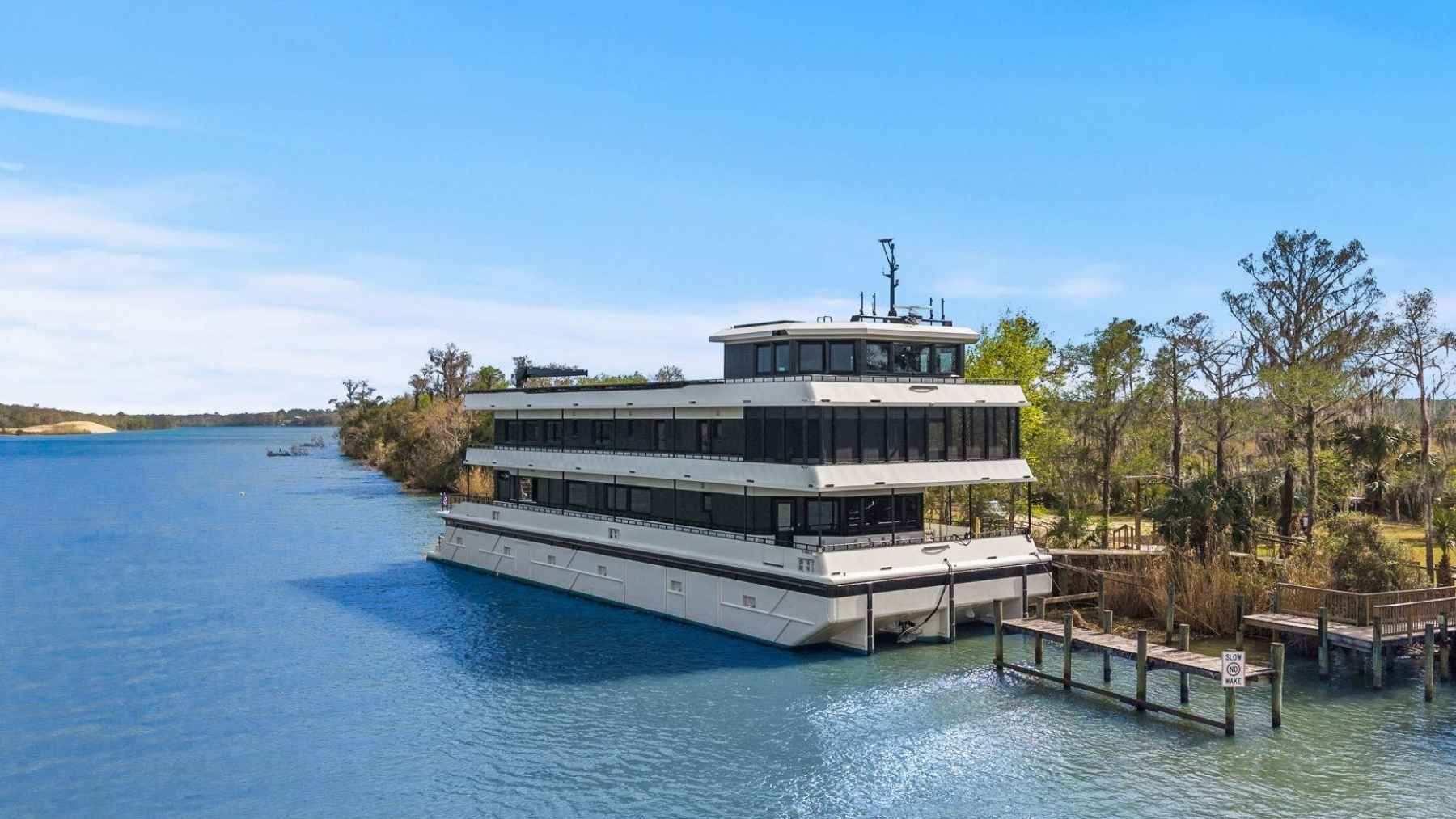

Bolting solar panels onto your roof is supposed to be the sensible, slightly dull way to go green. A few panels go up, your power bill drops, and on a sunny afternoon you sell a little electricity back to the utility. A Florida couple took that exact idea and pushed it about as far as it will physically go. They commissioned a 120-foot aluminum mansion that floats, wrapped its entire roof in 108 solar panels, and built it to live completely off the grid for months at a stretch. It is called Shine Down, it is tied up in Apalachicola, Florida, and according to the brokerage listing it can be yours for $15 million.
This is not a yacht in the way most people picture one, and that is the entire point. Breaux Brothers, the Louisiana shipyard that built it, has spent four decades welding commercial-grade aluminum work boats, and the GLV-120 is its first real swing at luxury living on the water. What came out reads less like a superyacht and more like a four-level apartment building that somebody floated. The solar array runs the home. The one thing it does not run, as we will get to, is the part where the boat actually goes anywhere.
It reads like a building because it basically is
The numbers are house numbers, not boat numbers. Shine Down stretches 120 feet long with a 38-foot beam, weighs in around 330 gross tons, and packs more than 11,800 square feet of total deck space, over 6,400 of it enclosed interior, on a flat-bottomed aluminum barge hull. The layout runs across three main decks plus a rooftop pilothouse, and inside there are five king-size bedrooms, seven bathrooms, a run of salons and lounges, dedicated offices, and two laundry rooms. The interiors were done by Rita Durio and Associates.
Then come the touches that give the game away. There is a swimming pool on the rear main deck, a side-loading garage for a tender and jet skis, and a dumbwaiter that runs dishes and drinks up to the rooftop pilothouse, which doubles as a party deck and observation lounge. The design language is deliberate. No stylized clipper bow, no attempt to look fast. It is a residential rectangle that happens to float, and the builder leaned all the way into that rather than fighting it.
108 panels and 300 kWh run the household
The roof is the headline. 108 high-efficiency solar panels sit edge to edge across the top of the vessel, feeding more than 300 kWh of lithium iron phosphate (LFP) battery storage, the same broad chemistry now turning up in grid-scale battery farms because it runs cool and holds up over thousands of cycles. Behind the cells sits 170 kW of inverter power. Per the builder’s own breakdown, the solar system handles lighting, cooking, climate control, fresh-water production and even wastewater treatment, which is how the boat can sit at anchor for months without a shore cord or a generator droning away in the background.
Rhonda Shelley, who owns the boat with her husband Phil, told Louisiana TV station KLFY that the setup lets them “live off the grid if you need to for months and months.” The pool, for what it is worth, is solar-powered too. It is the same basic promise as an off-grid solar home that banks its own power by day and feeds it back at night, only scaled up to something the size of a small hotel and set on the water.
Three diesel engines do the part the sun can’t
Here is the line the brochure language tends to skate past. The solar runs the home. It does not move the boat. According to the builder’s own description, when Shine Down is underway it leans on three Cummins QSM11 diesel engines, one of which drives an azimuthing bow thruster, all of it managed through joystick control. Feeding them is a 5,000-gallon diesel fuel tank.
So “makes all its own power” is completely true for the lights, the air conditioning and the coffee maker, and not true at all for propulsion. To get anywhere, the boat burns diesel like any other 330-ton vessel its size. There is something quietly funny about a 5,000-gallon diesel tank parked directly under 108 solar panels, but the split is honest engineering: solar for the house, diesel for the journey. It is the same compromise an off-grid gold mine in Australia made when it ran six and a half days on sun, wind and batteries with every engine switched off, then kept its diesels on site for the days the weather quit.
Where a flat-bottomed barge can actually go
The hull shape decides the cruising ground, and this one is built for calm water. Maximum draft is just 5 feet, the bottom is flat, and the top speed is 10 knots with a 7-knot cruise. That is a recipe for the Florida coast, the Intracoastal Waterway and the Caribbean on a settled day, not for crossing an ocean. None of that is a knock on the boat. It reads like architecture because the priorities were a building’s: floor space, stability and standing headroom over seakeeping and range. A passagemaker built to punch through Atlantic swells would look nothing like this, and would have a fraction of the living area.
The couple, the build and the $15 million ask
Phil and Rhonda Shelley, both Florida natives based in Apalachicola, spent roughly three years taking the vessel from concept to reality with the shipyard, which had never built a luxury houseboat before this one. When it was finished, Shine Down got a proper christening in Loreauville, friends and community on hand, before being towed out down Bayou Teche in June 2025. Local outlet The Advocate pegged its value at $10 million as it left the yard. Phil Shelley, speaking to The Daily Iberian, called it “not just a boat, but a lifestyle.”
The asking price has since climbed to $15 million, listed through World Wide Yacht Sales and put back on the market in April 2026, and as of the middle of the year it is still available in Apalachicola. Breaux Brothers believes it is the largest solar-powered houseboat in the country, a claim no independent body has refereed but one that gets easy to believe once you count the panels. Whether a buyer agrees that a one-off floating estate is worth five million dollars more than it was valued at leaving the yard is the open question sitting on the listing.
The pitch underneath all the teak and marble is genuinely appealing: drop the shore cord, kill the generator, and run a full-size home off sunlight for months at a time. That part is real, and the 108 panels and 300 kWh of batteries deliver it. Anyone picturing a silent solar voyage to the islands just needs to remember the three Cummins diesels and the 5,000-gallon tank doing the actual moving. Shine Down is a house that makes its own power and a boat that burns fuel to travel, and at $15 million you are paying for both.