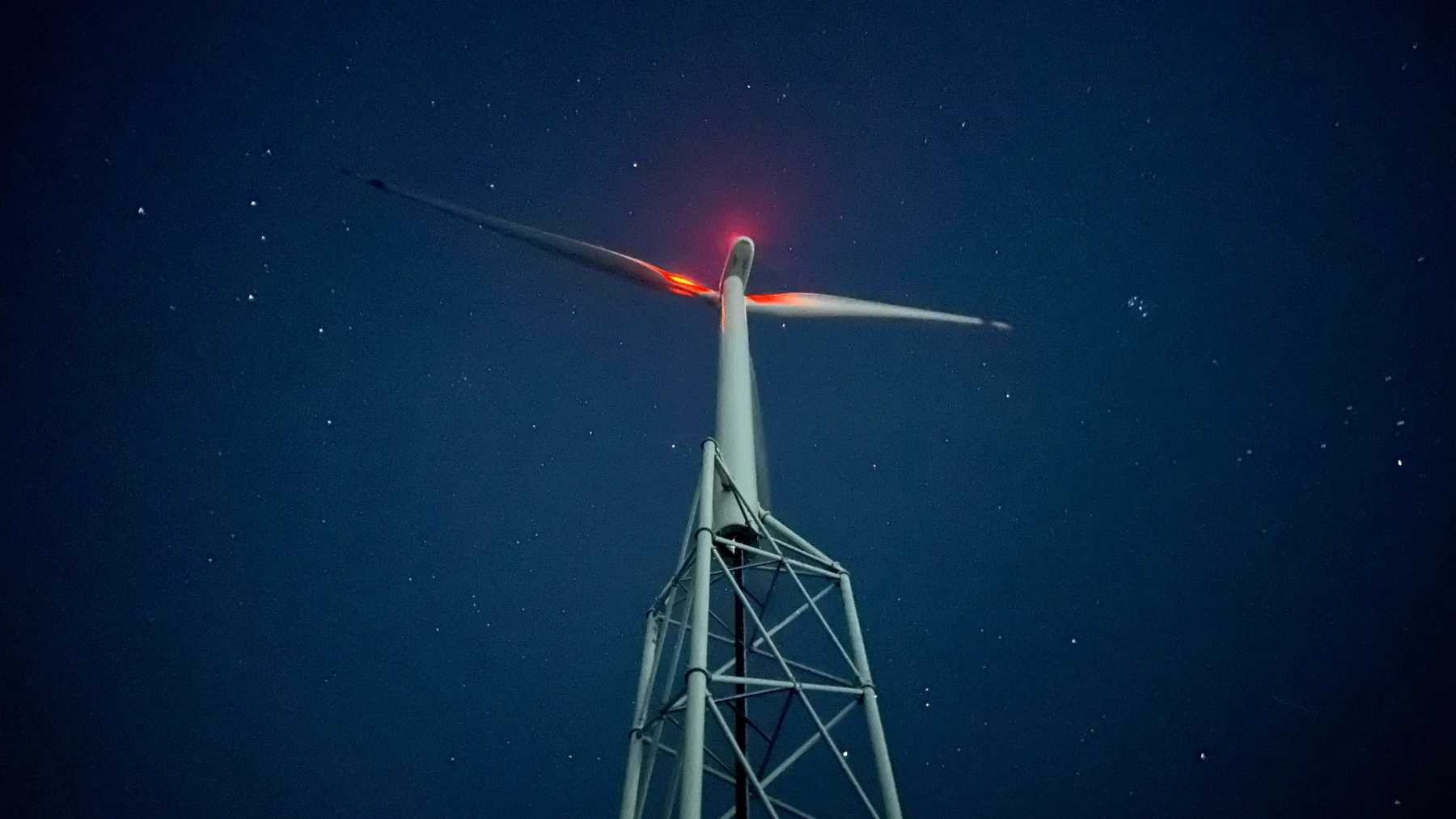

Every wind turbine you’ve ever driven past works on the same basic idea. Big blades catch the wind, spin a shaft, and a generator turns that rotation into electricity.
The blades are the entire point: no blades, no spin, no power.
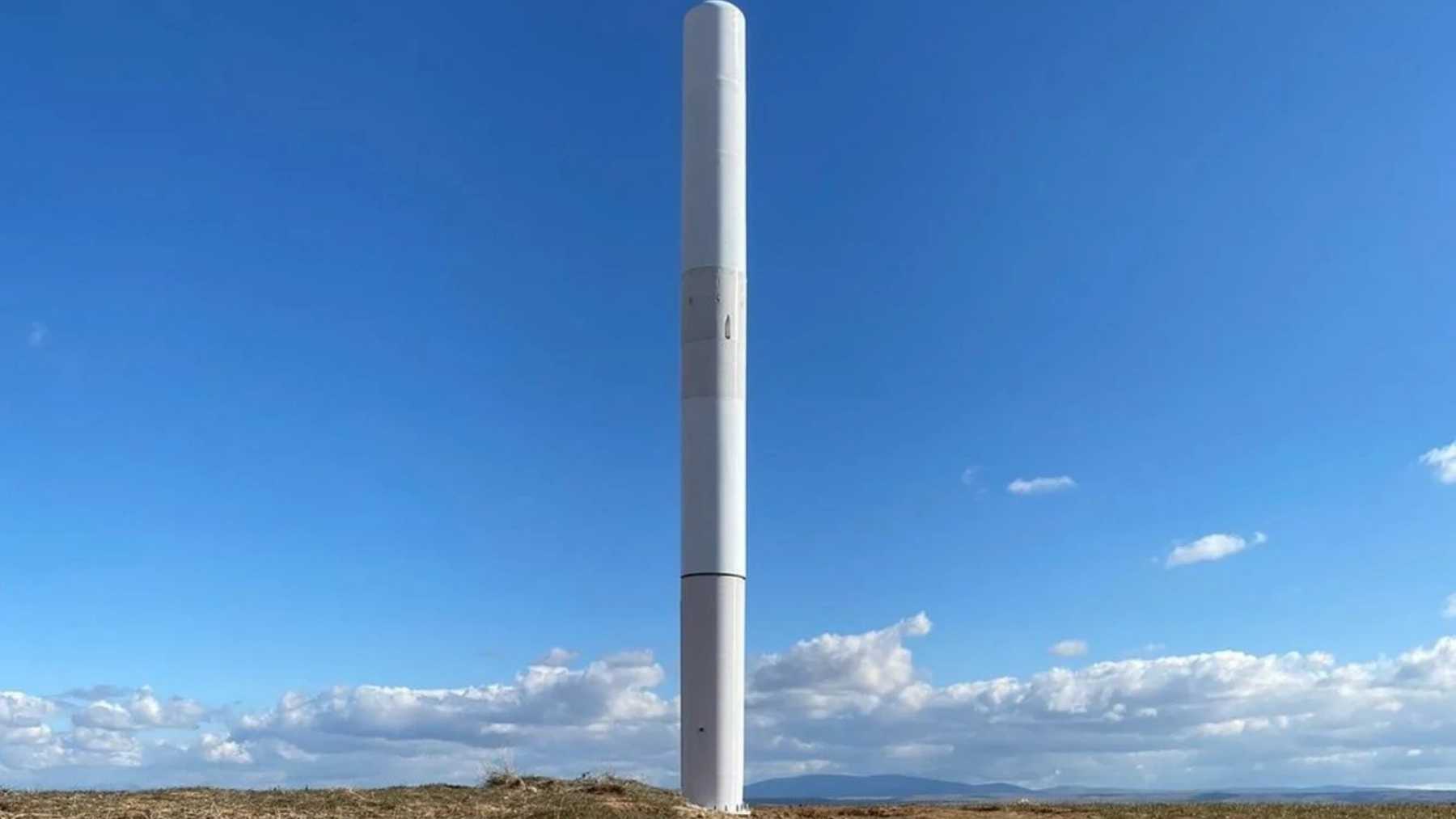
So it takes a second to make sense of a machine out of Spain that generates electricity from wind with no blades at all. It’s a tall, skinny cylinder bolted to the ground that, when the wind hits it, just shakes.
This isn’t a concept rendering that lives only in a press kit. The company behind it, a Spanish startup called Vortex Bladeless, has been building and testing these poles for over a decade.
The internet long ago handed the design a nickname it can’t shake: the “Skybrator.”
The physics underneath it is real, the prototypes are real, and the advantages it claims are real too — near silence, almost no maintenance, and no spinning blades for birds to fly into. The part still up in the air is whether any of it scales past powering a refrigerator.
The idea came from a bridge that tore itself apart on camera
If you’ve ever sat through a high school physics class, you may have seen the footage.
The Tacoma Narrows Bridge in Washington State, in November 1940, rippling and twisting like a ribbon in a stiff wind until it ripped apart and dropped into the water below.
Engineers have studied that collapse for decades as a cautionary tale about what wind can do to a structure when the two fall into a destructive rhythm.
Vortex’s inventor, David Yáñez, looked at that same footage and saw something else. If wind could pour that much energy into a bridge and shake it to pieces, then that energy was there to be captured rather than feared.
The company even named its flagship model the Tacoma, which reads as either a nice piece of engineering history or a slightly ominous branding choice, depending on your mood.
The whole product is built on deliberately doing the thing every bridge engineer since 1940 has worked to prevent.
No blades, no gears, no oil, and that’s the pitch
Here’s what’s actually happening when the cylinder shakes. When moving air flows past a fixed, rounded object, it doesn’t slide by cleanly.
It peels off in alternating swirls, first on one side, then the other, in a pattern engineers call von Kármán vortices. Each swirl shoves the object the opposite way, so a cylinder sitting in the wind gets pushed back and forth in a steady rhythm.
That’s vortex shedding, and it belongs to the same family of forces that got the Tacoma Narrows Bridge moving.
Vortex’s mast is a fiberglass and carbon-fiber tube tuned so that this side-to-side push lines up with the structure’s own natural frequency. When they match, the cylinder locks into resonance and the swaying grows large and consistent.
Down at the base, a linear alternator packed with neodymium magnets converts that motion into current. Nothing meshes, nothing spins on a shaft, nothing grinds against anything else.
The company patented a magnetic tuning system to keep the mast in its resonant sweet spot as wind speeds change, which is the clever part that stops it from only working in one narrow band of conditions.
Strip all that down and you get the sales pitch. Since nothing rotates, there’s nothing to lubricate: no oil, no grease, no gearbox to fail.
By the company’s own conservative estimates, posted on the Vortex Bladeless site, that pushes manufacturing costs roughly 53% lower and operating costs about 51% lower than a conventional turbine of the same height.
It runs close to silent, because there are no blades chopping the air. And because nothing sweeps through a wide circle, birds can fly right past it.
For anyone who’s followed the long fight over wind farms and bird deaths, that last point isn’t a small one.
The biggest working version powers a fridge
All of which sounds great until you ask the obvious question: how much power does it actually make?
This is where the story has to get honest with itself. Vortex lays out three sizes, and only the small ones exist as real hardware.
The Vortex Nano stands about 3 feet (1 meter) tall and is rated at 3 watts. That’s not a typo.
Three watts is trickle power, enough to keep a sensor alive or top up a small battery somewhere off-grid where running a wire would be silly, ideally working alongside a solar panel.
The Vortex Tacoma is the flagship: roughly 9 feet (2.75 meters) tall, about 33 pounds (15 kg), and rated at 100 watts. Jorge Piñero of Vortex has said a Tacoma that size could run “a fridge, many phones, and some LED lights” for an off-grid house.
The third model, the Atlantis or Grand, is penciled in at 9 to 13 meters and around a kilowatt, but that one lives on paper, not in a field.
Piñero’s point, and the company’s entire bet, is that the physics rewards going big.
The energy you can pull out climbs with the square of the height and the cube of the wind speed, so a taller mast in a faster wind isn’t a little better, it’s dramatically better.
On paper, that math is exciting. The catch is that paper and a working 50-meter resonating tower are very different animals.
Making it bigger is the whole problem
Scaling a bladeless turbine isn’t a matter of building the same thing larger.
The entire design hangs on keeping that mast at its resonant frequency, and as a structure gets taller, stiffer, and heavier, that sweet spot shifts and gets harder to hold. You’d also need a much larger generator at the base to capture all the extra motion.
Vortex has said it’s working toward a larger, grid-relevant prototype and is courting partners to help it scale. But turning a 9-foot, 100-watt unit into something a utility would care about is a real engineering jump, not a formality.
That gap is also where the hype lives, so it helps to separate ambition from spec.
Some coverage has floated capacity figures for future bladeless machines that run well ahead of anything the company has demonstrated, and those numbers are best read as goals, not specifications. What’s been shown in the field is a 3-watt Nano and a 100-watt Tacoma.
Skeptics have circled for years for exactly this reason. PBS SoCal flagged early on that the design might not hold up against the real-world output of bigger turbines, and plenty of engineers have pointed out that there’s only so much motion happening down at the base, which is where the power actually gets made.
The rest of the industry, meanwhile, is sprinting in the opposite direction. China keeps rolling out ever-larger bladed turbines, and Germany is lining the Rhine with wind and solar using conventional hardware.
Vortex isn’t trying to win that race. Its pitch has always been that the bladeless design belongs where the big machines can’t go, like rooftops, dense neighborhoods, and off-grid cabins, rather than out on a wind farm.
The math is now being checked outside the company
What’s shifted lately is that Vortex no longer has to make its case alone. Independent researchers have started running the numbers on bladeless turbines, and that outside scrutiny is arguably worth more to the technology than any company statement.
In 2025, engineers at the University of Glasgow published a study in the journal Renewable Energy using a wake-oscillator model to map how the geometry of these machines could be tuned for maximum efficiency. That’s the kind of foundational math that has to be settled before anyone builds a serious large one.
Their framing was honest: bladeless turbines are still at an early research stage, and work like this is what might move them from small field experiments toward real grid-scale generation.
The interest hasn’t cooled in 2026, either. A study published in the journal Energies in February 2026 proposed and simulated a new bladeless design with a cylindrical-cam mechanism for turning the sway into usable energy.
That’s fresh evidence the academic world still treats this as an open problem rather than a dead end.
Vortex has picked up some credibility along the way, too. Norway’s state energy company, Equinor, has named it one of its ten most exciting energy startups, the kind of nod that tends to open doors with investors.
None of that proves a bladeless turbine will work at scale. It does mean the question is being taken seriously by people with no product to sell.
So is the swaying pole the future of wind?
Somewhere genuinely interesting and clearly unfinished.
The small units work, the physics is sound, and the upsides are real: quiet, low-maintenance, bird-safe, and easy to tuck into spots a 200-foot blade will never reach. That fits neatly into a world bolting solar onto rooftops and stitching together small off-grid setups.
Whether Vortex can carry the same trick up to a mast big enough to matter on the grid is the one thing nobody can answer yet, including Vortex.
The most honest way to think about the Skybrator today is as a clever solution still hunting for the right size, and as proof that a bridge shaking itself apart in 1940 might yet turn out to be a decent blueprint for keeping the lights on.
 @shonhauck ROOKIE3 months ago