- 3 MONTHS AGO · MILITARYA US Army Black Hawk fired a drone off its wing pylon over the Mojave, it joined others, one of them found a target and told the rest, and another hit it. Nobody in the helicopter steered any of it, and the Hellfire that crew usually carries reaches 6.8 miles
- 2 MONTHS AGO · MILITARYA 23-foot American drone sailboat that rides the wind on a 15-foot rigid wing turned up burning in an Iranian video at the mouth of the Strait of Hormuz, and four days later a US drone put two missiles into boats grabbing at another Navy surface drone
- 2 MONTHS AGO · MILITARYA 54,000-pound twin-rotor special operations helicopter set down on a self-driving drone barge holding position with nobody aboard, took on supplies right on deck, and the landing is the first of its kind the American public has been told about
- 2 MONTHS AGO · MILITARYAn 18-foot drone boat ran into a surface target off Turkey and set off a live 220-pound warhead for the first time, after trials with an inert lump bolted in where the bomb goes, and the target was picked out for it by a drone aircraft flying its own first navy exercise
- TODAY · THIS ARTICLEA 23-foot drone boat fired a winged kamikaze drone out of a launcher on its deck at a NATO exercise, the aircraft popped its wings open and streamed live video into the Spanish fleet’s combat software on the way to its target, and nobody was aboard the boat or the aircraft
When you think of drone boats, you probably think of Ukrain’s cheap drone boats that have been blowing very expensive holes in Russian warships. Every navy with a coastline took notes, and the copycat phase keeps producing new tricks.
Just this week, we covered an 18-foot Turkish drone boat that set off a live 220-pound warhead against a surface target. Spain’s now taken its swing, and it went a different way. Instead of turning the boat into a weapon, the Spanish Navy turned the boat into a launchpad.
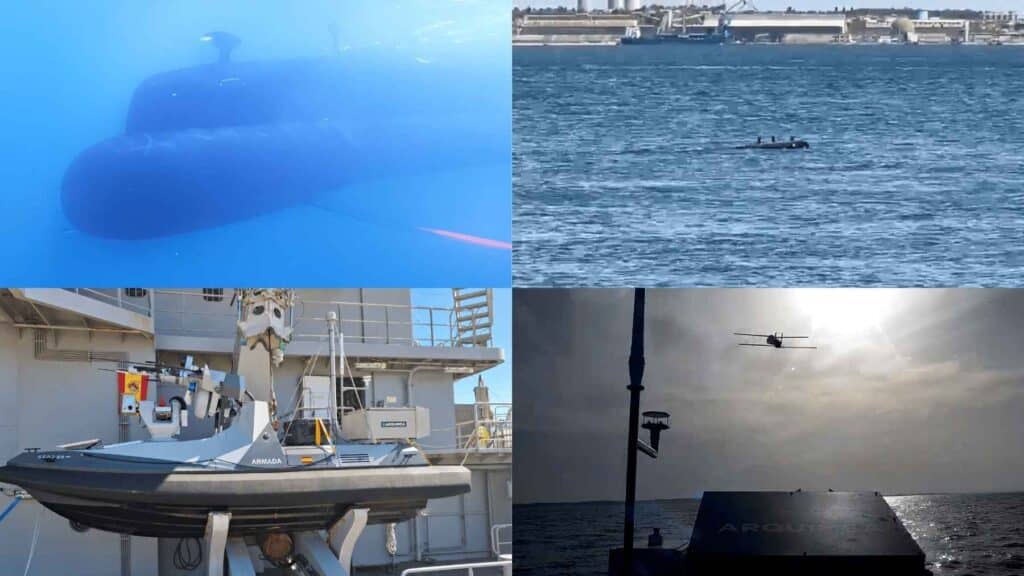
It happened at REPMUS, a NATO experimentation exercise that the Portuguese Navy hosts off its coast every year; this edition ran from August 31st to September 25th. A Spanish Navy drone boat carried a winged attack drone out to sea in a launcher on its deck and fired it off. The little aircraft powered up on command, flew away from the boat, streamed live video back into the Navy’s command systems, and arrived at its target. Arquimea, the Madrid-based company that builds the drone, announced the test on September 29th, and the Spanish defense outlet Infodefensa identified the boat as the Sead 23, with the munition riding in a multiple launcher on deck.
Nobody was aboard the boat. Instead, an operator ran the entire sequence remotely. Arquimea says the drone handled it all while plugged into the NAIAD/SCOMBA NG ecosystem, in accordance with NATO’s STANAG 4817 standard. I’ll explain all these terms in a second.
So was this a first?
Not exactly.
Arquimea bills it as the first loitering munition launch from an unmanned surface vehicle, and that claim needs some scoping. MARTAC, a Florida company, fired Switchblade loitering munitions off its 38-foot Devil Ray catamaran at targets in the Arabian Gulf back in 2023. Ukraine went further still in April, when a crewless boat launched an interceptor drone that knocked a Russian Shahed out of the sky.
So if you’re keeping score: it’s the first time the Q-SLAM-40 has flown off a boat, and the first time Spain’s navy has launched an attack drone from one of its own crewless vessels.
SCOMBA is the combat management software that runs on Spanish warships, and STANAG 4817 is a NATO standard for how drones and control stations communicate. So one ally’s console can task another ally’s robot, which matters more than you’d guess from the acronyms. A demo drone that only answers to its maker’s laptop is basically a science fair project. But a drone that shows up inside a navy’s own combat system, as a weapon the fleet software can see and task, that’s a capability.
Arquimea got to prove that in front of participants from 36 countries and more than 130 companies.
The boat only joined the Navy in December
The Sead 23 comes from Seadrone, a builder in Galicia, up in Spain’s green northwest, and it isn’t some trade show prototype. The Navy spent about two years wringing it out, running it through three earlier editions of REPMUS plus BALTOPS 24 and NATO’s Dynamic Messenger, and craning it on and off warships, including the Juan Carlos I, Spain’s flagship. In December 2025, the Navy formally took delivery at its drone experimentation center in Rota, after a deal Spanish trade press put at about 1.1 million euros. Nine months later it was launching aircraft.
The Navy’s own spec sheet is refreshingly concrete. The hull runs 23 feet, a 250-horsepower diesel pushes it to a top speed of 34.5 mph, and it carries enough fuel for 230 miles at a 17-mph cruise. Payload tops out at 661 pounds. The standard fit includes a seafloor-mapping sonar, a surface radar, a day-and-night camera, and an AIS transceiver, the transponder system ships use to broadcast who they are and where they’re going.
That 661-pound budget has to cover everything the Navy straps on, launcher and drones included, so a 23-footer’s a pretty modest thing to hang an air weapon on. The link setup’s what makes the whole thing work anyway. The boat talks over three different connections, satellite, radio, and 5G, and hops between them automatically to keep the best one. Live drone video flowing through a crewless boat into a naval command center doesn’t happen unless those links hold.
And the drone it threw?
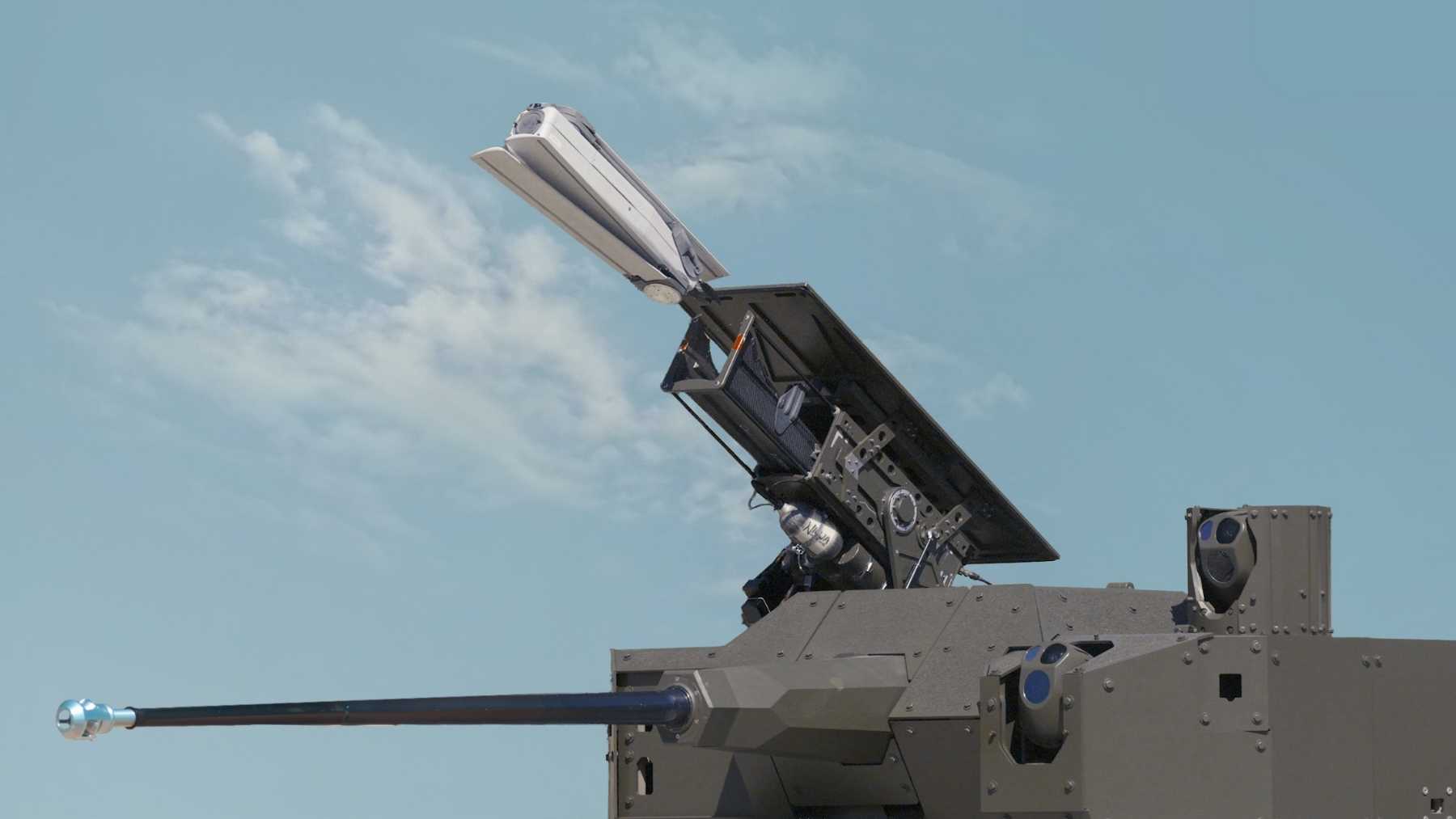
The Q-SLAM-40 is a loitering munition, which is the industry’s polite term for a kamikaze drone. If you haven’t run into the breed before, here’s the two-sentence version. It’s a small aircraft that gets fired out of a tube, pops open a set of folding wings, and circles an area while a human watches its camera feed. When the operator picks a target, the drone dives into it, and there’s no landing in the plan. Simple enough.
Arquimea designed the ground version to be carried by two soldiers in backpacks and to be set up in minutes, with the operator in the loop for the entire mission. And the company’s spent the past couple of years bolting it to pretty much anything that will hold still: armored vehicle turrets, a five-tube launcher on a ground robot, and now a boat.
Alright, there are a few things Arquimea hasn’t said, and I’d rather tell you than let you assume. The company hasn’t published which day the launch happened; its release is datelined September 23rd from Tróia, the Portuguese base the exercise runs out of. It hasn’t said whether this flight carried a warhead, either. The account runs through remote activation, launch, communications, navigation, and arrival at the target, and ends there, which is fairly standard for an experimentation exercise where the point is proving the chain works.
Manuel Martín, Arquimea’s general manager of defense, called REPMUS “an exceptional opportunity to demonstrate the performance of our solutions in demanding operational scenarios.”
The company isn’t slowing down on the integration front, either. On September 30th, one day after announcing the boat launch, Arquimea and EM&E Group showed the Q-SLAM-40 integrated into the Guardian 30 remote weapon station for armored vehicles at the Spanish Army’s 2E+I Forum in Toledo.
Image credit: Arquimea
 A 1,123-foot aircraft carrier with eight defueled reactors is under tow from Newport News to Mobile, where a scrapyard will cut the hulk apart around those reactors over the next four years while a 100-yard safety zone moves with herMilitary · 2 weeks ago
 A 13-foot-wide US Navy nuclear mini-sub rolled across the seabed off Scotland on wheels, found an F-14 upside down in fishing nets nearly 1,900 feet down and brought its secret Phoenix missile up with a Soviet spy trawler watching, after a month of sonar ships had come up emptyMilitary · 2 weeks ago
 Drone boats that ride almost awash like a drug smuggler’s semi-submersible just went to three American companies to prototype, and the Pentagon’s spec asks each one to haul 18,000 pounds of Marine supplies up to 2,000 nautical miles alone and sink itself on commandMilitary · 2 weeks ago