
If you’ve watched a war movie made in the last 50 years, you know how a wounded soldier gets off a battlefield. A helicopter comes. Someone pops smoke, a medic yells over the rotor wash, and the guy is on an operating table inside the hour. The US military even has a name for that window, the golden hour.
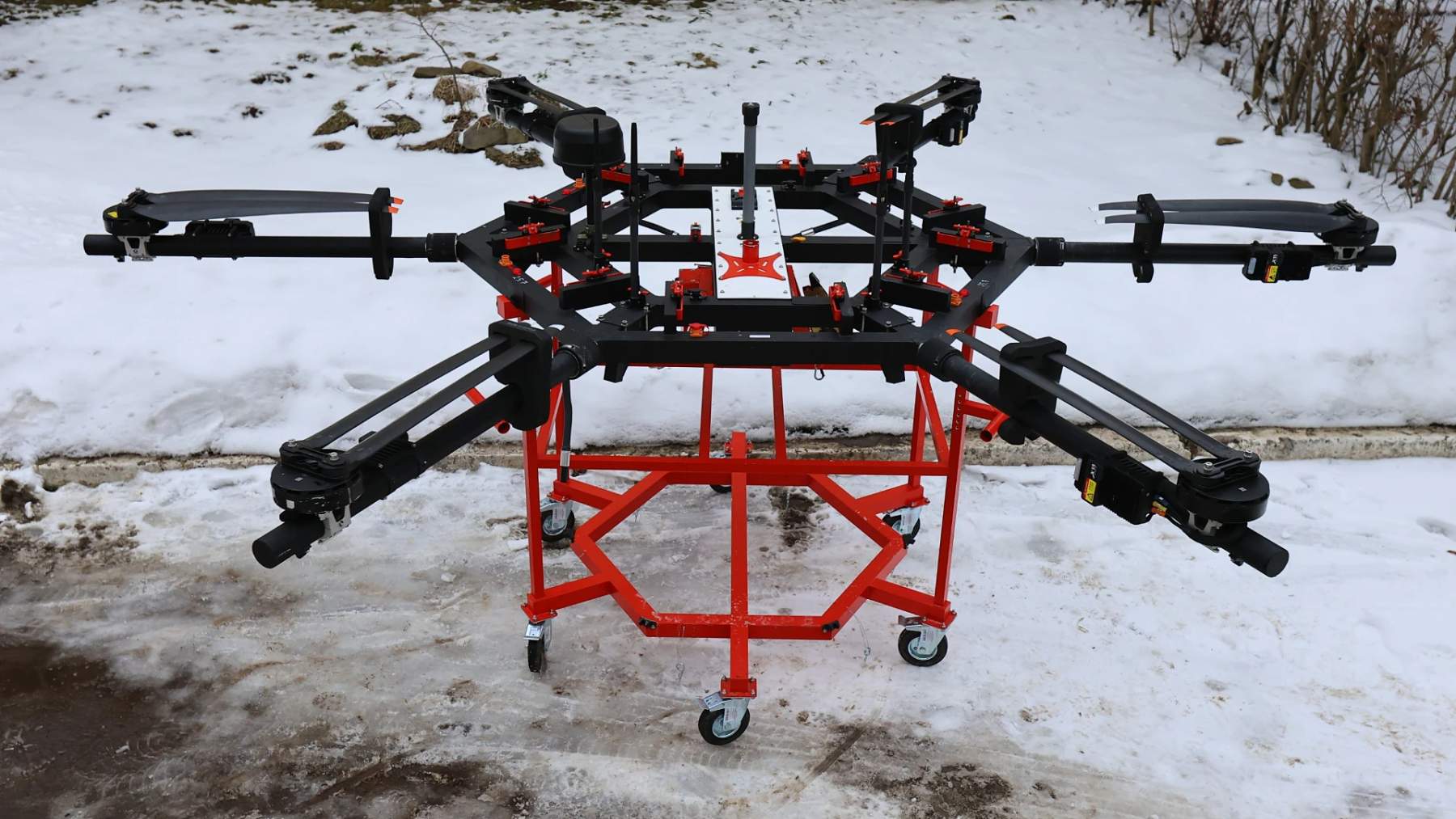
In eastern Ukraine, nothing with a rotor and a pilot in it gets anywhere near the front line, because the sky over the front belongs to drones. So when a 49-year-old infantryman named Kostiantyn Vlasenko lost both legs at a position no one could reach by land, the people trying to get him out eventually settled on the only aircraft that could go: a six-rotor cargo drone that weighs about 216 pounds, with an electric winch bolted to its belly.
Ukraine’s military and the drone’s maker, a Ukrainian company called Gurzuf Defence, announced the flight on October 19 and called it the first time anyone has flown a wounded soldier off a battlefield by drone. I’ll get to how solid that claim is. The short version is that I couldn’t find a counterexample.
So how does a soldier spend 491 days at one position?
Mezha, a Ukrainian defense outlet, got the detailed account from the units involved, and the military hospital in Kharkiv that’s treating Vlasenko filled in the medical side through Ukrinform.
On June 2 of last year, Vlasenko and a partner walked out to a position in the Kupiansk sector, on the far bank of the Oskil River from the rest of their unit, the 30th Mechanized Brigade. The position flooded, so they moved into an abandoned building. His partner was killed moving to a backup spot, by drone-dropped explosives according to the hospital, and from then on Vlasenko was holding an observation post by himself in the strip of ground between the two armies that both sides call the gray zone.
Then, on February 14 of this year, a Russian drone dropped a munition on him and wounded both legs.
I had to read this next part twice. No one could get to him. The Oskil sat between him and his own side, the approaches were mined, and Russian drones patrolled the area around the clock. His unit sent an unmanned ground vehicle, basically a tracked robot cart of the kind Ukraine now uses to haul ammunition and pull out wounded, and the Russians spotted it and destroyed it on the way in. Infantry couldn’t get through either. So a man with two wounded legs stayed where he was, and his unit’s drones kept him alive. Mezha reports that he had to finish the amputations himself to survive, and I’m going to leave it at that.
Gurzuf counts 491 days at the position in all. That’s nearly a year and a half, and more than seven of those months came after the wound.
Medicine fell out of the sky, and so did a loudspeaker
Small drones flew out to him with food, water and a pharmacy’s worth of supplies: Betadine, antibiotics, painkillers. Volodymyr Kupriianchuk, who runs the surgical infections department at the Kharkiv hospital, told Ukrinform that by the time Vlasenko reached him the wounds were already granulating, which is the medical word for tissue healing from the bottom up, and that the antibiotics the drones dropped are the reason there was no gangrene. “Without that, he would not have survived,” Kupriianchuk said.
The Russians used drones on him too, and one of their drops was a loudspeaker. By his own account to the hospital, it played a recording on a loop near his position: we know you’re here, your friends won’t come, walk toward the white light and it’s captivity, a prisoner swap and home. Vlasenko says he remembers every word of it. He shouted back the same unprintable reply a Ukrainian garrison gave a Russian warship on the first day of the war, and the next things to land near him were two anti-tank mines.
He’s 49. I’d like to think I’d have done the same, but I’ve never been asked.
So what is a Heavy Shot Ayudag-6?
It’s a hexacopter, so six arms and six motors, built by Gurzuf as a heavy-lift logistics drone. Picture a camera drone scaled up until it weighs about 216 pounds and can lift a load heavier than itself. Gurzuf and the units involved put the payload at up to 287 pounds, which is enough for a man and a harness. A spec sheet Ukrainska Pravda published earlier this year listed 150 to 200 pounds, so either the rating has grown with the new model or the evacuation rig is working the drone pretty hard, and I frankly can’t tell you which from here. Gurzuf hasn’t published a range for it either, and you’ll see why that matters in a minute.
The name is a mountain. Ayu-Dag is a peak on the Crimean coast right above the resort town of Gurzuf, both of them under Russian occupation, which is a pointed thing to name your drone after.
Until this month, the Heavy Shot family had two jobs: carrying ammunition and supplies to the front, and dropping bombs. The 30th Brigade already flew the bomber version, and that’s how the idea started. A battalion intelligence officer with the call sign Alex, who runs the drone side of his unit, heard Gurzuf was testing a new heavy model and asked whether it could carry a person. Mezha says the drone wasn’t finished yet and the engineers took the job anyway. From that conversation to the flight took close to six months.
So what did they bolt on? An electric cargo winch under the airframe, a harness system with carabiners, a thermal camera so the pilot could see him at night, and a Starlink terminal for the control link, per Gurzuf’s description of the rig. That last one is the big one.
If you’ve read anything about the drone war in Ukraine, you know both sides run electronic warfare gear that floods the radio frequencies drones use to talk to their pilots. Fly a normal drone into that and the video feed dies first, then the controls. Ukrainian FPV pilots get around it by flying on a fiber-optic thread that unspools behind the aircraft, but you can’t trail miles of glass fiber across a river. A satellite link over the jammers’ heads is the other way around it, and Ukrainska Pravda reports that’s what kept this drone talking to its pilot. Gurzuf says the jamming was constant for the entire flight.
A phone, a video and a heart made with his fingers
Mezha says the planners rated the hookup as the biggest risk, more than the flight. There’s no crew chief on a drone to clip a casualty in. So Vlasenko, with two wounded legs, had to strap himself to a harness hanging under a hovering 216-pound machine and get it right the first time.
The day before, the pilot recorded a video on a phone showing how to put the gear on and clip in, and a drone dropped the phone and the climbing gear at his position. The hexacopter itself got a camera aimed at the winch so the team could watch him work. The 30th Brigade pilot who flew the mission, call sign Chornyi, said Vlasenko followed the video step by step, and when he was ready he made a heart with his fingers for the camera.
I don’t know about you, but a phone tutorial is the most human piece of this whole machine.
About 15 people planned the mission over two months, by Mezha’s count, and dozens more worked it the night it ran, according to Artem Bohomolov, who commands Ukraine’s 10th Army Corps. Artillery, electronic warfare teams and air defense were all written into the plan. Drone units from at least four brigades took part, and specialists from the 3rd Army Corps fitted the hexacopter’s own jamming protection before takeoff. Other pilots flew Vampire bomber drones nearby as decoys so Russian spotters would watch the wrong aircraft, and Pravda reports one decoy was shot down while the Ayudag-6 went unnoticed. Bohomolov’s summary of all that was that there was no other way to save him.
The flight took 1 hour, 14 minutes and 36 seconds
Gurzuf published the mission numbers to the second: 1 hour, 14 minutes and 36 seconds in the air, and about 39 miles logged. Not all of that was with a man underneath. Ivan, one of Gurzuf’s directors, told Ukrinform the drone carried Vlasenko a bit over 9 miles, and the rest was the drone getting to him and getting home. Which is also why the missing range figure bugs me, because 39 miles is a long way for a six-rotor electric aircraft, and Pravda reports the hexacopter stopped along the route for a battery swap.
Vlasenko’s own review of the ride is pretty understated. He told the Ukrainian channel ICTV the flight felt calm and that the drone climbed to the height of three ten-story buildings, then higher, which puts him somewhere around 300 feet up. One part did get to him. “I was very worried when we flew over water, because I can’t swim,” he said.
The drone didn’t fly him to a hospital. It set him down at an intermediate position on the Ukrainian side of the river, where soldiers unhooked him and loaded him onto a ground robot called Myrotvorets, Ukrainian for peacemaker, which drove him another 5 miles over rough ground. From there a vehicle took him to a stabilization point for emergency surgery, and then to the military hospital in Kharkiv. The hexacopter made it back to base in one piece.
Is it really a world first?
Ukraine says so, and I haven’t found anything that contradicts it. Bohomolov was careful with the claim, telling Ukrinform he could vouch for a first in Ukraine but couldn’t speak for the rest of the world. AeroTime dug up two earlier demonstrations, a Lockheed Martin rescue test with an unmanned K-MAX helicopter about a decade ago and a US Army drill a year later, and both used a simulated casualty. As far as anyone has shown, no one had hung a real wounded man under a drone in a real war before this month.
The company that built it says don’t expect this every day
Pavlo Feldblium, a co-founder of Gurzuf, basically headed off the hype inside his own company’s announcement. Gurzuf never set out to build an evacuation drone, he said, just a heavy modular platform that ought to be able to pull off a rescue when there’s no other option. When he hears talk of thousands of these flights, or of drones putting every casualty inside the golden hour, that still sounds to him like Ray Bradbury. The risks to a wounded man in the air are too high, every mission has to be planned for one spot on the front, and “air rescue is a last resort,” as he put it.
That’s a fairly unusual thing for a drone company to say in its own victory lap, and I think it’s the right call. The 92nd Assault Brigade, whose ground-robot company handled the drone’s extra equipment, sees it a little differently and is already talking about making flights like this regular.
Vlasenko is still at the Kharkiv hospital, where surgeons spent several days stabilizing him and have operated several times since, with prosthetic legs and rehab ahead. Chornyi, the pilot, has been by to see him. Ukrainska Pravda reported on October 23 that Gurzuf Defence has decided to build the winch and mounting hardware into every production Heavy Shot Ayudag-6 it ships from now on.
Image Credit: pravda.com.ua