
American fighter jets have been named after birds of prey for about as long as anyone reading this has been alive. Eagle, Falcon, Raptor, Hornet. Every single one of them had a person strapped into the front of it.
The Air Force’s newest fighter is named after a bird too. This one is a falcon that hunts other falcons. And there is nowhere in it to put a pilot.
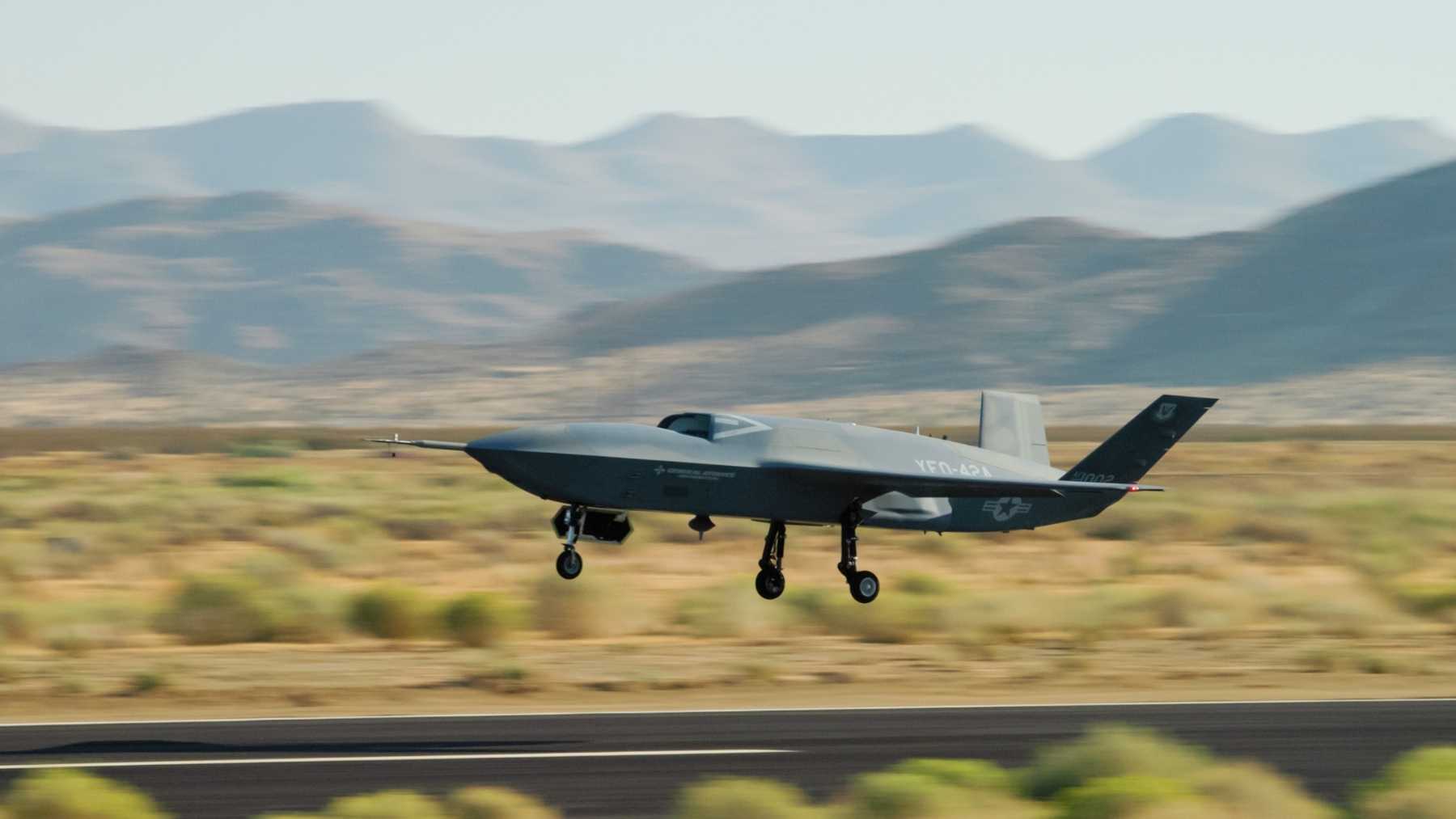
On June 17 the Department of the Air Force ordered two uncrewed fighters into production: General Atomics’ FQ-42A Dark Merlin and Anduril’s FQ-44A Fury. Secretary of the Air Force Troy Meink said in the service’s announcement that the contracts back a plan to buy “over 150 combat capable CCA by the end of the decade.” The eventual target is around 1,000.
At the time that was a press release with two jets attached to it. Over the last three weeks it stopped being paperwork. One of them fired a missile, both of them deployed to a base in the Nevada desert with weapons hanging off the wings, and the first production airframe rolled out of an Ohio factory that did not exist two years ago.
The letter they dropped is most of the story
Until June both aircraft were the YFQ-42A and the YFQ-44A. Now they are the FQ-42A and the FQ-44A. One character.
Air Force designation grammar is stricter than it looks. F means fighter, Q means uncrewed, and the Y in front means the airframe is an early production-representative test model. The Y comes off when the thing goes into real manufacturing, which is how the YF-16 turned into the F-16.
The FQ series, assigned in 2025, is the first fighter-drone designation the Air Force has ever issued. So these two are not just the first American aircraft to wear it. They are the first to earn their way out of the Y.
That distinction matters more than it sounds. The US has flown armed drones for a quarter of a century, and every one of them was a bomber, a spy plane or a missile with a camera on it. None of them were bought by the hundred to go looking for other aircraft.
One is named after a falcon that eats falcons. The other used to play the bad guy.
General Atomics named its aircraft in February, and the explanation it published is genuinely worth reading. Dark merlins are small, dark-feathered falcons that ambush other birds in flight, including other falcons, and they hunt cooperatively in groups.
They also happen to migrate through southern California, near where the aircraft is built. GA-ASI President David R. Alexander put it more bluntly in the naming release: “They harass other falcons for fun, and they eat what they kill.”
The company also admits the name winks at the wizard, quoting Arthur C. Clarke’s line about advanced technology being indistinguishable from magic. But the bird came first, and it is a neat piece of continuity that the Air Force’s most-produced fighter is a Fighting Falcon and its first uncrewed one is a falcon that preys on those.
Fury has a stranger backstory. The airframe started life at a North Carolina company called Blue Force Technologies under the name Grackle, then REDmedium, and it was designed to be the enemy. Its whole job was to imitate a modern adversary fighter during training so the Air Force would not have to burn hours on crewed jets doing it.
Anduril bought Blue Force in September 2023 and pointed the design at the CCA competition instead. The aircraft that was built to be shot at is now the one doing the shooting.
A factory that did not exist two years ago is now building fighters
On July 27, Anduril rolled the first Ohio-built Fury off the line at Arsenal-1, its plant in Pickaway County near Rickenbacker International Airport. Ohio Governor Mike DeWine was there for it.
The company’s own framing of the milestone was that 557 days earlier the site was nothing. Production there only started in March, which makes this the first complete aircraft the plant has ever finished, and the line is set up to build as many as 150 Furys a year in its current configuration.
General Atomics announced the same day that full-scale manufacturing of the FQ-42A is underway in San Diego. So both halves of the order are physically being built right now, about six weeks after the contracts were signed.
That pace is the entire pitch. The Air Force awarded the production contracts four months ahead of its own schedule, and the aircraft themselves went from first flight to production order in under a year. The Dark Merlin flew on August 27, 2025, and Fury followed on October 31.
It has not all been clean
On April 6 a Dark Merlin crashed shortly after takeoff from a company-owned airfield in the California desert. Nobody was hurt, but the aircraft was written off entirely.
General Atomics and the Air Force ran a joint safety review and traced it to the autopilot getting the aircraft’s weight and center of gravity wrong. The fix was software, and flight testing resumed on May 21, roughly six weeks after the crash.
The detail that keeps this from being a story about robots going rogue: that autopilot is the basic flight-control software, and it is a separate thing from the mission autonomy stack that actually decides what the aircraft does. The plane did not make a bad tactical call. It miscalculated how heavy it was.
Six weeks later the Air Force ordered it into production anyway, which tells you roughly how much appetite for risk there is in this program.
Australia already did the part America is still testing
On July 15 the Air Force announced that a Fury had fired an AIM-120 AMRAAM out of Edwards Air Force Base into closed airspace over the Mojave, working with the 412th Test Wing’s Air Dominance Combined Test Force. Anduril’s Mark Shushnar, the company’s VP of Autonomous Airpower, described it as “an end-to-end, beyond-line-of-sight strike against a simulated target.”
Read that carefully, because the wording is doing work. The Air Force’s own release said the shot was taken at a digital target, not a physical one. Military Times reported that an Air Force spokesperson described the missile itself as inert, while imagery of the round appeared to show live markings.
What was demonstrated is the kill chain: the aircraft took off, its software ingested a target track, a human on the ground authorized the engagement, and the missile came off the rail. The Air Force has been firm that weapons release stays with a person, and this test was built to prove that loop works, not to hit anything.
Which is why the comparison with Australia is unavoidable. Boeing’s MQ-28 Ghost Bat fired an AIM-120 at an actual airborne target back in December 2025, a milestone Australian Defence Minister Richard Marles announced alongside a A$1.4 billion order for six operational aircraft. We wrote about how far ahead Canberra had quietly gotten back in June, and this does not undo that. Boeing pitched the Ghost Bat for Increment 1 and lost to these two.
Ten days after the Mojave shot, both American aircraft went to Creech Air Force Base in Nevada for a July 20 to 24 exercise, run by the Collaborative Combat Aircraft Experimental Operations Unit under Lt. Col. Matthew Jensen. The point was Agile Combat Employment: operating from rough, remote locations with as little support equipment as possible. Airmen loaded inert AMRAAMs onto a Fury on the flight line and refueled it there. An April exercise at Edwards had involved Fury alone, so this was the first time both types worked the problem together.
Nobody will say what one of these actually costs
The Air Force’s stated goal is a unit cost under a third of an F-35, which works out to roughly $30 million or less. Col. Timothy Helfrich, the service’s acquisition executive for fighters, has said both designs are currently beating that number. He has not said by how much, and neither company has published a price.
Helfrich has also described the aircraft as “optionally attritable,” which is a careful way of saying the Air Force wants them cheap enough to lose without being so cheap that losing them is the plan. Budget documents released earlier this year showed the service asking for close to $1 billion in fiscal 2027 to buy its first batch.
The software is being bought separately, which is the genuinely unusual part of all this. Six vendors are in the pool for the mission autonomy: Anduril, General Atomics, Lockheed Martin, Northrop Grumman, RTX Collins Aerospace and Shield AI. Anduril, Collins and Shield AI got the first competitive production options, and a primary provider gets picked in summer 2027.
The Air Force built that around a government-owned open architecture so the same autonomy can be moved between different airframes, and structured the contract so it only pays the full licensing fee if operators say the software is any good. Shield AI’s Hivemind is one of the packages in the running, and it is the same autonomy stack the Pentagon picked for its LUCAS attack drones earlier this year.
Increment 1 is bought. Increment 2 is nine unnamed vendors sitting in a concept-refinement phase with about ten months left to run, and Helfrich has said as many as six could get prototyping work by roughly mid-2027. Whether that batch ends up cheaper and more expendable than these two or considerably more capable has not been decided.
What has been settled is narrower and more concrete than the headline number suggests. Two aircraft with no cockpits are in serial production, one has put a missile in the air, both have deployed to a desert base and been armed by regular airmen, and one crashed hard enough to be scrapped without the program losing a step.
The 150 figure covers the rest of the decade, and it is a floor rather than a ceiling. But the first one already exists, sitting in a building in Ohio, and the second production line is running in San Diego. Whatever else gets argued about, the part where America was still deciding whether to do this is finished.