
When most people picture a cutting-edge combat drone, they picture something stamped Made in USA or rolling out of a Chinese hangar with a slick promo video. Australia doesn’t usually make that list, which is fair: the country isn’t famous for designing fighter jets, and the last time it built its own combat aircraft, Lyndon Johnson was in the White House. So it’s a little awkward that the most mature AI-piloted fighter drone in the allied world right now is Australian, has already shot down a target with a live missile, and suddenly has Germany and the US Navy circling.
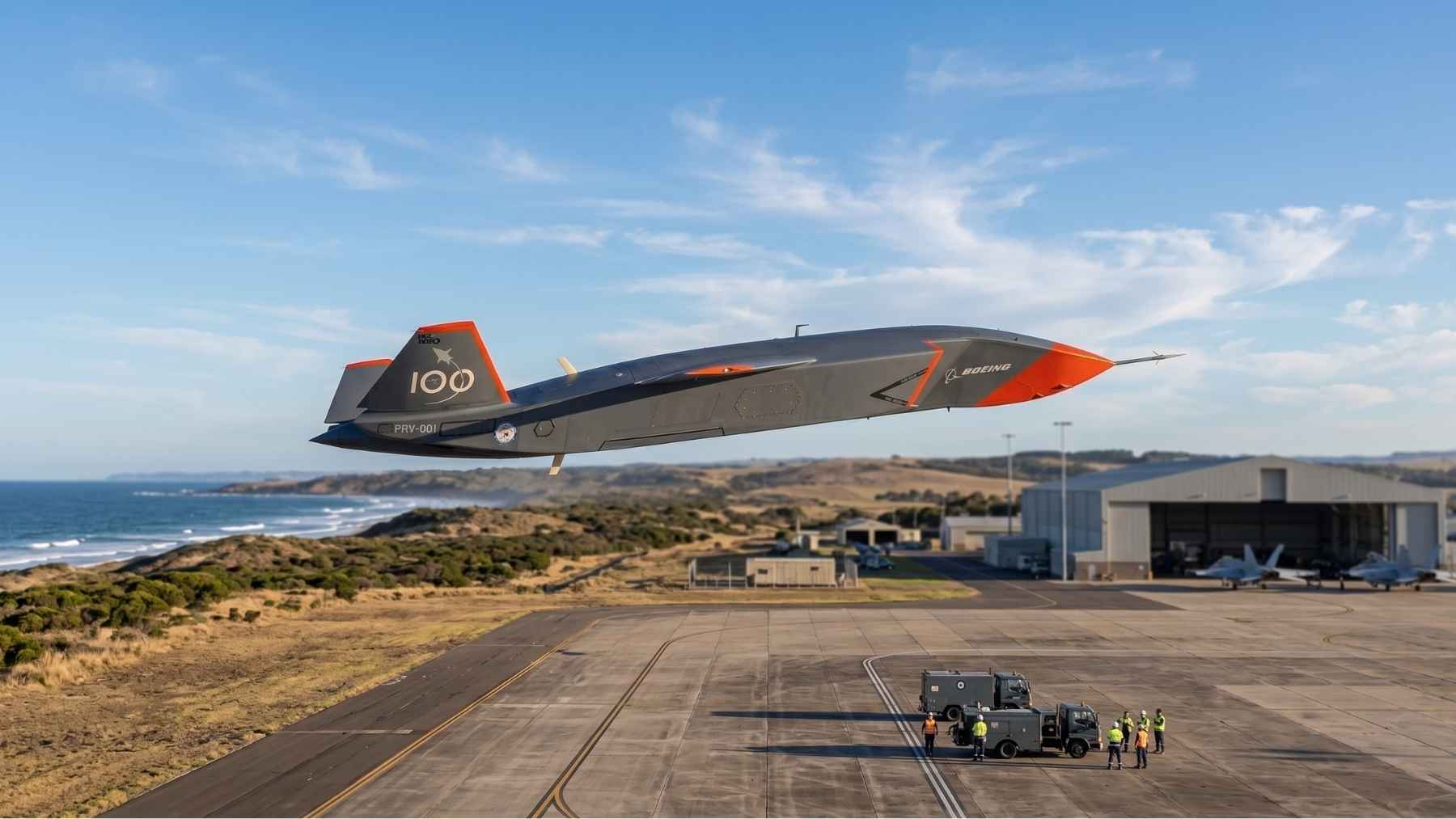
The aircraft is the Boeing MQ-28 Ghost Bat, a stealthy loyal wingman built to fly alongside crewed fighters and do the dangerous parts of the job on its own. Canberra has poured billions into it while almost nobody outside defense circles paid attention. Now Berlin wants a version in service by 2029, the Ghost Bat has just flown its first missions on US soil, and Boeing is shopping it around Europe and the Indo-Pacific like a salesman who realized he’s holding the only finished product on the lot.
The $2.4 billion drone nobody outside Australia noticed
The money trail is what makes this unusual. Canberra had already sunk on the order of a billion Australian dollars into the Ghost Bat’s development, and in December 2025 the Albanese Government committed roughly A$1.4 billion (about US$930 million) to push the MQ-28A from prototype to a frontline, combat-ready aircraft for the Australian military. That pushes the running total toward A$2.4 billion.
And that sits inside a much bigger bet. Australia is putting more than A$10 billion into drones this decade, at least A$4.3 billion of that into uncrewed aircraft, part of a wider push into autonomous systems across every domain. The aircraft slice of the December package was an A$754 million (about US$500 million) deal for six Block 2 jets plus the first Block 3 prototype, this time with an internal weapons bay in the design. When the deliveries are done, Australia will have 18 Ghost Bats in total.
For a sense of how rare this is: the MQ-28 is the first combat aircraft Australia has designed and built for itself in more than half a century. That isn’t marketing. The country has basically been a customer in this market for half a century, and now it’s the one with something to sell.
What the Ghost Bat actually does
Strip away the branding and the Ghost Bat is a CCA, a Collaborative Combat Aircraft. The idea is simple: an AI-piloted jet flies in formation with crewed fighters like F-35s or Super Hornets, stretches their sensor reach, absorbs risk in contested airspace, and can shoot if it’s told to. Boeing pitches it at roughly one-tenth the cost of a typical crewed aircraft, which is the kind of math that gets defense ministers to sign things.
The specs are properly fast-jet, not toy-drone. The MQ-28 runs about 11.7 meters long, has a maximum take-off weight near 3,175 kilograms, a range beyond 2,000 nautical miles, a single turbofan, a top speed approaching Mach 0.9, and a ceiling above 40,000 feet. That puts it in the same operating envelope as the manned fighters it’s meant to fly with. It’s also modular by design: the nose section swaps out for mission-specific payloads, from AESA radar and electro-optical sensors to electronic-attack and signals-intelligence kit, and eventually compact internal weapons bays. Swap the nose, change the job. The same airframe can be a sensor truck, a jammer or a shooter depending on what you bolt onto the front.
The shoot-down that changed the conversation
Until late 2025, the Ghost Bat was an interesting prototype that had flown a lot and never killed anything. That changed on December 8, 2025, at the Woomera Test Range in South Australia. During a mission the Australian Defence Force labeled Trial Kareela 25-4, an MQ-28 fired a Raytheon AIM-120 AMRAAM and destroyed an Australian-made Phoenix Jet target drone, working alongside a Royal Australian Air Force F/A-18F Super Hornet and an E-7A Wedgetail early-warning aircraft.
The choreography is the interesting part. The three aircraft took off from different places. An operator aboard the Wedgetail took “custodianship” of the drone once it was up, owning safety and engagement oversight. The Super Hornet flew formation with the drone, found and tracked the target, and pushed targeting data across the network. The MQ-28 then repositioned and, once the E-7A cleared it to engage, took the shot. Three platforms, three locations, one networked kill chain, with the autonomous aircraft pulling the trigger.
And autonomous here is closer than you’d think. According to Boeing Phantom Works general manager Colin Miller, the operator issued only four major commands across the whole engagement: take off, fly a combat air patrol, commit to the intercept, and clear the MQ-28 to arm and fire. Four button presses, one dead target drone. Boeing billed it as a milestone: by its account, no autonomous aircraft had pulled off “an air-to-air weapon engagement with an AIM-120 missile” before, though it wasn’t the first uncrewed jet to loose a beyond-visual-range shot. Turkey’s Baykar got its Kizilelma to fire a Gokdogan about a month earlier, in November 2025.
Why Germany suddenly cares
This is where the export story turns real. Germany has been agonizing over how to field a Collaborative Combat Aircraft on a tight timeline without strangling its own industry, and the Ghost Bat happens to be the one CCA in the allied world that has already shot something down. On March 31, 2026, Rheinmetall, Germany’s largest arms maker, announced a partnership with Boeing Defence Australia to jointly offer the MQ-28 to the Luftwaffe, with Rheinmetall acting as the in-country system manager. If Berlin picks it, Germany becomes the Ghost Bat’s first export customer.
Four days earlier, German Defense Minister Boris Pistorius had said publicly, on a visit to Australia, that the Ghost Bat was under consideration, and that Germany wanted a flexible buying approach rather than a traditional long-term contract. Translation: Berlin doesn’t want to spend six years writing a requirements document while Russia keeps doing Russia things. The Bundeswehr is racing a 2029 in-service target driven by the looming retirement of its Tornado fleet.
It’s not a done deal. The Boeing-Rheinmetall pairing is up against an Airbus-Kratos offer based on the XQ-58A Valkyrie, a General Atomics European CCA built on the US Air Force’s YFQ-42A, and Helsing’s still-unflown CA-1 Europa. But the Ghost Bat has something the others don’t: around 150 flights logged and a real air-to-air kill.
The Americans got in early, and quietly
The US angle surprises people, because the Ghost Bat is technically a Boeing aircraft and Boeing is American, yet the program is run out of Australia and the Pentagon has spent years circling it rather than building from scratch. Back in August 2022, then-Air Force Secretary Frank Kendall floated buying the MQ-28 for US service, and the two countries later signed a collaboration arrangement on it.
In May 2026 the talking turned into flying. Boeing confirmed on May 27 that an MQ-28 had completed three operational flights at the Point Mugu Sea Range, at US Naval Base Ventura County in California, the aircraft’s first missions ever flown outside Australia. Boeing framed them as proof the drone can be dropped onto an allied base and turned around fast, and as a show of its “maturity and potential export opportunities.” Days later, on June 1, the company said it had also validated the MQ-28’s radar cross-section, the stealth measurement that matters to any air force buying into a contested-airspace mission. The choice of a US Navy range, rather than an Air Force one, wasn’t subtle about where Boeing thinks the buyers are.
Boeing isn’t shy about the pitch. It’s chasing export customers across the Indo-Pacific, where Japan, South Korea and Singapore have all shown interest, and at the Paris Air Show in June 2025 Boeing’s defense chief Steve Parker confirmed talks were also underway with the UK.
What’s actually being built next
The Block 3 variant is where this gets dangerous in the literal sense. Unveiled at the 2026 Singapore Airshow, it tucks weapons inside the airframe (the AIM-120 or the GBU-39 Small Diameter Bomb) and stretches the wingspan from roughly 6 to 7.3 meters, adding about 30 percent more fuel. Internal bays matter because external pylons wreck stealth, and the December kill flew its AMRAAM on an external pylon, fine for a test, bad for a real fight. A Block 3 with its missiles tucked inside is a meaningfully different animal, and Boeing plans to start building it in 2028.
The industrial base is scaling to match. Boeing is building a 9,000-square-meter hall at the Wellcamp Aerospace and Defence Precinct outside Toowoomba, Queensland, to handle final assembly and integration. The program already underpins over 440 skilled jobs across Boeing Defence Australia and more than 200 local suppliers, with 70 percent of the money staying onshore. That sovereign-industry angle is exactly what Germany wants to copy with Rheinmetall, and part of why Berlin finds the Ghost Bat structurally more attractive than buying off an American line.
The unit economics, if Boeing hits them, are what could turn this from a one-country program into a NATO-wide platform. Analysts reckon a production MQ-28 might go for somewhere between $10 million and $15 million apiece, with air forces eyeing roughly two CCAs for every crewed jet on most missions. Two cheap autonomous wingmen per F-35 is the kind of math that turns a A$2.4 billion program into a serious export business, especially when the alternative is paying $80 million-plus for another crewed fighter with a human inside it. It’s also the direction the whole field is heading, with the US and its allies pouring money into cheap autonomous systems meant to add mass without adding pilots.
Whether the Ghost Bat actually closes deals with Berlin, Washington and Tokyo or just becomes the platform everyone studied before buying something else, Australia has already gotten what it paid for: a sovereign combat aircraft program, 200-plus local suppliers, a live air-to-air kill, and a seat at the table in the argument over what an AI air force looks like. Not bad for a country whose last home-grown fighter flew when the Beatles were still together.
 @brettrumble ROOKIE5 months ago