
If you live anywhere in Southern California, you’ve probably heard the words “Godzilla El Niño” thrown around a few times this fall. NOAA’s Climate Prediction Center expects a strong to very strong El Niño this winter, and it favors wetter-than-average conditions across the southern tier of the country. That’s great news for most reservoirs.
It’s less great for Hodges Dam.
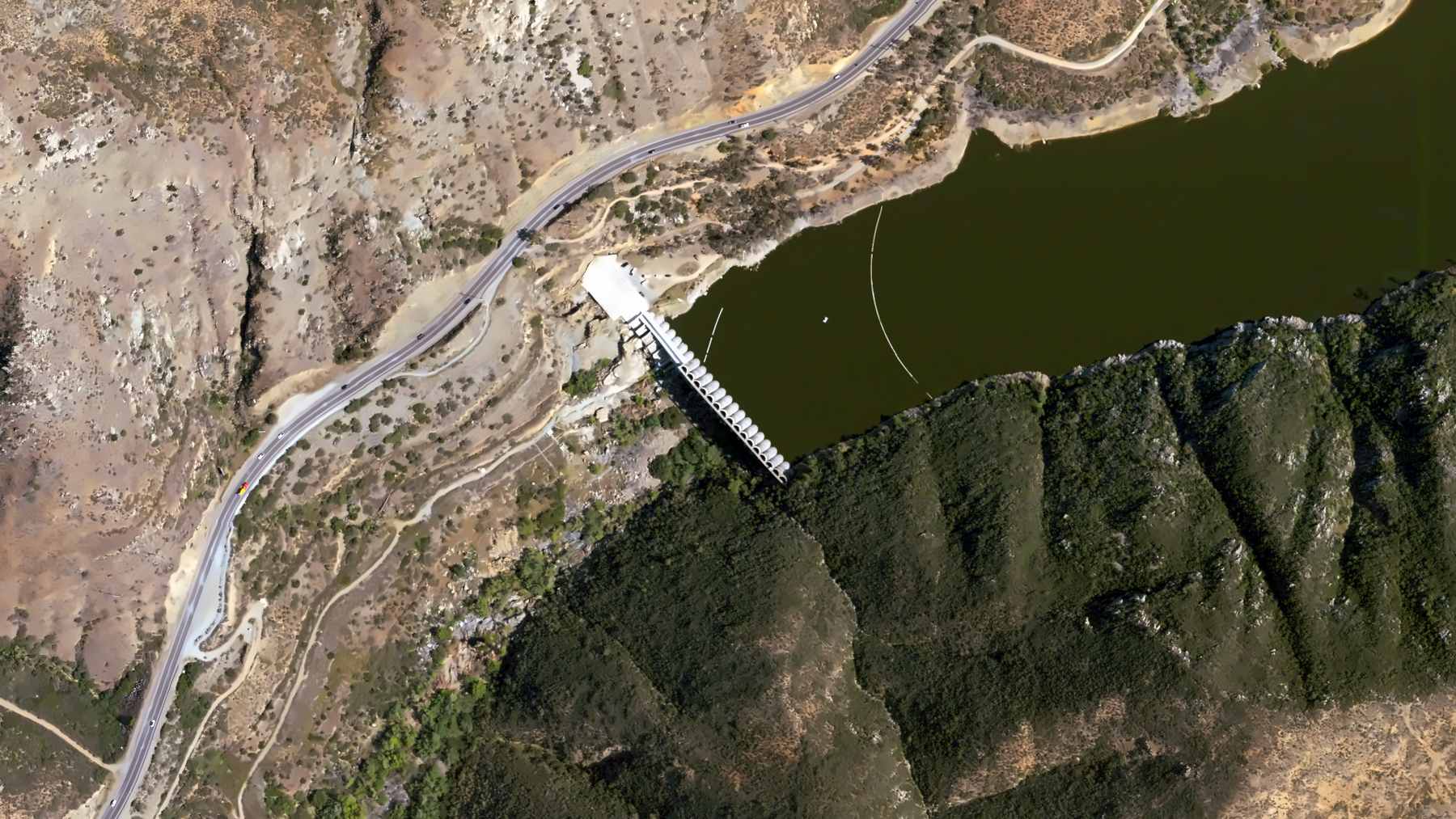
The dam sits on the San Dieguito River in north San Diego County, and it’s 108 years old. It’s also the only dam in California that the state’s Division of Safety of Dams (DSOD) rates as “Unsatisfactory.” The San Diego Union-Tribune reported on October 28, in a story picked up by the Water Education Foundation, that the City of San Diego, which owns the dam, plans to lower its spillway from 315 feet to 280 feet. That’s a 35-foot cut, and the paper puts the bill at $30 million to $50 million.
So what’s actually wrong with Hodges Dam?
It’s a multiple-arch dam. Instead of one big curved wall, you get a row of concrete arches, each about 24 feet across, braced by buttresses on the downstream side. According to the city, the whole thing stands 131 feet tall and runs 729 feet along the crest.
Hodges has been sliding down the state’s scale for a while. DSOD called it “Fair” in 2017, mostly over worries about spillway capacity. Two years later, engineering studies confirmed the dam was seismically unstable, and it dropped to “Poor.” Then a 2022 inspection found widespread concrete deterioration, and the state moved it to “Unsatisfactory.”
The city’s explanation of that last downgrade is pretty blunt. In its Hodges Reservoir and Dam FAQ, revised this month, the city says the damage “could not be repaired without further compromising the Dam’s integrity.” Basically, fixing the concrete properly would mean doing more harm to a structure that’s already in bad shape. San Diego did patch up concrete on the spillway apron and on both faces of the dam a few years ago, but the city admits those repairs didn’t make Hodges any more stable.
If aging dam concrete sounds like a familiar story, we’ve covered a Canadian hydro dam whose concrete has been swelling for decades. Hodges is in worse shape on paper: the state won’t let it hold a full lake.
Why would you make a dam smaller?
You’d think the fix for a weak dam would be to make it bigger and beefier.
So why cut it down?
A spillway is basically the overflow drain on a bathtub. Once the lake hits that level, water pours over the top and down a channel instead of piling up behind the dam. At Hodges, the spillway crest sits at 315 feet of elevation. But the state requires the city to keep the lake at or below 280 feet, a limit DSOD and the city settled on after modeling what a breach would do to the communities downstream. Which means there’s a 35-foot gap between where the water is allowed to sit and where it naturally starts spilling.
Keeping a lake inside that gap is manageable in a dry year. In a wet one, the city has to watch storm forecasts and dump water down the San Dieguito River to stay under the cap. KPBS and inewsource counted 13 releases between 2022 and this spring, totaling more than 41,500 acre-feet, or about 13.5 billion gallons. San Diego did it again in February after several days of storms.
And there isn’t a lot of hardware to do it with. According to the Union-Tribune, Hodges counts on a 36-inch pipe to move surplus water out of the lake, and a heavy storm could send in more than that pipe can handle. If the lake keeps rising anyway, the one dam in California the state rates as “Unsatisfactory” ends up holding back more water than it’s cleared to hold. Spillways on old dams are a recurring headache, by the way: an Idaho dam recently ended up with only nine of its 10 spillway gates fully working.
Lower the spillway to 280 feet and the lake starts spilling at the same level the state already caps it at, without anyone having to open a valve. Apparently the city looked at other options first, including a wider pipe, a second pipe and punching a hole through the dam, but state dam officials concluded a lower spillway was the only workable interim fix, the Union-Tribune reports. The city’s FAQ says DSOD approved the project in August.
A shorter spillway is the cheap option
None of this was supposed to be the long-term answer. The plan was always to build a brand-new dam about 100 feet downstream of the old one. Then a preliminary design study pushed the estimated price from about $275 million to between $474 million and $697 million. Under the original deal, the San Diego County Water Authority was supposed to cover half of it, with the city paying a quarter and the Santa Fe Irrigation District and San Dieguito Water District splitting the rest. After the cost jumped, the Water Authority told the city it didn’t believe it had a financial obligation toward a full replacement, and the city disagrees. San Diego has paused the replacement and is now studying alternatives, from a full-size dam to a smaller flood-only structure to no new dam at all, and that analysis is expected next spring.
So $30 million to $50 million for a shorter spillway looks pretty reasonable next to a $697 million worst case. It isn’t free of side effects, though.
The Water Authority spent $208 million on a pumped storage facility, finished in 2012, that links Lake Hodges to Olivenhain Reservoir. That pump needs at least 290 feet of water in Hodges to run, and it’s already sat idle in recent years because the lake has been held too low. The Union-Tribune reports it’ll become unusable once the spillway comes down. I’d argue that’s the most expensive casualty of the plan, even if it’s been gathering dust for a while.
Neighbors want a fuller lake
Friends of Lake Hodges and other civic groups near the reservoir aren’t fans. They’d rather keep the water higher, partly for boating and fishing and partly because a fuller lake keeps the surrounding brush moister during fire season. Residents interviewed by KPBS and inewsource in May wanted the level set at 295 feet. The groups have also asked whether a stopgap that costs tens of millions is worth it if a replacement dam might start construction not long after it’s finished.
I get it. At 280 feet, the lake holds less than 30% of its maximum capacity, private boat launching isn’t available, and Rancho Bernardo hasn’t forgotten the Witch Creek Fire, which destroyed 365 homes there. Still, a closed boat ramp is a much better problem to have than a failed dam, and that’s presumably why DSOD signed off.
So when does the work actually happen?
Not soon. The Union-Tribune reports the City Council isn’t expected to vote on design and funding until around 2030, with the spillway coming down around 2034.
That date’s a little awkward. KPBS and inewsource reported in May that the state requires an interim solution at Hodges by 2029. I couldn’t find anything from DSOD explaining how a finish around 2034 squares with that deadline.
Until then, the lake’s going to be run the same way it’s been run for years. The city says its operators keep an eye on lake levels, incoming flows and storms all through the rainy season, working alongside state and local agencies, which in practice means letting water go when the forecast looks ugly. If you live along the San Dieguito River, you’ll probably see a few more of those releases this winter.
The first real step is paperwork. CEQA is California’s environmental review law, and most public projects in the state have to clear it before anyone picks up a shovel. San Diego says design and CEQA permitting for the lower Hodges spillway will begin in spring 2027.