
Nobody mass-produces submarines. General Dynamics Electric Boat, the busiest submarine builder in the country, is working toward a rate of two Virginia-class attack boats per year in the early 2030s, and the Navy treats that number as ambitious. Which makes the newer tenant at Quonset Point, Rhode Island, a strange neighbor. A short drive from the yard where Electric Boat fabricates hull sections for nuclear submarines, Anduril runs a 150,000-square-foot plant designed to turn out as many as 200 autonomous submarines a year.
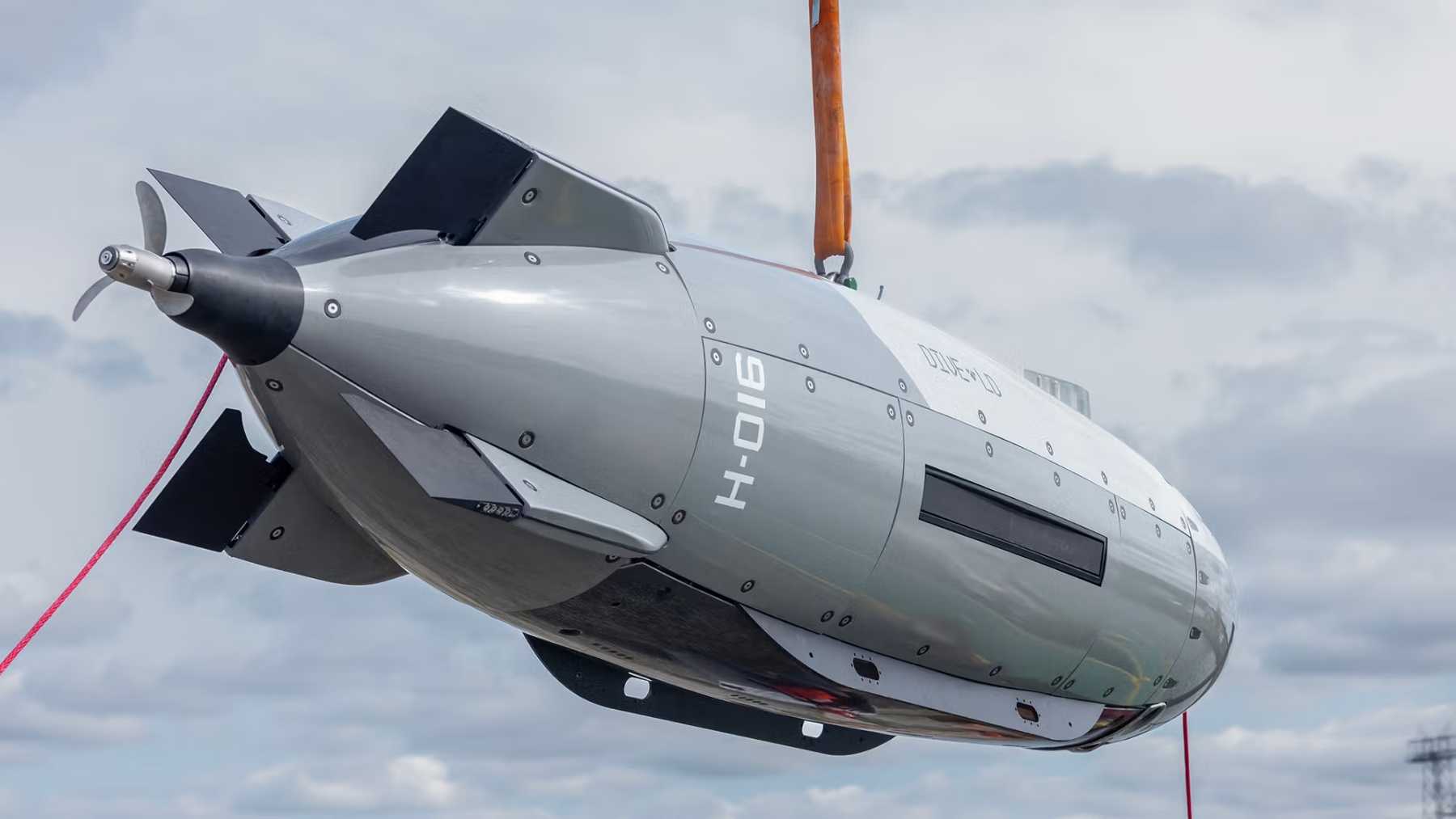
The machine that plant was built around is not the famous one. Anduril’s 39-foot Ghost Shark, assembled in Sydney for the Royal Australian Navy, gets the cameras and the ministerial photo ops. The Quonset Point line was tooled for the smaller sibling: the Dive-LD, a 19-foot underwater drone that dives to 6,000 meters, stays down for 10 days, and wears a hull that comes out of a printer.
The machine is 19 feet long and dives past 19,700 feet
The published numbers are compact. The Dive-LD measures 5.8 meters long, about 19 feet, with a 1.2-meter diameter, roughly 4 feet, and a dry weight of 2,720 kilograms. Call it a three-ton cylinder about the size of a small delivery van, minus the wheels and the driver.
The two figures Anduril leads with on its own product page are endurance and depth: up to 10 days submerged on a single mission, at depths down to 6,000 meters. That second number deserves a pause. Six thousand meters is about 19,700 feet, which puts the Dive-LD’s rated floor more than 7,000 feet below where the wreck of the Titanic sits. Crewed attack submarines have classified test depths, but every public estimate puts them in the hundreds of meters, not thousands.
It gets there slowly, at 2 to 7 knots, somewhere between a brisk walk and a light jog. Speed was never the pitch. The pitch is that the vehicle can cover around 580 kilometers of survey lines in one mission, per its published specifications, then come home and do it again with a different payload in its roughly one-cubic-meter bay.
The hull floods itself, and the shell comes off in 15 minutes
The Dive-LD survives those depths by refusing to fight them. The vehicle uses a free-flooded architecture, meaning seawater flows straight through the structure while the electronics sit inside individual pressure vessels. No giant steel pressure hull, no heroic welding. The Ghost Shark plays the same trick, and it is the single design choice that makes both machines buildable in a factory rather than a shipyard.
The outer shell is where it gets properly unusual. The Dive-LD’s exterior fairings are made by large-format 3D printing, and according to CompositesWorld, the full set of hull components for one vehicle prints in under two days. Two operators can strip every fairing off the frame in under 15 minutes. The design was pressure-tested at Woods Hole Oceanographic Institution before full-scale sea trials off the Massachusetts coast.
None of this started as a Silicon Valley defense project. The Dive-LD was created by Dive Technologies, a Boston subsea robotics startup that built the vehicle around off-the-shelf commercial components. Anduril bought the company in 2022 and inherited a drone that had been engineered for production volume before anyone had ordered production volume.
From 12 hulls a year to a 200-hull ceiling
Until this plant existed, every Dive-LD came out of Anduril’s maritime engineering center in Quincy, Massachusetts. That site could build 12 hulls a year, with the ability to push toward 24 depending on variant, the company told Janes in 2024. Fine for prototypes. Useless for a Pentagon that had started talking about undersea drones in fleet quantities.
So in June 2024, Anduril announced the Quonset Point factory, and Defense News reported the plant would eventually churn out “as many as 200 of its Dive-LD autonomous underwater vehicles annually.” The plan: open in late 2025, begin operations in early 2026, and hit full capacity by the end of this year, starting at 50 hulls annually and scaling to 200 if demand shows up. Rhode Island approved about $5.4 million in tax credits to sweeten the location, and chief strategy officer Chris Brose was blunt about the point of the whole exercise: proving to the government that Anduril can deliver on large contracts if those contracts arrive.
The schedule appears to have held. When Defense Secretary Pete Hegseth toured the factory in February, Rhode Island Current photographed employees hauling Dive-LD hulls across an active floor, with vehicles visible in various stages of assembly. Hegseth signed one of the panels and told the workers, “You’re on the frontlines of ensuring we stay ahead.” He then walked off to the Yardbirds’ Got to Hurry playing over the factory speakers, which was either a coincidence or the most on-message sound system in defense manufacturing.
There is also a program pulling the volume along. The Pentagon selected the Dive-LD for the second tranche of its Replicator initiative in 2024, the effort built specifically to field cheap autonomous systems in large numbers, and DefenseScoop reported the vehicles run about $2.5 million each. For reference, that is roughly the cost of a single heavyweight torpedo, attached to a machine you can use more than once.
The order book is filling from three directions
The U.S. Navy came first. After a Defense Innovation Unit swim-off, the service put $18.6 million into an initial buy of Dive vehicles, and the first Dive-LD was delivered to Unmanned Undersea Vehicle Squadron 1 in April 2025. Then in March of this year, DIU and the Navy picked Anduril for the XL-AUV program, the extra-large effort whose American Dive-XL variant, the container-shipped drone that sleeps on the seabed, comes out of the same Rhode Island building. Naval News noted the Quonset plant is designed to deliver dozens of Dive-XLs and hundreds of Dive-LDs per year, side by side.
Export customers came next. Taiwan’s state weapons institute, NCSIST, bought a Dive-LD alongside other Anduril kit and is scheduled to take delivery in August, this month, with crews already through acceptance training. That vehicle, as we covered when the deal surfaced, is contractually restricted to civilian work like inspecting the undersea cables that carry the island’s internet. Australia rounds out the map: the Royal Australian Navy already operates the Dive-LD, and Anduril’s Sydney line is configured to build LD variants alongside Ghost Shark.
Zoom out and the timing makes sense. The Navy has committed to 16 of Boeing’s 85-foot Orca drone submarines, Australia commissioned a Speartooth factory built on the same small-smart-many doctrine, and half a dozen navies are shopping for hulls. Quantity is now the product, and quantity needs a building.
Capacity is a ceiling, not an order book
The honest print on all of this: 200 hulls a year is what the plant can do, not what anyone has ordered. Anduril built the capacity ahead of demand on purpose, betting that the factory itself would unlock the contracts. Some of that bet has landed, between Replicator, the XL-AUV selection and the export deliveries. The full-rate deadline the company set itself is the end of 2026, which is now four and a half months out.
And there is something fitting about where the bet is being placed. Quonset Point has done mass production before. The Quonset hut, the corrugated half-pipe shelter the Navy stamped out by the tens of thousands during World War II, was invented on this same stretch of Rhode Island shoreline and named after it. The new product is a harder build. It has to keep working under 8,700 pounds per square inch.