
The usual way the Pentagon buys a big new machine is to pick one company, sign a long contract, and then spend the next decade explaining to Congress why it is late. The Navy has been doing exactly that with its robot submarine since fiscal 2017, and its own auditors have the receipts. On the follow-on program, the Defense Innovation Unit is trying the opposite approach: hire several teams at once, let them disagree, and refuse to choose yet.
That produced two announcements one day apart. On July 14, Kongsberg and Oceaneering said DIU had selected them for the Combat Autonomous Maritime Platform program, with a design due in the third quarter of this year. On July 15, Metron said metalwork had started on the nose, tail and midsection of the vehicle it is building for the same program.
Same customer, same requirement, very different stages. One team is drawing. Another is welding.
And the thing these four teams disagree about most is not the shape of the hull. It is what makes the thing go.
The requirement is public, the range number is not settled
The CAMP solicitation went out in April 2025. It is named after Richard Camp, a former director of warfare systems at U.S. Pacific Fleet who argued for large uncrewed submarines, and it opens by describing what the Navy does not have. USNI News quoted the document: “Current UUV capabilities present limitations in range and payload capacity.”
What DIU wants is specific:
- More than 1,000 nautical miles of transit
- Operation deeper than 200 meters
- Navigation with no GPS
- Communication across the air and water boundary, acoustic and radio
- The ability to drop payloads on the seafloor, the largest of them 21 feet long and 21 inches in diameter, the smallest 5 feet by 19 inches
One wrinkle is worth flagging before anyone builds a spreadsheet out of that list. The public solicitation set the range floor at more than 1,000 nautical miles. Metron, which holds the first CAMP prototype agreement, described the program in July as calling for 1,400. DIU has not published a revision, so two numbers are in circulation and only one of them comes from the original document.
Everything else has stayed put. Deeper than 200 meters, no satellite navigation, and a payload bay big enough to swallow something the size of a heavyweight torpedo and put it on the bottom.
Four teams, four different answers on power
Endurance underwater is an energy problem before it is anything else, and the CAMP field has split three ways on how to solve it.
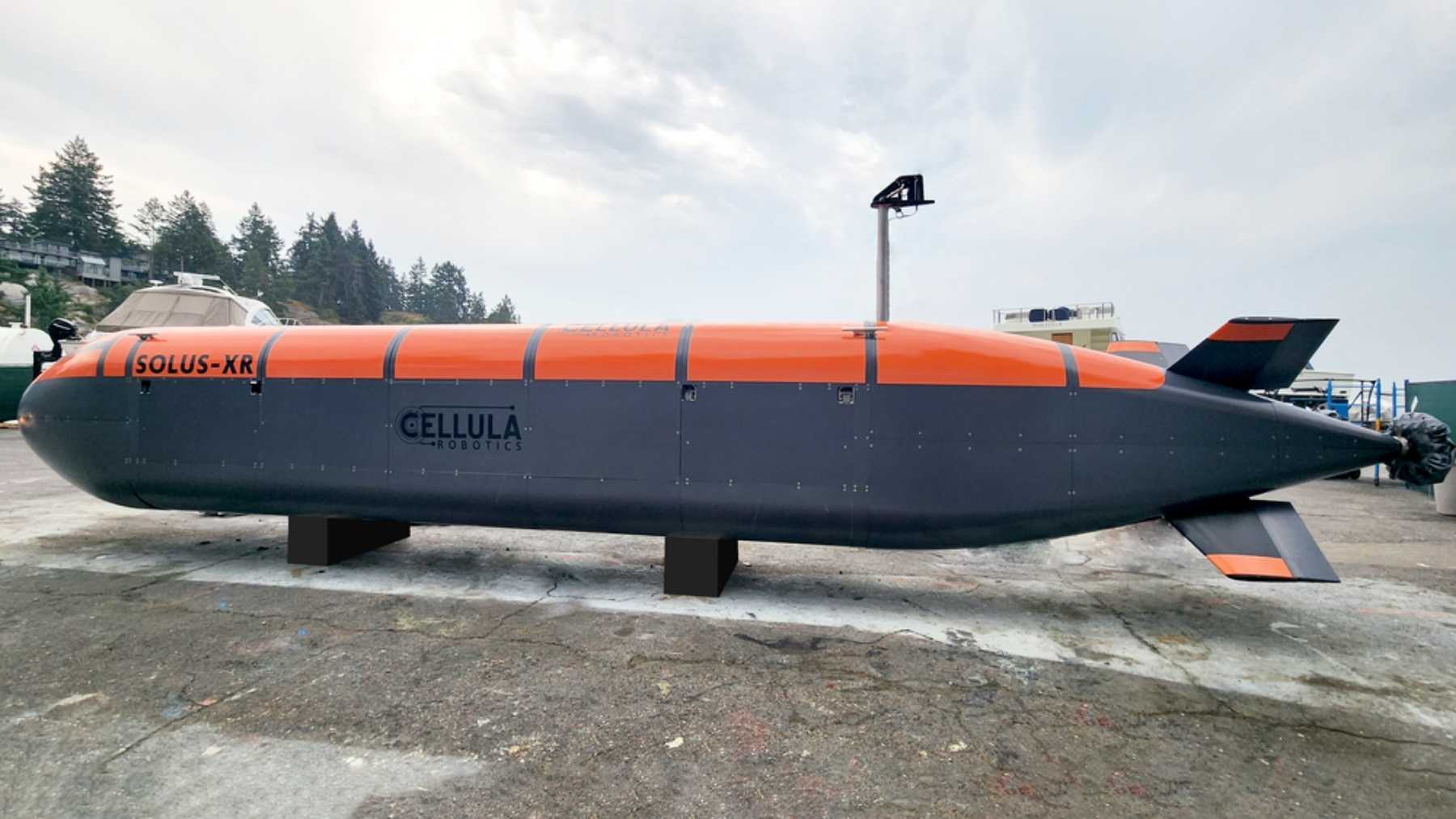
Metron’s Lancet runs on a hydrogen fuel cell. The vehicle is built around Cellula Robotics’ Guardian AUV, with Metron supplying the autonomy software, Integer Technologies handling vehicle health monitoring and General Dynamics Applied Physical Sciences working on payload delivery.
Anduril’s Dive-XL is all-electric, with a stated range beyond 2,000 nautical miles. It grew out of the same engineering as Ghost Shark, the flooded-hull boat Australia now builds by the dozen. The company’s pitch leans hard on the fact that an electric powertrain never has to break the surface, which is a fairly direct shot at the machine it wants to replace.
That machine is Boeing’s Orca, which is diesel-electric and is not competing in CAMP. It is the only extra-large uncrewed submarine the Navy has actually taken delivery of, and it is most of the reason DIU is running this competition at all.
Kongsberg has said nothing about which way it will go. Its own long-range vehicle uses pressure-tolerant lithium-ion batteries, so batteries are the reasonable assumption until somebody says otherwise.
They are nowhere near the same stage
Order of arrival matters here, because a design study and a hull under construction are not the same kind of progress.
Metron took the first CAMP prototype agreement in December 2025. Seven months later it announced fabrication, and Van Gurley, the company’s president and chief executive, put it plainly in the statement: “The design work is behind us and we are bending metal.” Payload module work runs through the fall, integrated sea trials are set for early 2027, and the CAMP demonstration is scheduled for March 2027.
Anduril announced its own selection on March 12, 2026. It said it had won after completing the longest XL-AUV demonstration on record, and committed to a long-duration, operationally representative Dive-XL demonstration within four months of contract award. Four months from that announcement ran out in the middle of July, and the company has not said publicly how it went.
Kongsberg and Oceaneering arrived on July 14 with concept definition, system architecture and design trade studies. That puts them last in the field. Last is not the same as out, and DIU has not down-selected anybody.
All three names have shared a room before. In February 2024, DIU and the Navy’s advanced undersea systems office handed prototype agreements for large-displacement uncrewed vehicles to exactly three companies: Oceaneering, Kongsberg Discovery and Anduril. Two of them are now working together against the third.
Nobody has published one specification for the Kongsberg vehicle
The obvious question is whether Kongsberg will just stretch the drone it already sells. HUGIN Endurance is the biggest vehicle in its family, runs roughly 40 feet by 47 inches, weighs about 8 tons, and has already covered 1,200 nautical miles on a single autonomous dive. We went through that machine and its sudden defense career back in June.
The arithmetic says not directly. A payload tube 21 feet long and 21 inches across does not fit inside a 40-foot hull that is 47 inches wide, not once propulsion, batteries, navigation and a release mechanism have taken their share of the volume. Whatever lands in the third quarter will be a bigger animal than anything currently in the HUGIN catalog.
Past that, the public record is empty. Length, displacement, diameter, endurance, propulsion, number of prototypes, none of it has been announced, and neither company has attached a value to the agreement. Any figure you see quoted for this vehicle right now is DIU’s requirement being repeated back.
Oceaneering is the American half of the team, and defense is not its main business. The Houston company booked $768 million in revenue in its second quarter of 2026, most of it from offshore energy. Its aerospace and defense unit accounted for $133 million of that, up 22 percent year over year, which makes it the fastest growing part of a company that still mostly rents remotely operated vehicles to oil producers.
Orca is the reason DIU is running it this way
Navy work on an extra-large robot submarine goes back to fiscal 2017, and the Government Accountability Office has been writing about the thing for most of that time.
In 2022 the GAO found the effort at least $242 million, or 64 percent, over its original cost estimate, and at least three years late. The newest annual weapons assessment, published July 2, did not improve the picture. Defense Daily read the report as putting the accumulated delay at roughly five years. Breaking Defense reported that the first prototype reached the Navy in September 2025 and that the remaining four are now expected in January 2027.
The Navy committed anyway. Its May 2026 shipbuilding plan moved Orca out of prototype status, a decision that turned into a commitment to 16 vehicles through fiscal 2031, after the service’s own auditors had questioned whether the program had a mission it could afford.
CAMP is the hedge against that history. Instead of one prime with one design, DIU is carrying several teams with different power systems and different hull philosophies at once, and paying for the privilege of not choosing yet.
The Kongsberg and Oceaneering design is due within the next few weeks, and two parts of it are worth waiting for. The first is propulsion, because that is where the field genuinely splits and where the endurance argument gets settled. The second is whether anybody attaches a number to it, since a submarine nobody has priced is hard to weigh against a rival that has already started cutting steel.