
The Hubble Space Telescope is famous for its pictures of galaxies, not its batteries, which is arguably a little unfair to the batteries. Hubble ducks into Earth’s shadow on every lap around the planet, and a lap takes about an hour and a half, so its batteries get drained and topped back up more than a dozen times a day. NASA says the first set kept doing that for 19 years before astronauts swapped them out, and the replacements run on the same nickel-hydrogen chemistry.
Now that chemistry has a factory of its own. EnerVenue, a battery startup out of Fremont, California, started production on September 24 on a new line in Changzhou, in eastern China, built to make what it calls the Aqueous Metal Cell. It’s basically a nickel-hydrogen battery reworked with cheaper materials for use on the ground, and the company says the first cell that met spec rolled out at the end of September. It hasn’t said which day.
The cell itself is frankly a strange-looking thing to call a battery. It’s a tube about 6.8 feet long, roughly the length of a couch, and it weighs 152 pounds. EnerVenue’s cell datasheet rates each one at 3 kilowatt-hours.
By my math, that’s a little more than one of Hubble’s six batteries holds. NASA rates each of those at 88 amp-hours and 32 volts, which works out to about 2.8 kilowatt-hours, and it takes 22 cells to get there.
So why does a battery need a tank?
Because one side of the reaction is hydrogen gas. When you charge a nickel-hydrogen cell, hydrogen builds up inside it, and when you drain it, that hydrogen gets used back up, so the pressure inside rises and falls with the charge. That’s why NASA’s Goddard engineers keep an eye on battery pressure when they charge Hubble, and it’s why EnerVenue’s cell is really a sealed tank with electrodes inside. The liquid in there is water-based, so there’s none of the flammable solvent you’d find in a lithium-ion cell.
The tank’s changed a lot. EnerVenue’s earlier cells used a metal canister. In the fourth-generation cell this line builds, the stack of electrodes goes into a plastic liner, the liner goes into a steel tube, the tube gets sealed, and the whole thing gets wrapped in glass fiber. In a video the company posted in August, CEO Henning Rath walks through the layers, and EnerVenue says the fiberglass adds strength and should cut the amount of steel each cell needs.
What I can’t find anywhere in EnerVenue’s published specs is how much pressure that tube is built to hold. For a battery that’s essentially a pressure vessel, that seems like a strange number to leave off the sheet, but the datasheet covers size, weight, energy, voltage and certifications, and that’s it.
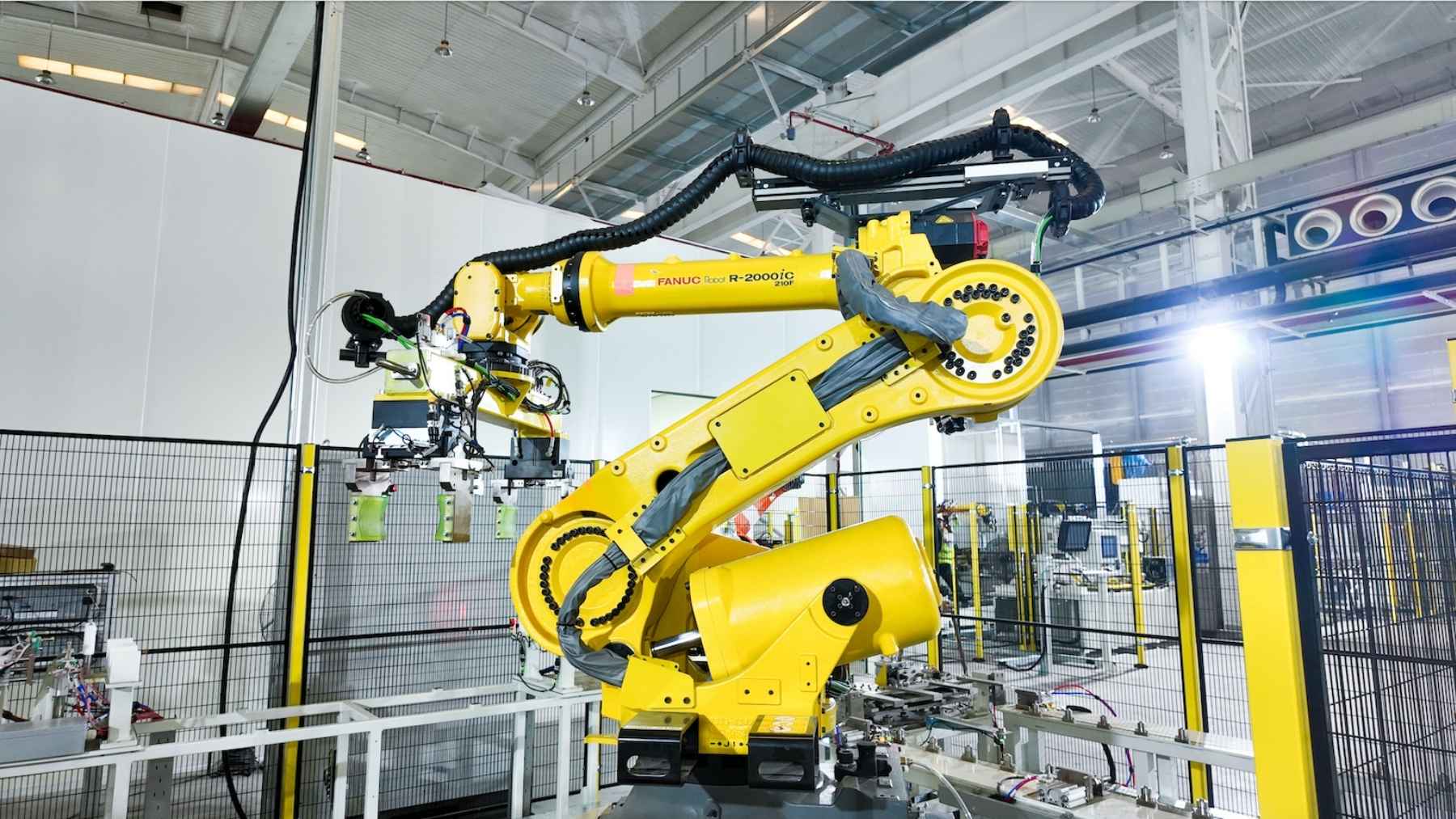
From the looks of things, most of the effort went into the factory, and I think that’s the right call. According to EnerVenue, nobody else builds this kind of cell, so each machine had to be designed from scratch and proven out first on a research line a few miles away. Robotic carts shuttle cells between stations so nobody has to carry them (which, at that weight, I’d count as a perk). A camera-guided machine stacks the electrodes, and a winder lays the fiberglass on with its tension managed layer by layer, starting at the tube.
Then there’s the number EnerVenue really wants you to remember. Every cell gets 41 checks at 11 test stations before it’s allowed out the door, covering the welds, leaks and performance. “Anyone can make one good vessel,” TJ Hua, the company’s head of production, said in its production announcement. His point, and it’s a fair one, is that a factory earns its keep by making thousands of cells that all come out the same.
So what’s the catch?
Nickel-hydrogen is heavy
Three kilowatt-hours in 152 pounds isn’t a great ratio by modern standards. I ran EnerVenue’s own figures against the battery-only add-on for Tesla’s Powerwall 3, the lithium-ion home battery you may have seen bolted to a garage wall, and the gap is pretty big.
Basically, you’re carrying three to four times the weight for the same energy, depending on whether you count the bare cell or the finished rack. It’s safe to say nobody’s bolting one of these into a pickup bed. The rack also needs fans to push air through it, according to EnerVenue’s spec sheet. Weight matters a lot less for something that sits in one spot for decades, which is why grid storage keeps attracting heavy, unglamorous ideas like the graphite battery going up in Massachusetts.
EnerVenue isn’t trying to win on weight anyway. The pitch is that each cell is built for 30,000 charge cycles, a figure the company gets by assuming as many as three full cycles a day, every day, for 30 years. It also says the chemistry can’t go into thermal runaway, the self-feeding overheating behind most lithium battery fires, and that if something goes wrong, a relief valve in the cell vents water vapor. The datasheet lists UL 9540A, the fire-propagation test US fire codes point to, among its certifications.
Those are design claims, though, not a track record. EnerVenue says its oldest fourth-generation cells in the field have been working since November 2025 at a bus charging station in Jintan, a district of Changzhou. Towngas, the Hong Kong gas utility whose subsidiary runs the site, described it in May as a single rack, cycling for two to four hours every day alongside solar panels. That’s less than a year into a 30-year promise.
I’d also flag that EnerVenue’s datasheet and Towngas’s announcement don’t agree on how cold or hot these cells can run, so I’ve left temperature out of this entirely. If you’re in the US, the more relevant detail is that EnerVenue says cells have already shipped to American customers, and it names PowerSecure among them.
Kentucky was supposed to come first
This isn’t the factory EnerVenue originally pitched. Its first plant was supposed to be a 1-million-square-foot building in Shelby County, Kentucky, with a $264 million first phase and 450 jobs, according to the state’s announcement, and Kentucky lined up tax incentives tied to those jobs. Reuters reports that EnerVenue dropped the plan about a year after it was announced.
So what happened?
Rath, who joined EnerVenue in April, told Reuters the Kentucky attempt was a “valuable learning experience” but that the technology wasn’t ready, and that the company went back and reworked the cell and the factory from there. As for why the new plant ended up in China, he pointed to engineering skills and how deep the supply chain runs around Changzhou. Reuters also reports he made building there a condition of taking the job.
The new plant is a lot smaller than the Kentucky plan, at around 215,000 square feet against the planned 1 million. Rath wouldn’t give Reuters an exact cost, but he put it somewhere between $20 million and $50 million, and the news agency says it’s almost entirely automated and should employ around 400 people by the end of the year. Which, admittedly, isn’t far off the 450 jobs listed for Kentucky.
Will any of this end up in the US? Maybe, eventually. Rath told Reuters that EnerVenue wants plants in Europe, the Middle East and North America starting in 2028, with sites picked next year, though he said a US plant depends partly on legislation and regulation. Reuters also notes nobody knows yet whether China-made cells can claim federal clean energy tax credits, since the 2025 tax law left those credits in place for battery storage but added limits on Chinese content and ownership. Not every lithium-free battery company has gone that way. Form Energy builds its iron-air batteries in a former steel town in West Virginia.
EnerVenue says the Changzhou line is designed to turn out about 300 cells a day at full automation. At that pace, cell number 10,000 shows up in a little over a month, and the company says the line keeps ramping up through November before it hits full speed.