
Say the words “grid battery” and most people picture the same thing: rows of lithium-ion cabinets baking in the sun. Lithium is cheap, it’s everywhere, and it nails the four-hour duty cycle the grid asks for most of the time.
But two microgrid projects announced in June 2026, one on a tropical island in the Maldives and one on tribal land in Northern California, are quietly skipping lithium for the heavy lifting. Both are reaching for non-lithium chemistries built to outlast it.
The thesis is the same in both places. If you’re running a microgrid somewhere the grid either can’t reach you or actively betrays you, you don’t want to be swapping lithium packs every decade in conditions that punish them. You want storage that sits in a shed for 25 or 30 years and shrugs.
One project uses a true flow battery. The other uses zinc. Neither is a lab demo anymore.
Storage: MWh-class
Job: cut diesel imports
Backer: Tencent CarbonX
Storage: 21 MWh (15 zinc / 6 Li)
Job: wildfire resilience
Cost: $54M
Two June 2026 microgrids choosing non-lithium long-duration storage. Quino’s is a true flow battery; Eos’s zinc system is a non-flammable aqueous battery, not a flow battery.
Quino lands a Tencent grant for a Maldives island
The first project sits on Himandhoo Island in the Maldives. California startup Quino Energy, which builds water-based flow batteries that store charge in organic molecules called quinones, won a grant from Tencent’s CarbonX program to put a megawatt-hour-scale system there.
The flow battery is one piece of a bigger machine. The island will pair Quino’s electrolyte tanks with floating solar, terrestrial solar, and lithium-ion, with financing help from the Asian Development Bank. The lithium and the ground-mounted solar come through a separate Maldives government program called POISED, which is running roughly the same solar-plus-storage retrofit across around 160 outer islands.
Why add flow on top of lithium that’s already in the plan? Because the Maldives runs its power on imported diesel, and diesel gets expensive fast when you’re a thousand miles from anywhere.
Quino’s pitch is a division of labor. The organic flow battery handles long-duration shifting, the overnight stretches, multi-day weather and demand swings, while the lithium handles fast response. Eugene Beh, Quino’s CEO and cofounder, called the deal “the first commercial deployment of the organic flow battery technology” outside the company’s earlier government-backed pilots.
An Indian electrolyte factory and a Chinese hardware partner
The supply chain is worth a second look. Quino holds the tech. The proprietary organic electrolyte gets manufactured in Pune, India, by Atri Energy Transition, the same investor that led Quino’s Series A round back in October 2025. Atri also keeps an operations-and-maintenance team on the island for at least five years after the battery is switched on.
The flow battery hardware itself, the stacks and balance of plant, comes from Chinese maker Suqian Time Energy Storage, through a joint development deal with its affiliate Jena Flow Batteries.
Atri’s founder, S. Kishore, framed the Tencent pick as an endorsement of organic electrolyte chemistry and a step from pilot to commercial gear. That’s the part that matters. Organic quinone flow batteries have been a lab-curiosity story for about a decade. A working megawatt-hour unit on a real island, with real diesel-displacement targets, is the milestone you need before anyone takes the chemistry seriously as a lithium alternative.
Meanwhile in Tehama County: zinc, not lithium
The California half is the Paskenta Band of Nomlaki Indians microgrid, near Corning in Tehama County. On June 16, OATI (Open Access Technology International), which makes a controls platform called GridMind, announced it’s running the brains of the system. It’s billed as one of the largest state-funded microgrid projects in California history.
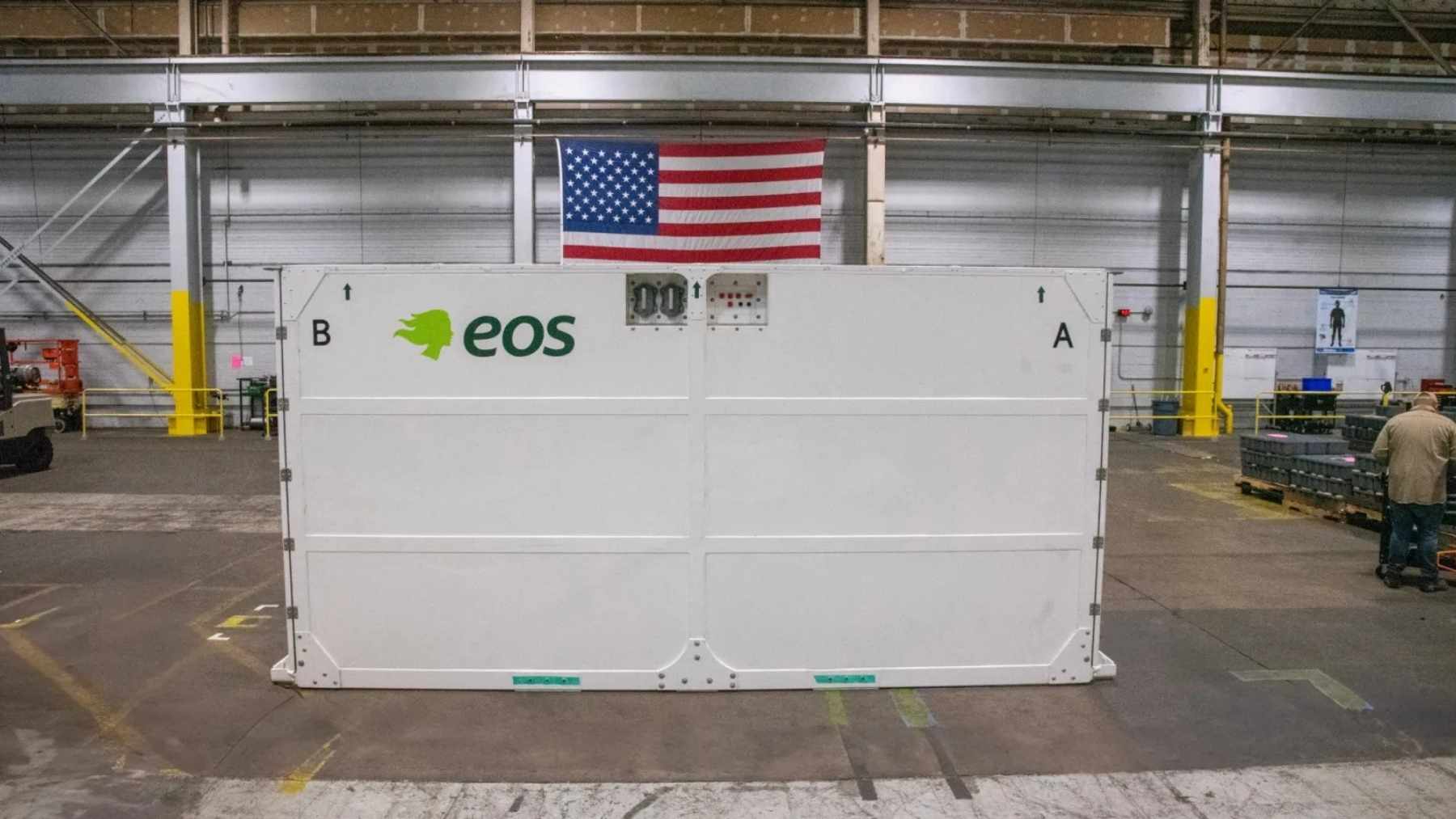
The scale isn’t trivial. The build is 4.5 MW of solar across two sites and 21 MWh of storage. That storage is split: roughly 6 MWh of lithium-ion for fast response, and 15 MWh of long-duration zinc-hybrid-cathode batteries from Eos Energy Enterprises, which builds its Z3 units in Turtle Creek, Pennsylvania.
The total runs about $54 million, funded through a mix of California Energy Commission money, FEMA’s BRIC resilience program, and tribal dollars. The CEC’s original 2023 award went to developer Charge Bliss: a $32.7 million grant for 5 MW of solar plus 15 MWh of long-duration storage, designed to deliver roughly 18 hours of dispatchable power. Eighteen hours is exactly the duration lithium doesn’t hit economically.
Why zinc and quinone instead of more lithium
Here’s what both projects are quietly testing. Lithium-ion is the default because it’s cheap per kilowatt-hour and the supply chain is enormous. It’s just not great when the duty cycle stretches past 12 hours, when the ambient temperature stays high all year, or when you need the asset to sit there for 25 years without fading. Tropical humidity and salt air don’t help either.
The two non-lithium options attack that differently. Quino’s organic flow battery decouples power from energy: the stacks set your kilowatts, and the electrolyte tanks set your kilowatt-hours. Want more hours? Build a bigger tank. Eos’s zinc system isn’t a flow battery, but it’s a non-flammable, water-based chemistry built to cycle for years without the fire risk baked into lithium.
That fire point matters a lot on an island with one ferry a week, or on tribal land where wildfire response is measured in hours. Neither chemistry goes into thermal runaway when something punctures it.
It’s also why lithium’s grip on the grid keeps getting poked. Four-hour lithium taps out right when a long outage or a multi-day weather event needs power, and California alone figures it needs tens of gigawatts of long-duration storage to retire its gas fleet. The state is already permitting 500-megawatt compressed-air caverns to help close that gap. These two microgrids are walking through the same door.
Energy sovereignty is doing a lot of work here
Both projects share a less-technical motive too. For the Paskenta Band, the microgrid is the physical layer under an eventual tribal-owned utility. The tribe is building its own utility and regulatory body, with the long game of becoming a peer player in California’s grid instead of a captive ratepayer.
Damon Safranek, who runs the tribe as CEO, frames it as a resilience play optimized day to day for cutting demand. The cost problem is really a volatility problem. As he put it, “it’s not just cost, it’s volatility of cost,” the kind of swing that makes it hard to plan housing, jobs and long-term investment.
The location is the point. Hemmed in by mountains on three sides, Paskenta served as a deployment hub during the deadly 2018 wildfires to its north and east. A microgrid that can island itself is, in that context, infrastructure for staying alive.
The Maldives case is simpler. Every kilowatt-hour of solar-plus-storage on Himandhoo is a kilowatt-hour of diesel the government doesn’t have to import or subsidize. POISED’s whole goal is to cut diesel dependence across the outer islands while pulling down both consumer prices and the subsidy bill.
What this actually means for flow batteries
Neither of these is a gigawatt-hour monster. The Maldives system is one megawatt-hour. The Eos order at Paskenta is 15 MWh on the long-duration side. Next to the grid-scale lithium projects switching on every quarter in Texas and California, these are pilots.
But pilots are how flow ever gets out of the lab. Quino’s earlier wins, a $10 million California Energy Commission grant, a $5 million Department of Energy award for a 5 MWh deployment in Southern California, and a joint development deal with Jena Flow Batteries, were either still under construction or government-funded demos. Himandhoo is the first one that’s commercial.
Eos has had its Z3 zinc systems shipping for a couple of years, and Paskenta is proven hardware scaled up. Both companies are reaching the point where the question stops being “does the chemistry work” and becomes “does the operating math work over a 20-year asset life.”
This is also part of a wider revolt against lithium that runs from tanks of liquid CO2 to compressed air and hot sand. If the Maldives system shrugs off a few cyclone seasons, and the Paskenta microgrid carries the tribe through a few PG&E safety shutoffs without breaking a sweat, the non-lithium case for isolated communities writes itself. If they don’t, lithium keeps its monopoly and the long-duration crowd goes back to PowerPoint. The next couple of years are when we find out which.