
Strontium-90 has never had a good reputation, and it earned all of it. The isotope is a fission product, it turns up in spent fuel and at cleanup sites, and when it gets inside a body it heads straight for bone. Keeping it sitting still has been a line item on the Department of Energy’s books for decades.
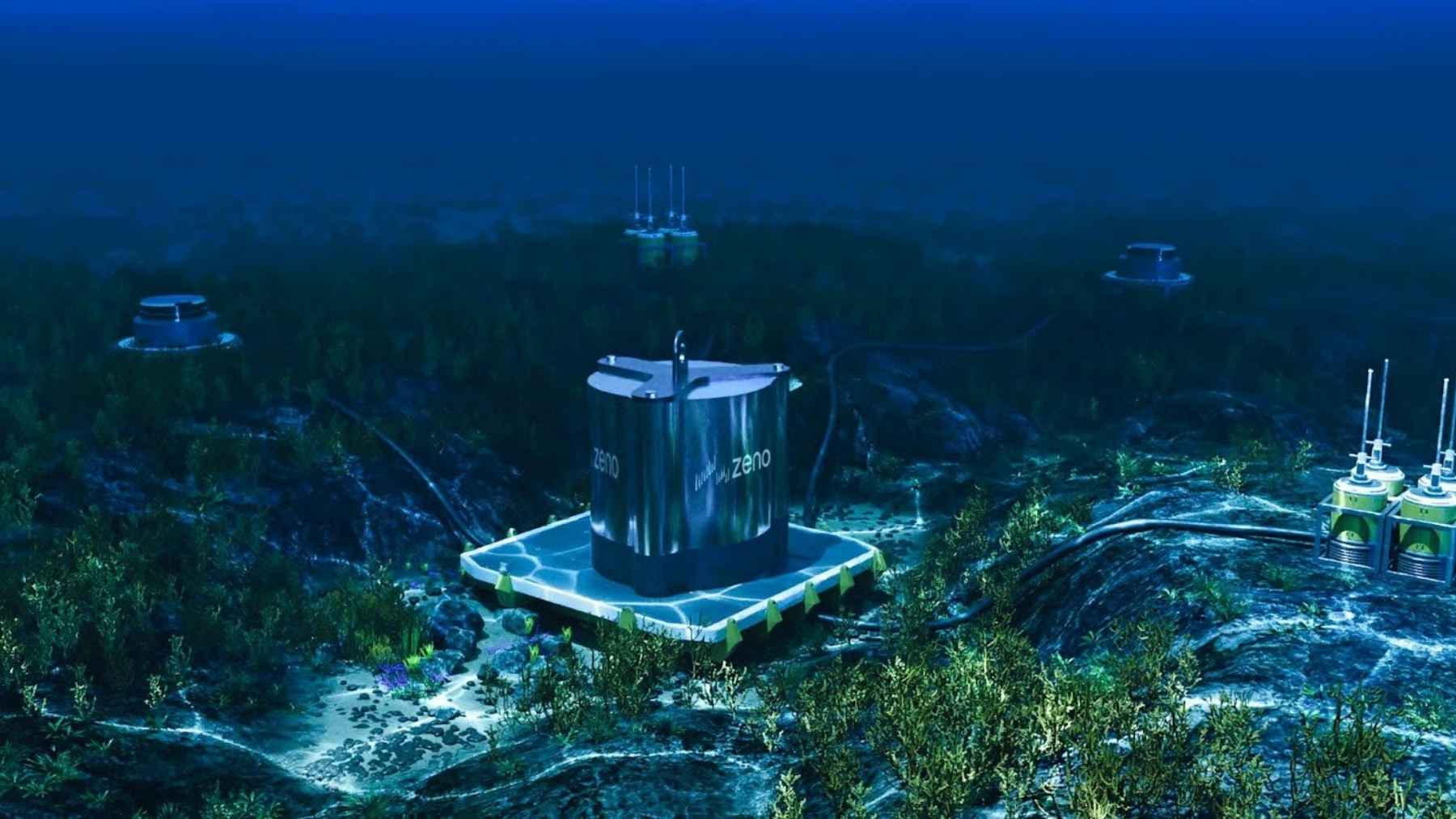
The Pentagon would now like some of it on the ocean floor, and not as a disposal problem. The plan is to run seafloor sensors off it, and further out, charging stations for underwater drones.
That is not marketing language. It is the written objective of a Defense Department program called DEPTHS, and the company holding the contract is Zeno Power, a startup split between Washington, D.C. and Seattle. Nothing has been switched on at the bottom of the ocean yet. But in June the company took possession of a set of hot cells in California, which is the part of this story that stopped being theoretical.
The contract is small, the job description is not
DEPTHS stands for Distributed Energy Provided Throughout the Seas, and Zeno won it in October 2023. The award is $7.5 million, funded through the DoD’s Operational Energy Innovation office and the Office of Naval Research.
The stated goal in Zeno’s announcement of the contract is decentralized nodes for generating and distributing energy on the seabed, enabling long-endurance sensors and charging stations for autonomous undersea vehicles. Blue Origin and Sunpower are on the team for the Stirling converter, alongside PowerLight Technologies and the University of Dayton Research Institute.
Admiral John M. Richardson, the retired former Chief of Naval Operations who later joined Zeno’s board, framed it in the same release: “ubiquitous access to power in maritime environments is critical to maintaining U.S. leadership.”
Why anyone cares is straightforward arithmetic. Every autonomous machine on the seafloor is on a timer set by its battery, and the workarounds are expensive. The pressure-tolerant battery packs going into drone submarines buy endurance by deleting the housing, not by adding energy. A power node that runs for years without a cable or a support ship changes what you can leave down there, which matters more every year that China keeps wiring the Pacific floor with sensors.
America put one of these in Baltimore harbor in 1961
This is a rerun, and the original is well documented. Under the SNAP program, the Atomic Energy Commission funded a strontium-90 thermoelectric generator for a U.S. Coast Guard light buoy.
The final report filed with the Department of Energy spells out the numbers. Four capsules holding 40,800 curies of strontium-90 titanate. A 10-watt generator feeding a 5-watt electrical system. Installed in the buoy at Baltimore, Maryland, on December 15, 1961, with the lamp running continuously.
A sister unit, SNAP-7D, went into a modified Navy NOMAD-class weather buoy in the Gulf of Mexico with a 60-watt generator behind a 30-watt system. More than 100 strontium-90 generators were built in total, per a Waste Management Symposia paper on the program, most of them for government monitoring work, and the material itself came out of Hanford.
Then the whole thing was abandoned. The reason is the same reason your phone doesn’t have one: strontium-90 shielding is heavy, and those marine units ran to thousands of pounds to deliver single-digit watts. Zeno says as much in its own materials, describing historic Sr-90 systems as heavy enough to constrain them to limited terrestrial use.
The Stirling engine is the reason anyone is trying this again
Two things changed. The first is the heat source itself. Zeno’s patented claim is higher specific power, meaning more thermal watts per kilogram than the 1960s hardware managed, and it demonstrated a first strontium-90 heat source at Pacific Northwest National Laboratory in Richland, Washington in October 2023.
The second is what happens to that heat. A conventional radioisotope thermoelectric generator converts roughly 5 percent of it into electricity, which is why the old units were so lopsided. A Stirling engine is a piston cycle driven by a temperature difference, and it converts a much larger share.
Zeno’s founder and CEO Tyler Bernstein has been candid that this is the hard part. He told GeekWire the Stirling generator “is right now at a lower technology readiness level” than the company’s other products, with NASA and DoD programs maturing it in parallel.
The physics underneath does not need maintaining. Strontium-90 has a half-life of 28.8 years, per NIST, decaying into yttrium-90 and throwing off heat the entire time. No sunlight, no fuel deliveries, no crew.
The fuel is a generator the government has been storing for years
Zeno is not buying fresh strontium. In January 2024 it announced a partnership with the DOE’s Oak Ridge Office of Environmental Management to recycle a legacy radioisotope power system known as the BUP-500, held in storage at Oak Ridge, into fuel for its first ten-plus systems.
Chief Commercialization Officer Harsh S. Desai described the deal at the time as reducing a DOE liability and revitalizing the technology for modern use. The fabrication work goes to Westinghouse at a facility in Pennsylvania, while the Seattle lab does its recipe development with strontium-88, the non-radioactive version, so chemists can iterate without a hot cell.
Zeno is not the only outfit that spotted the same isotope. On July 3, Defense One reported a $3.37 million award under DARPA’s Rads to Watts program, targeting more than 10 watts per kilogram, with Morgan State University as prime contractor and PNNL handling nuclear materials and testing. Northrop Grumman and ARA are doing computational modeling, and Project Omega is building the generator.
That one skips heat entirely. “Ours directly convert radiation into electricity,” Project Omega founder and CEO Stafford Sheehan told the outlet, describing a solid isotope layered against a semiconductor. A prototype is due at PNNL in early 2027. It is a different bet on the same waste stream, closer in spirit to the coin-sized betavoltaic cells now being pitched for century-long service than to anything with a piston in it.
The factory is the actual news, and it is in California
Hot cells are the bottleneck in this entire industry. They are heavily shielded rooms where technicians handle radioactive material remotely, through leaded glass, with mechanical arms. There are very few of them in the United States, and most were built for small batches.
On June 18, Zeno announced a lease with NorthStar to restore the hot cell complex at the Vallecitos Nuclear Center in Sunol, California. The site opened in 1957, spans 1,600 acres, and held Power Reactor License No. 1 from the Atomic Energy Commission. NorthStar closed on a deal to decommission it in March 2025 and will keep working the rest of the site while Zeno operates the hot cell portion.
“Vallecitos wrote the first chapter of American commercial nuclear power,” Bernstein said in the announcement. Non-radiological work has already started. Radiological operations are expected later this year, pending regulatory approval.
The commitments attached are specific. More than 50 jobs in the Tri-Valley over three years, a third company location alongside Seattle and D.C., first deliveries to government customers in 2027, and scaled production from 2028. Zeno puts its total funding above $130 million, including $70 million in private capital and $60 million in contracts with the Pentagon and NASA. Scott State, NorthStar’s CEO, said his company preserved the hot cells deliberately, expecting them to have future value.
There are under five months left in the demo year
Here is where the calendar gets interesting. When Zeno closed its $50 million Series B in May 2025, led by Hanaco Ventures, the stated plan was to demonstrate full-scale nuclear batteries in 2026 and deliver systems in 2027. GeekWire reported a tank-based demonstration scheduled for 2026, which is how you test a seabed power system without going to the seabed.
As of early August, no such demonstration has been announced. The company’s homepage now leads with a single line: delivering to market in 2027. Bernstein’s late-June essay says the same thing, adding that Zeno has demonstrated its heat source and its electrically heated power systems, which is a meaningfully different sentence from having run a fueled, full-scale unit.
None of that is a broken promise. Deliveries were always slated for 2027, and 2026 is not over. But the year has four and a half months left in it, and the difference between a company with a hot cell lease and a company with a working nuclear battery is the demonstration nobody has seen yet.
If it lands, the Navy gets something it has wanted since it started buying machines that sit on the seafloor and listen for months at a time: a power outlet down there that nobody has to visit. If it slips, it slips into a year where the first customer hardware was already due.
 @montyjoemartinj ROOKIE1 month ago