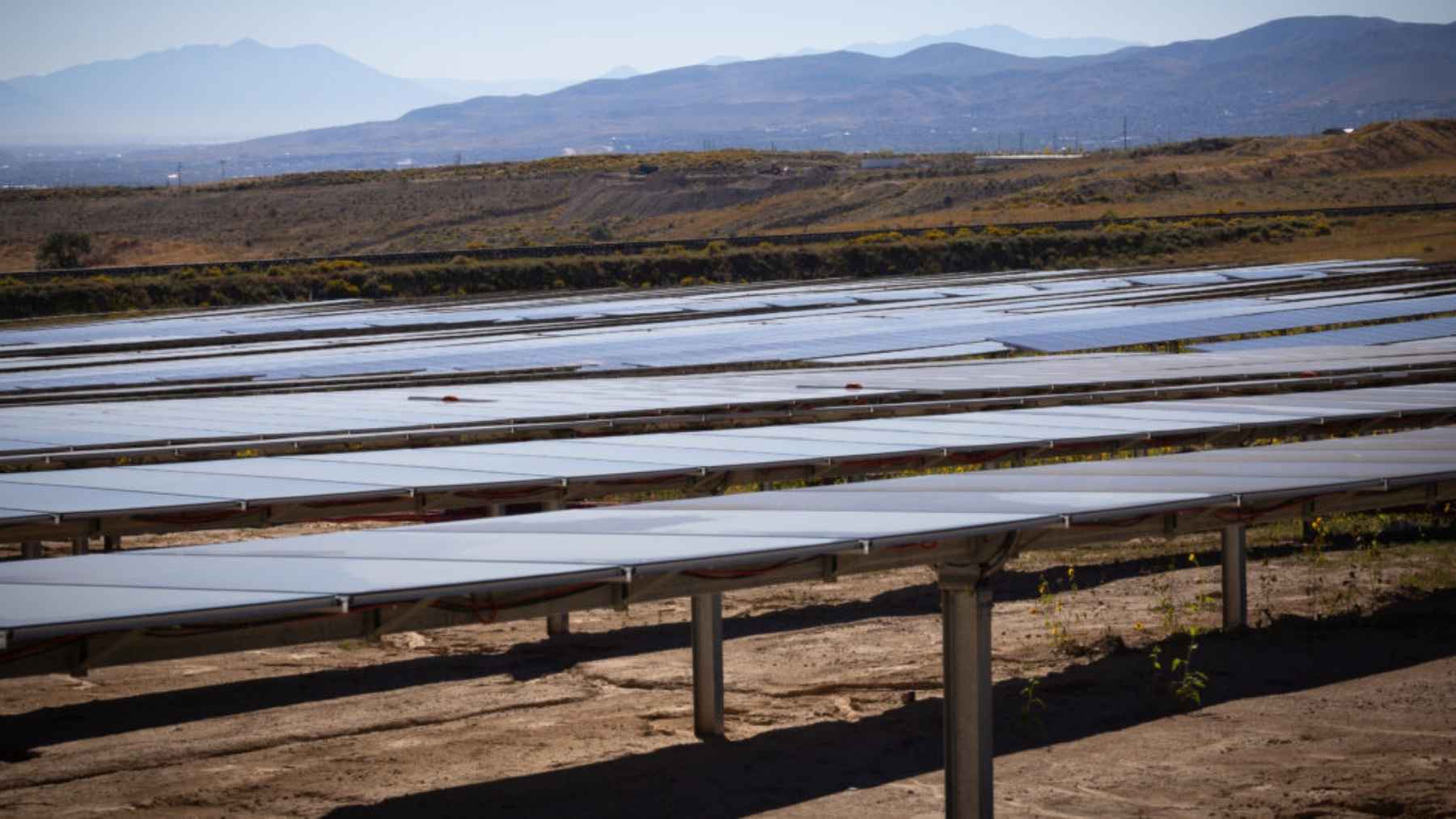

Ground-mount solar has a steel problem. You buy the modules, then you buy tons of structural steel to hold them at an angle, then you pay a crew to drive posts into graded dirt and bolt the whole thing together.
On a small municipal project, that middle layer is often what decides whether the numbers work at all. So a developer in Fresno skipped it, laid the panels flat on the ground, and has now published five months of output.
ForeFront Power says the array has run at an average of 101 percent of its expected production since late March and delivered 862 megawatt-hours to the city, per its August 13 announcement carried by CleanTechnica. Every outlet that picked it up ran the same two numbers.
Neither of them tells you what you probably want to know, which is whether flat beats tilted. So let’s work that out.
Start with the size, which nobody printed
The announcement never states how big the array is. That is a strange omission for a performance release, and it makes 862 MWh unreadable on its own.
The number exists in older coverage. When the Fresno Department of Public Utilities portfolio was finished, a project FAQ put the Northeast Surface Water Treatment Facility at 1.7 MW-DC with 1 MW-AC and 2 MWh of Sungrow battery storage.
Run the arithmetic on that. From late March to August 13 is about 141 days. 862 MWh across 1.7 MW-DC works out to roughly 3.6 kilowatt-hours per installed kilowatt per day, and that is over spring and early summer, the best stretch of the year in the Central Valley.
Now the benchmark. The same DPU portfolio, 27 MW-DC across three sites, is projected to generate about 47 million kWh a year. That is around 4.8 kWh per kilowatt per day as an annual average, winter included.
Beating your own model by one percent proves less than it sounds
So the flat array is delivering roughly three quarters of what the portfolio it belongs to was designed to average, and it is doing it during the sunniest months on the calendar. The real annual gap is wider than that comparison makes it look.
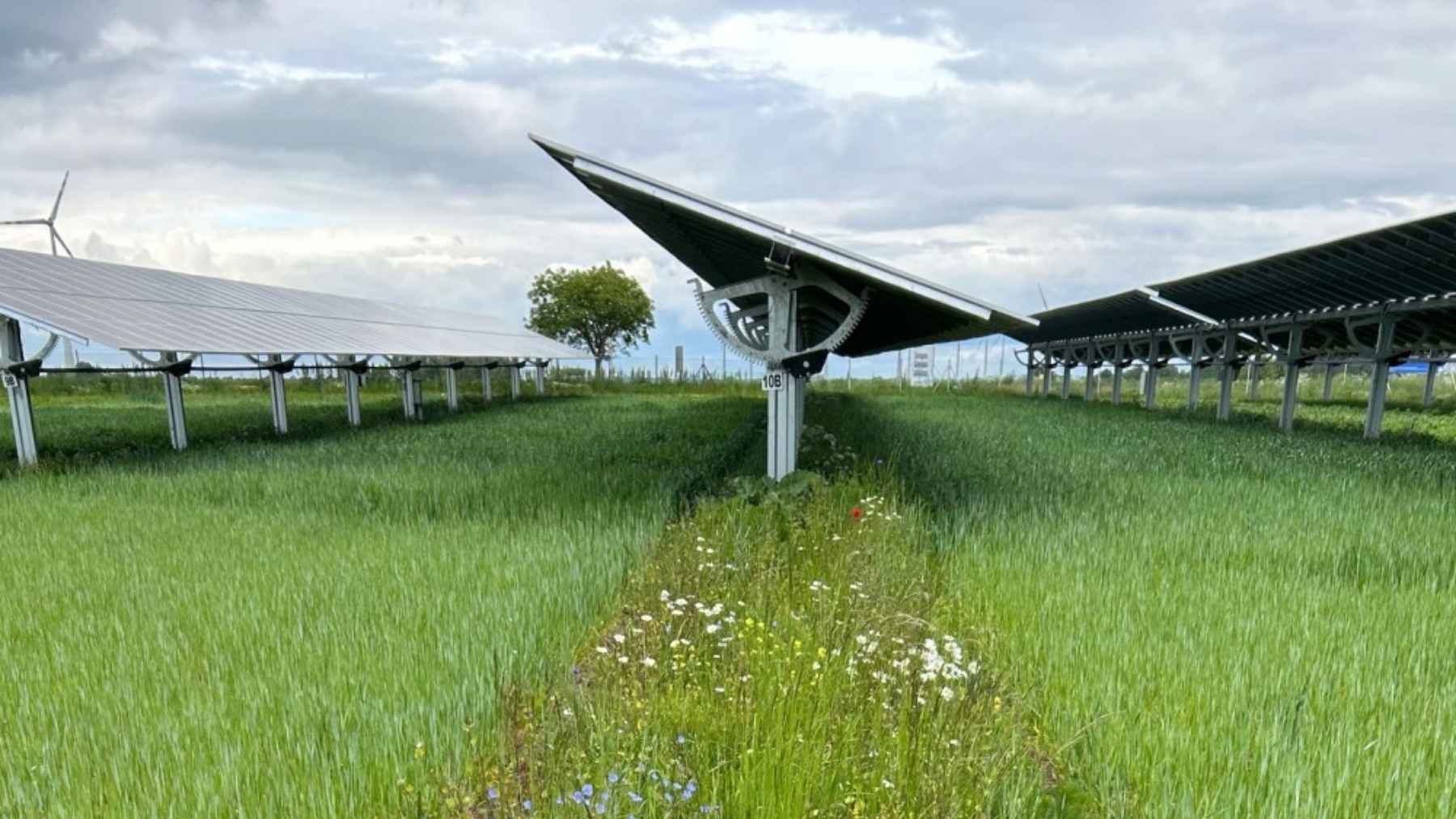
Some of that is not about tilt. Solar Power World reported at the portfolio’s completion ceremony in April 2025 that the DPU projects used single-axis trackers, and a tracker beats fixed-tilt before you even get to the flat-versus-angled argument.
Which is the point. Hitting 101 percent of a P50 model tells you the model was built for a flat array in Fresno and the array is meeting it. It does not tell you flat-mount closed the gap on tilt, because the gap was priced into the forecast before anyone poured a foundation.
Treat the 1.7 MW figure with a little care, since it comes from 2025 coverage of the wider portfolio rather than from this month’s release, and the Erthos build reached commercial operation almost a year after the ceremony that declared the portfolio done. If the site’s capacity changed in between, the yield math moves with it.
None of this makes the project a failure. It makes it a cost story rather than a performance story, which is exactly how Erthos has always sold it.
Steel and civil work were the two lines that killed the math
Fresno did not do this to make a point about the future of solar. It did it because a conventional array stopped penciling.
ForeFront approached Erthos in 2023, after inflation and supply shocks pushed labor and material prices up far enough to wreck the payback period. Erinne Davis, a senior project manager at ForeFront, told Solar Builder the design let them skip “significant, expensive civil upgrades” on top of the racking steel and the labor to install it.
Skipping the grading is arguably the bigger win. Erthos says its arrays follow contours up to a 15 percent slope, so the bulldozers that normally flatten a lot before construction starts never showed up. In California, that phase is where schedules and budgets tend to bleed.
The density claim is the other half. Flat panels do not shade each other at low sun angles, so there is no row spacing, and Erthos puts the gain at up to 275 percent more energy per acre or up to 60 percent less land for the same interconnect capacity.
Fresno owns none of it. The city buys the power under a 20-year PPA at a fixed rate below what the utility charges, with ForeFront owning and maintaining the assets at no upfront cost and no bond money.
Worth noting how the deal got done, because that is the replicable part. Fresno procured through the Renewable Energy Aggregated Procurement program, a pre-negotiated public-sector contracting vehicle run by SPURR. And the labor Erthos supposedly eliminates was still union: the DPU sites were built by IBEW Local 100.
Heat is the objection, and Tyler answered it years ago
Everyone who looks at flat-mount solar raises soiling first. Tilted panels get rinsed by rain and shed dust downhill, flat ones do not, and Fresno sits in an agricultural basin that produces real summer dust.
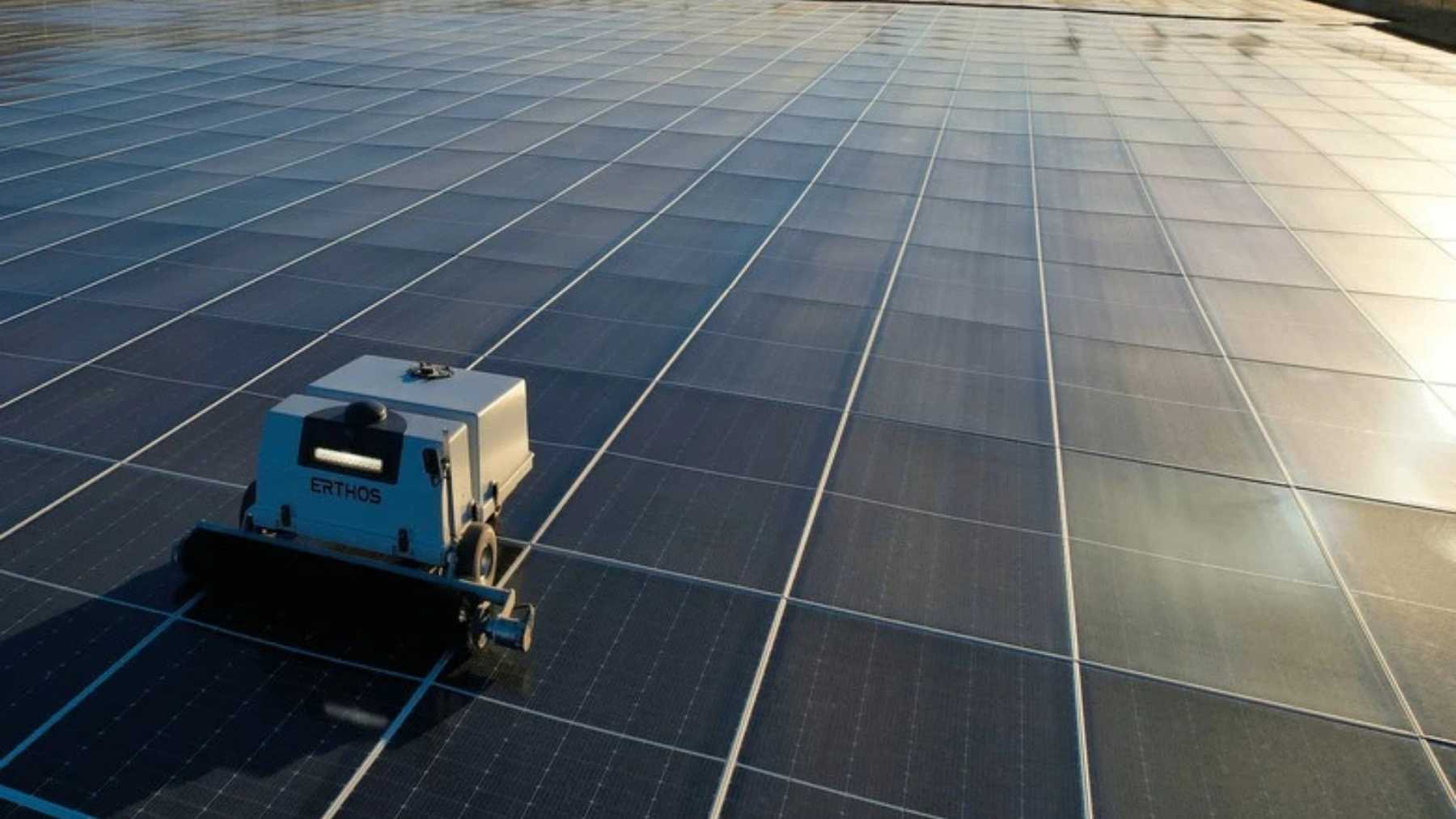
Erthos handles that with a robot. The ErthBot is a dry nylon brush unit that runs at night as needed, covers more than 3.5 MW-DC per machine, and parks itself at a charging dock before the sun comes up so it is never shading production.
The economics of it are more persuasive than the press-release adjectives. Erthos chief executive Jim Tyler has put the comparison at roughly 50 cents per kW to clean a tracker plant once, against cleaning an Erthos plant “every day for a year for 50 cents per kW”. Dry brushing also uses no water, which in California is not a small detail.
The objection almost nobody raises is temperature. Silicon loses efficiency as cell temperature climbs, and a module lying on hot ground gets less rear convection than one sitting on a rack in open air.
Tyler says he checked. In the same interview he described running a fatal-flaw analysis on the concept, deciding temperature was the only serious candidate, and then operating an early plant in Phoenix through 118°F ambient without cell temperatures approaching their maximum.
Durability got a harsher test in Chowchilla, about 40 miles north of Fresno, where an Erthos array sat through a California winter of atmospheric rivers, bomb cyclones and 80-mph gusts, as Canary Media reported after visiting the site.
Erthos is seven years old and now chasing data centers
The company is based in Tempe, Arizona, and Tyler founded it in 2019 after a career on the build side. He ran the EPC team at First Solar, then co-founded Depcom, a solar EPC outfit that grew large enough for Koch Industries to buy it.
Funding has been modest by cleantech standards: a $17.5 million Series B in March 2022 led by Capricorn Investment Group, then a $24 million round in 2023. TIME named it to a list of America’s top greentech companies this April.
The strategic move worth watching came in March, when Erthos announced a formal push into the AI data center market as a full energy solutions provider rather than a mounting vendor. That is a crowded room, but the pitch translates: operators already building their own generation behind the fence care about dollars per megawatt-hour and acres per megawatt more than they care about racking philosophy.
Tyler framed the Fresno result in exactly those terms, saying the design can “unlock projects that might otherwise be constrained by conventional construction costs.” Not projects that produce more. Projects that get built.
What the next twelve months actually decide
Five months is a start, not a record. The interesting data has not arrived yet.
Winter is the first real test, because that is when a zero-tilt array in the northern hemisphere gives up the most against a tracker, and Fresno sits near 36.7 degrees north. The second and third summers are the other one, once soiling patterns settle and the ErthBot has to earn its keep across years rather than months.
If the flat array holds its model through a full winter, ForeFront has something more useful than a press release. It has a public reference asset with a public number attached, in a state where every water district in the Central Valley has the same problem Fresno had.
That buyer profile is already well established. Water and wastewater plants own fenced acreage, run around the clock and carry ugly power bills, which is why they keep turning up in odd solar experiments, including the California operators floating panels over irrigation ponds because the only flat ground left was planted.
Which is the honest read on this. Nobody in Fresno proved flat panels out-generate tilted ones, because they do not. What got proved is that a 1.7-megawatt array can be cheap enough without the steel that a city signs a 20-year contract it would otherwise have walked away from, and for a municipal budget that is the only comparison that ever mattered.
 @danbaker ROOKIE2 months ago