
The polite way to describe a tunnel boring machine is a very big drill. That undersells it. The thing is a rolling factory: a cutterhead chews the rock face, a screw conveyor drags the debris out the back, a robot arm stacks precast concrete rings behind it, and hydraulic jacks shove off those fresh rings to drive the whole train forward another few feet.
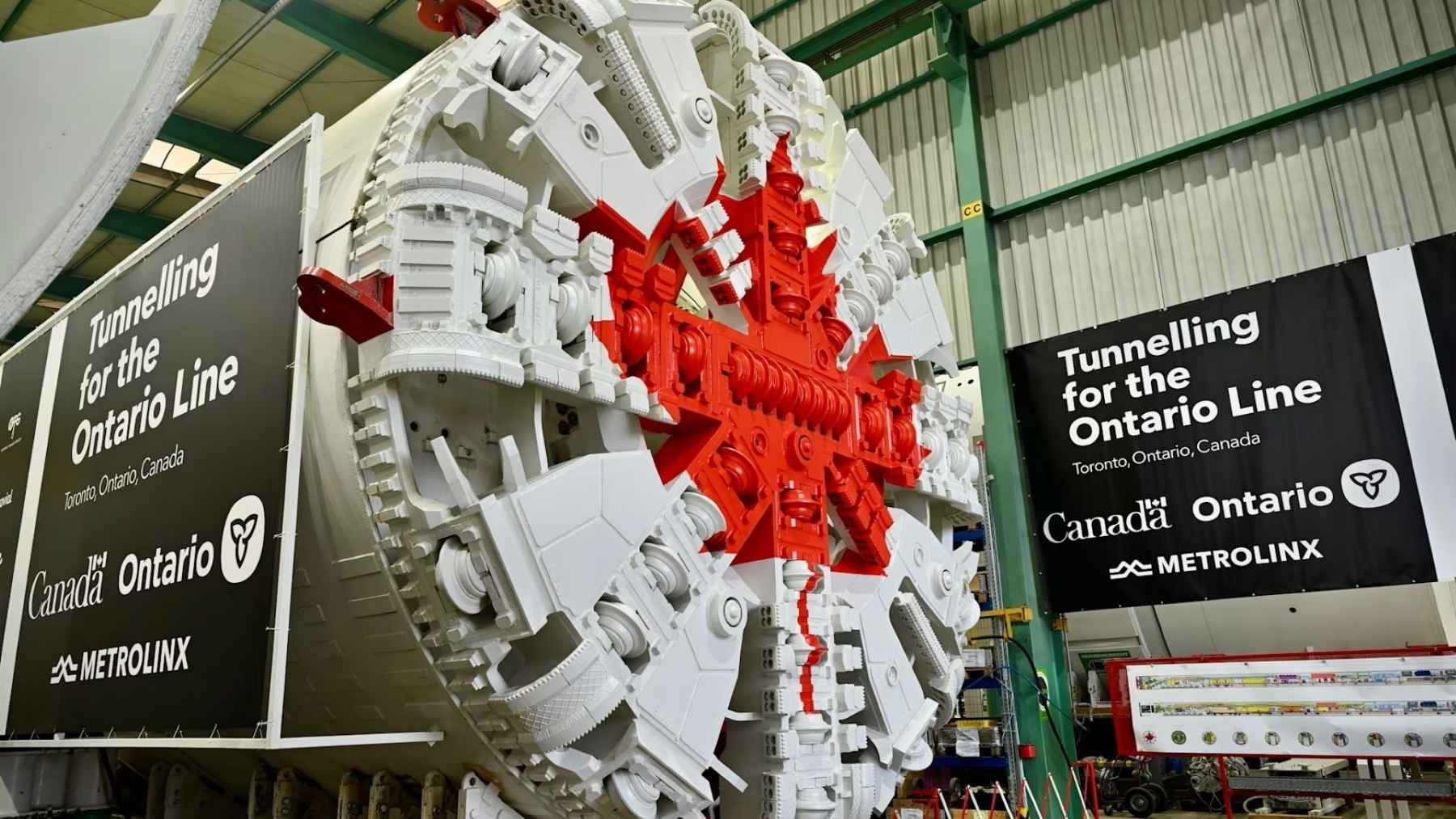
Toronto put two of them under its downtown in April. They’re called Libby and Corkie, they’re painted red and white with a maple leaf, and Metrolinx says they’re cutting the first subway tunnel under the core in more than 60 years.
All true. It’s also the smaller half of the story.
Toronto has been running these machines under itself the whole time. The last big one weighed 1,000 tonnes, worked 10 metres deeper, cut a hole nearly twice as long, and had to get through a buried prehistoric valley to finish. Nobody will ever ride through it. Four years after it broke through, it still isn’t doing the job it was built for.
What Libby and Corkie actually are
They’re Herrenknecht earth pressure balance shields, which is what you buy when the ground might not hold itself up while you cut it. The machine keeps the chewed-up muck packed in a sealed chamber behind the cutterhead and uses it as a plug, balancing whatever the earth and groundwater are pushing back with.
Per Herrenknecht’s own project data sheet, each one cuts a face 6,870 millimetres across, about 22 feet 6 inches, with 1,280 kW at the cutterhead (roughly 1,720 horsepower) and 6,925 kNm of torque. The sheet lists 9,620 metres of tunnelling on the contract, and spells out the ground: shale, very weak to medium strong, with siltstone and limestone interbeds.
Same formation the last machine cut. Hold that thought.
Both were assembled, tested, then taken apart again in Schwanau in southern Germany, shipped across the Atlantic, and unloaded at the Port of Oshawa on June 9, 2025. They went to storage, then to the launch site by truck, then got rebuilt in the open air beside the GO rail corridor. Libby was the first one put back together on site.
The launch shaft is 16 metres deep. The tunnel runs at 40. So the drive starts shallow and works its way down before it settles under the core.
Ontario’s own announcement lays out the choreography: the first machine cuts the eastbound tube, the second follows on the westbound. Libby leads, Corkie trails.
Neither of them digs the stations. Those get excavated from the surface, and the machines punch through six finished caverns as they pass: King West, Chinatown, Osgoode, Queen, Moss Park, Distillery District. The contractor is Ontario Transit Group, a joint venture of Spain’s Ferrovial and France’s VINCI.
The rest of the operation sits up top: a grout plant, a gantry crane, a yard of precast liner segments, and two conveyor systems in series to walk the muck out to a pile the trucks can reach.
The 1,000-tonne machine that went first
Now go back six years and a few kilometres east.
In December 2019 the city lowered a machine called Donnie into a 50-metre shaft at the Ashbridges Bay Treatment Plant. Per the city’s own release, it weighed close to 1,000 tonnes and ran 115 metres long, about 377 feet. It went down the hole in pieces and got bolted together at the bottom.
Donnie’s job was the Coxwell Bypass Tunnel: 10.5 kilometres of finished bore, 6.3 metres across, west along Lake Shore Boulevard East and then north up the Don Valley. R.V. Anderson, one of the designers, describes the tube as wide enough to park two buses side by side.
Most of that route is Georgian Bay shale, stable enough to cut with the face open to the air. But the alignment crosses a buried valley, an old soft-ground channel filled in long before anyone was around to notice it, and at two points the rock cover over the machine thins to less than six metres.
So the contract demanded a dual-mode borer: able to run open when the rock behaves, able to seal itself shut and hold back six bar when it doesn’t. Crews probe-drilled ahead of the cutterhead the whole way, hunting for water they didn’t want to meet by surprise. Per Tunnel Business Magazine, Donnie hit both stretches of the buried valley and got through in open mode anyway.
The rest of the build reads like somebody optimising a production line, which is what it was. The concrete segments are 12 inches thick, fibre-reinforced, with gaskets rated to 12 bar. They were cast six feet wide instead of the usual five, purely to cut the number of stops. Instead of rail cars, the contractor ran rubber-tyred Metalliance vehicles that could haul two rings at a time.
Donnie reached the last shaft at Coxwell Ravine Park in 2022. That tunnel contract alone came to about $397 million, awarded to a joint venture called North Tunnel Constructors. Every dollar figure here is Canadian.
It wasn’t even the only water machine in town. In May 2023 a 270-tonne borer went down a 40-metre shaft in Fairbank Memorial Park to cut a three-kilometre storm sewer 4.5 metres wide, grinding eight to 10 metres on a good day. It finished tunnelling in 2024.
Toronto used to build these things
Here’s the part that makes the whole German shipping operation sting a little.
Donnie didn’t come from Herrenknecht. It came from Lovsuns, and Lovsuns is what’s left of Lovat.
Lovat was a Toronto company, founded in 1972, and for decades it was the name in soft-ground tunnelling. It built more than 280 machines out of a factory in the Toronto area and sold them across six continents, in sizes from 2 to 12 metres. Toronto didn’t just dig tunnels. It supplied the planet with the machines that dug them.
Caterpillar bought the company in 2008. Its Toronto operation built eight more borers for local transit work, including machines for the Eglinton Crosstown and the Spadina subway extension. In 2013 Caterpillar announced it was shutting the plant.
In 2014 a Chinese manufacturer, Liaoning Censcience Industry, bought the fixed assets and the entire intellectual property and reopened the same facility as Lovsuns. In January 2017 Lovsuns closed the Toronto factory too and moved production to China. TunnelTalk described it at the time as closing out the history of TBM manufacturing in Canada.
So the machine that cut Toronto’s biggest hole was a Lovat design, built by its Chinese owner, sold back to the city that invented it. Nine years later the same city bought its subway machines from Germany and shipped them 6,000 kilometres across an ocean.
There’s a footnote to go with it. Libby and Corkie were named by public contest, and the winner, Jason Paris, also named two of the Eglinton machines Dennis and Lea back in 2013. Those were built here. His new pair wasn’t. He told TorontoToday he went with the “ie” in Corkie “because it sounded slightly cuter.”
A finished tunnel doesn’t do much without a pump station
Donnie’s tunnel does not empty itself. Everything it swallows has to be lifted into the Ashbridges Bay plant, and that needs a new Integrated Pumping Station to replace two aging ones.
As of the city’s last published progress update, dated March 2025, the Coxwell Bypass Tunnel was about 99 per cent complete. The pumping station was about 33 per cent.
A construction notice the city posted on February 23, 2026 fills in the rest. The deep excavation wrapped in 2025. An early-works contract started in mid-March 2026 and carries an expected end date of December 2029. The pumping station itself, plus the screen building, generator facility and substation, is a separate package that was still heading to procurement this year.
So a 1,000-tonne machine crossed a buried valley under 50 metres of ground to cut that hole, and the kit that empties it is currently a tender document. The notice signs off with a line the city presumably meant sincerely: “Building a great city takes time.”
None of which is abstract if you own a basement here. On July 15 and 16, 2024, about 100 millimetres of rain, close to four inches, landed on Toronto in a few hours. The Don Valley Parkway went under, subway service stopped, and more than 165,000 Toronto Hydro customers lost power.
The Insurance Bureau of Canada first put the insured damage above $940 million. CatIQ later revised it to $991 million, from about 36 hours of rain. Just under a quarter of the city still runs on combined sewers, where rain and raw sewage share a century-old pipe.
Same rock, same trick, opposite cargo
So: the shale.
Donnie cut Georgian Bay shale. Libby and Corkie are cutting shale with siltstone and limestone interbeds. Different manufacturers, different continents, different decades, same rock under the same city. The method barely differs either. Cutterhead, conveyor, segment erector, grout, jacks, repeat. Metrolinx lays out the sequence on its own site, and it describes Donnie as well as it describes Libby.
Canada is running both arguments, just not in the same city. Montreal has a 2,000-tonne Herrenknecht called Lisette chewing under its east end for the Blue Line extension. Washington is doing the water version, with a 1,200-tonne German borer under the Potomac, against the same combined-sewer problem Toronto has. Libby and Corkie rolled out of the same Schwanau plant that turned out the machines under London.
Toronto is the one city doing both jobs. Its water machine finished four years before its subway machines started.
The boring is the easy part
Libby and Corkie will finish their six kilometres, and the province will hold an event when they break through at the Don Yard. That part is close to routine now.
What comes after is not, and Donnie’s tunnel is the proof. It is 10.5 kilometres of finished concrete, cut by a machine bought specifically to survive a hole in the bedrock nobody could see from the surface, and its usefulness still depends on a pumping station whose main contract was going out to bid this year.
The Ontario Line now carries an estimated price of about $29.5 billion, against $10.9 billion when it was announced in 2019, and Metrolinx has quietly moved the opening from 2031 to the early 2030s. Chief executive Michael Lindsay told reporters at the April launch that the “complexity of this job is tremendous.”
He isn’t wrong, and the tunnel across town backs him up. Toronto has proved twice over that it can drive a thousand tonnes of steel through some of the least cooperative rock in the country and come out exactly where it meant to. It just can’t build the machines anymore, and it still can’t finish the plumbing.