
Every transit map has one: the extension that gets studied, promised, shelved and promised again until it turns into a local running joke. In Montreal, that’s the Blue Line push east to Anjou. The city’s own mayor, Soraya Martinez Ferrada, attended a ceremony for this same project as a schoolkid back in 1987, a story she shared at the launch event this spring, according to La Presse.
But the joke phase is over. Since May 19, a 2,000-metric-ton boring machine named Lisette has been grinding through the rock beneath the city’s east end, carving 4.6 kilometers (2.9 miles) of new metro tunnel from the future Vertières station to the future Anjou station.
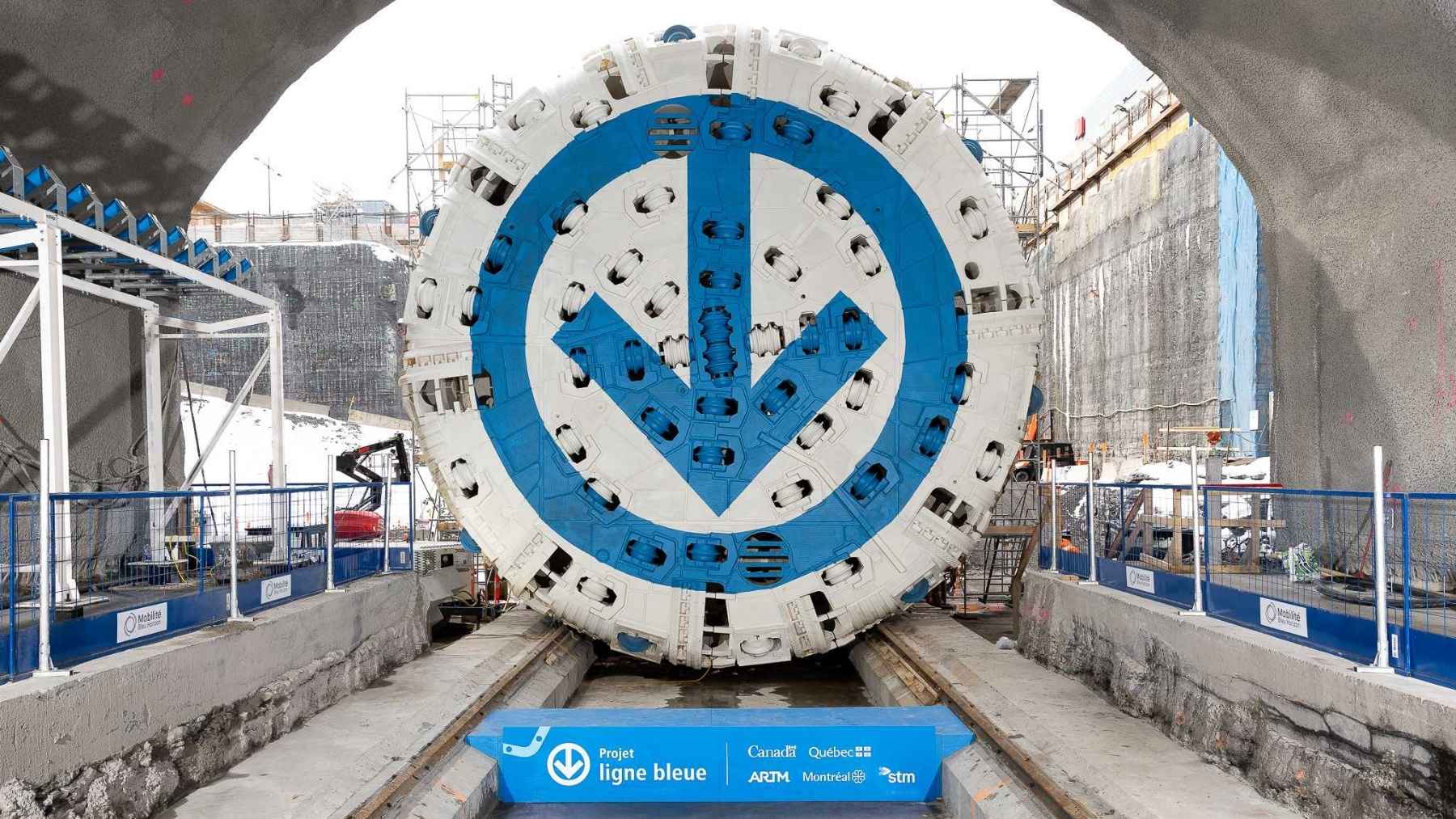
The machine is a Herrenknecht, custom-built in Germany, with a cutting wheel 9.7 meters across. That’s about 32 feet, and according to the Société de transport de Montréal, it makes Lisette the largest tunnel boring machine ever used in Quebec. It’s also the first time Montreal’s metro network gets dug by machine instead of conventional methods. If the schedule holds, Lisette surfaces at Anjou in early 2028, and trains start running in 2031.
The biggest boring machine Quebec has ever seen
Lisette is a lot more than a spinning wheel. The full rig stretches about 140 meters (460 feet) behind the cutting face, with a control cabin, hydraulics, transformers and conveyors packed into the tube. Total weight comes in above 2,000 metric tons, which Le Devoir helpfully translated for its younger readers as roughly 400 elephants.
The machine crossed the Atlantic in pieces and arrived at the Port of Montreal in fall 2025. Crews then spent months assembling it at the bottom of the Vertières shaft. One gear alone weighed 204 metric tons and had to be lowered nearly 20 meters below the surface, per the STM.
There’s a telling detail stamped on the machine itself: serial number S1423. Daniel Roussel, project director for the Mobilité Bleu Horizon construction consortium, told La Presse that makes it the 1,423rd machine of its kind from the same builder. So Lisette is about as far from an experimental prototype as industrial hardware gets. Herrenknecht is the same German firm behind Mary, the 1,200-ton borer that just started digging under the Potomac in Washington, and founder Martin Herrenknecht began sketching his first prototype in his garage in 1977, per La Presse. The 83-year-old dropped by the Montreal site in mid-May while the World Tunnel Congress was in town, presumably to watch number 1,423 do its thing.
On the global scale, Lisette sits comfortably midsized. China is running a 5,000-ton machine under the Yangtze with a cutter head 16.64 meters across. For Quebec, though, nothing this big has ever chewed rock.
It digs the tunnel and builds it in the same pass
A boring machine earns its keep by doing two jobs at once. Up front, the wheel spins cutting discs against the rock and breaks it into rubble, which conveyors haul out the back. Just behind the cutterhead, the machine installs precast concrete segments, about 14,300 of them across the full route according to the STM, so the finished tunnel wall goes up while the digging is still happening.
The route runs 18 to 40 meters (59 to 131 feet) below street level. By the time Lisette reaches Anjou, roughly 300,000 cubic meters of rock will have come out of the ground, per Le Devoir. That’s more than 100 Olympic swimming pools’ worth of Montreal bedrock, and none of it goes to waste. The rubble is trucked to the old Saint-Michel quarry for reuse in future city projects.
Progress here is measured in meters, not miles. The Tunnelling Journal reports the machine is expected to advance at “up to 15m per day” depending on ground conditions, with Le Devoir pegging the average at 10 to 15. Three crews rotate around the clock, seven days a week, and La Presse reports about 2,000 workers will cycle through the site this summer, making it one of the biggest construction jobs in the city.
Not every tunnel gets dug this way, either. Norway just funded a tunnel for ships that will be blasted through a coastal mountain with explosives, no cutter head involved. Montreal went mechanized partly because a borer is far gentler on the neighborhood upstairs. Maha Clour, executive director of the Blue Line Project, told Le Devoir the machine runs deep enough that residents will barely feel or hear it.
Montreal put the name to a public vote
Naming a boring machine after a woman is an old tunneling tradition. The machine gets a godmother before heading underground, symbolically watching over the crews. Montreal took the custom further than most and let the public pick, with a vote held March 9 to 22 that drew nearly 9,000 participants, according to the STM.
Five Quebec women with careers in fields like engineering, sustainable development and public transit were on the ballot, and the winner was Lisette St Onge. She was hired as a bus driver in 1980, back when the city’s transit authority had barely fifteen women behind the wheel, and in the spring of 1981 she became the first woman to operate a Montreal métro train. More than six years passed before a second woman followed her into the operator’s seat.
St Onge, now retired, was at the Vertières site on May 19 when the name was revealed. “I feel great, I feel nervous, I feel happy,” she told the crowd, per Global News. Her name now rides 2,000 tons of steel all the way to Anjou.
Nobody has decided what happens to Lisette in 2028
The Blue Line extension is a CA$7.6 billion project, per La Presse, adding five stations and about 6 kilometers of line to a network whose eastern end hasn’t moved since 1986. Officials told Global News the job is tracking on schedule and on budget, with the new stations opening in 2031. Between now and then, Lisette has to pass through the excavated boxes of the intermediate stations before surfacing at Anjou’s western access in early 2028.
Then things get interesting. The machine belongs to the Mobilité Bleu Horizon consortium, led by Pomerleau with EBC and Spie batignolles, and the default plan is to take it apart and ship it back to Germany, per La Presse. Mayor Martinez Ferrada would rather keep it, telling reporters Montreal has plenty more projects that could use a giant drill. Quebec’s transport minister, Benoit Charette, stayed noncommittal, saying the government will look at whether the investment can be put to further use.
There’s a catch, though. The STM notes that fully reusing a boring machine is rare, because each one is custom-designed around its specific project. So Lisette may well end up a one-tunnel wonder. Getting 2,000 tons of German steel to Anjou turns out to be the straightforward part. Deciding what to do with it afterward is the kind of digging no machine has been invented for.
 @christoskloukin ROOKIE3 months ago