
The Federal Communications Commission spends most of its time on paperwork nobody reads twice. Spectrum allocations, robocall enforcement, broadcast license renewals. On Thursday, though, the agency signed off on something considerably stranger: a license tied to a satellite whose entire job is bouncing raw sunlight back down to Earth after the sun has set.
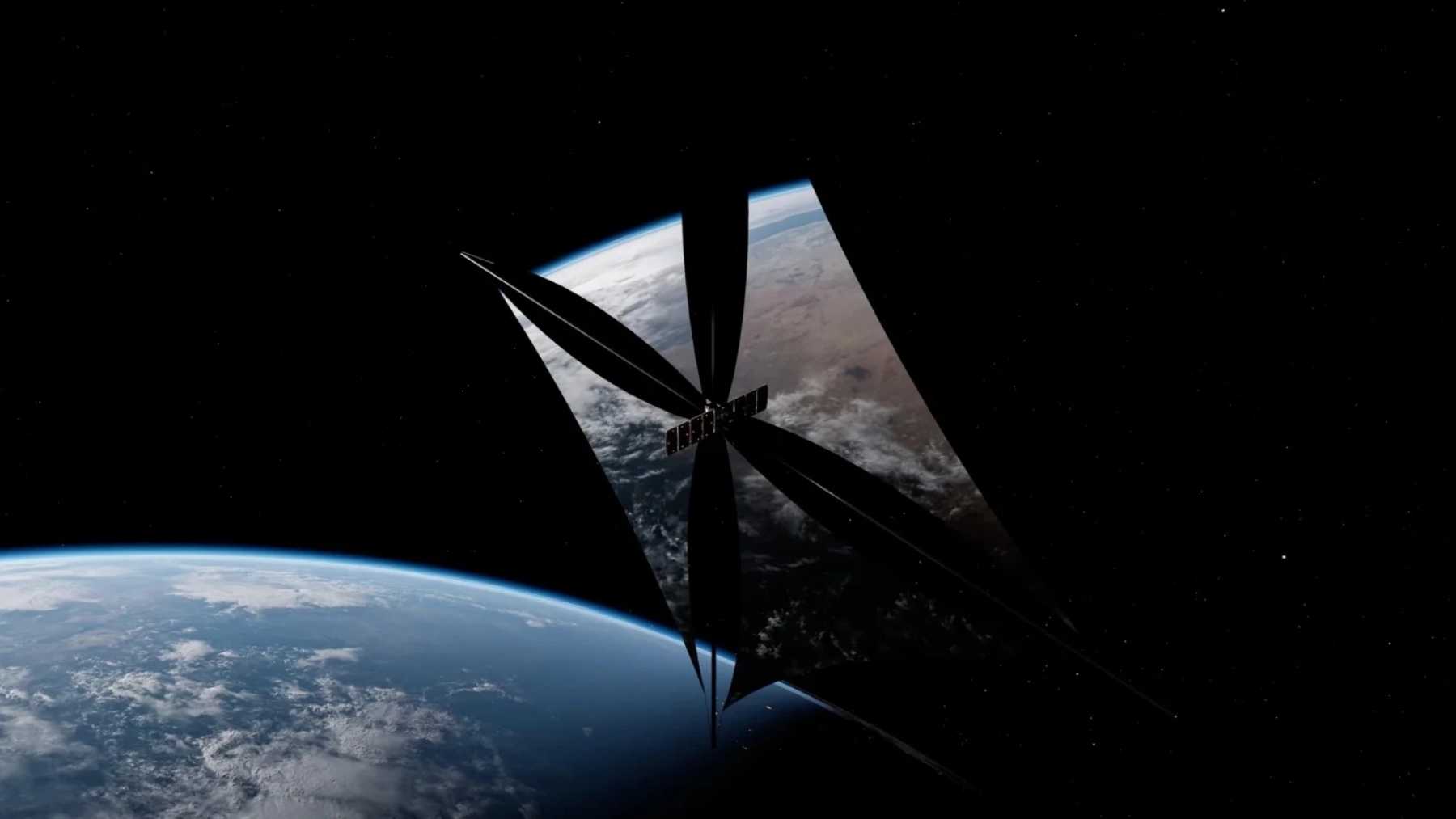
The satellite is called Eärendil-1 (a Tolkien reference, because aerospace founders cannot help themselves), and it belongs to Reflect Orbital, a startup based in Hawthorne, California. The FCC’s Space Bureau adopted the order on July 9, clearing the company to use radio frequencies to deploy, steer, and test an 18-by-18-meter orbiting mirror. It is a single demonstration satellite, licensed for two years, with one core trick: catching sunlight up in orbit and dropping a moving patch of it, roughly 5 kilometers wide, onto a chosen target on the night side of the planet.
The pitch is sunlight on demand. Reflect Orbital told the FCC the technology could extend the usable hours of solar farms and light up critical operations like search-and-rescue work after dark. Astronomers spent months telling the same agency this was a terrible idea. The FCC heard both sides, then explained why only one of them was legally its problem.
The mirror weighs less than a checked bag
Start with the hardware, because the hardware is genuinely clever. The reflector is a sheet of aluminized Mylar measuring 18 meters on each side, about 60 feet, for a total surface of 324 square meters, according to TechSpot. That is more floor area than the average American house.
The sheet itself weighs about 16 kilograms, or 35 pounds. Less than an airline checked bag, folded up for launch and designed to unfold once the spacecraft reaches orbit.
Per the FCC grant, Eärendil-1 will operate at an altitude of about 625 kilometers in a near-polar orbit inclined at 88 degrees. The mirror is motorized and steerable, and the company committed to keeping the reflected light visible only inside the targeted area. Each pass paints its 5-kilometer spot for a few minutes at a time, delivering about 0.1 lux, which the company compares to a full moon.
The satellite carries its own propulsion for collision avoidance, and the end-of-life plan is refreshingly unglamorous: an uncontrolled atmospheric re-entry within a year of the mission ending. Reflect Orbital told the FCC the only component expected to survive the burn is the titanium propellant tank, and NASA’s debris assessment software puts the odds of that tank hurting anyone at 1 in 119,400.
The FCC licensed the radio, not the mirror
Here is the part that made astronomers furious. The FCC did not really approve a space mirror. It approved radio transmissions: the uplinks that command the spacecraft and the downlinks that bring telemetry and test data home.
The giant reflective sheet bolted to that radio was ruled to be somebody else’s department. In the order, the commission wrote that the risks raised against the reflector are “unrelated to the Commission’s role in authorizing use of radiofrequency spectrum.”
That was not for lack of pushback. More than 1,800 individuals filed letters on the application, and the American Astronomical Society filed a formal petition to deny, with astronomy societies from Argentina and Spain lodging their own objections. The FCC denied the AAS petition outright and granted the license with conditions on the same day.
The commission knows it is in odd territory here. In March it published a rulemaking notice literally titled “Spectrum Abundance for Weird Space Stuff,” covering the wave of satellites that do things other than communicate. The docket keeps earning the name: days before Eärendil-1 got its license, another American company put the first commercial nuclear battery into orbit on a Falcon 9 rideshare.
Astronomers ran the numbers and hated them
The core objection is simple. A normal satellite is bright by accident. This one is bright on purpose. In a filing to the FCC, the American Astronomical Society argued the application is “fundamentally different from those for telecommunications satellites,” precisely because the whole point of the machine is maximum reflected light.
The society’s filings describe risks that go beyond ruined telescope images: brief flashes bright enough to dazzle pilots and drivers, and possible eye damage for amateur astronomers. Reflect Orbital itself has acknowledged, per the AAS, that looking at the satellite through a telescope with an aperture larger than 12 inches could injure an eye.
Then there is the sky itself. The European Southern Observatory said in a July 1 statement that the full 50,000-satellite constellation Reflect Orbital has proposed would raise background sky brightness at its Chilean facilities by a factor of three to four. Tony Tyson, chief scientist of the Vera Rubin Observatory, put it more bluntly at a National Academies meeting in June, as SpaceNews reported: “Imagine the sky full of moons.”
Reflect Orbital’s answer is a stack of self-imposed safeguards. The company says it will reflect light only at predetermined times, keep the beam away from observatories and protected areas, warn researchers in advance, and coordinate with NASA and the National Science Foundation. The license binds the company to those commitments. Whether they hold up across thousands of satellites is a different problem, and one demo cannot answer it.
The business is selling sunset extensions by the hour
The money side explains the hurry. As Futurism reported in March, CEO Ben Nowack has floated a price of about $5,000 per hour for a single mirror’s light, and he is targeting 1,000 satellites by the end of 2028. The roadmap cited in a recent study on satellite brightness goes further: 5,000 production satellites by 2030 and a possible extension to 50,000 by 2035, with future mirrors up to 57 meters on a side. Reflect Orbital told regulators it had already logged more than 250,000 applications for the service.
After the approval, Nowack said in a statement that the license is the first step toward rigorously testing both the technology and the safeguards the company has built around it. The Air Force is curious too, having put $1.25 million of small-business research funding behind the reflector work in 2025.
The energy angle is the one to watch, because solar is already having a strange decade. German researchers are testing whether a big enough solar farm can brew its own rain over the desert, and Japan just flew a washing-machine-sized satellite that beams solar power down as microwaves. Reflect Orbital’s version keeps the panels on the ground and moves only the light.
Keep the scale honest, though. Nobody is running an air conditioner off this demo. Direct sunlight is roughly 100,000 lux, and the patch Eärendil-1 paints is about a millionth of that. The demonstration exists to prove the hard parts: unfolding a giant sheet in vacuum, aiming it with precision from 625 kilometers up while moving at orbital speed, and keeping the light inside the lines.
Russia tried this in 1993, and one satellite proves nothing either way
None of this is entirely new. In 1993, Russia’s Znamya experiment unfurled a 65-foot Mylar sheet in orbit and swept a spot of reflected light roughly 3 miles wide across the ground, briefly, before the program faded. The physics has been sitting there for three decades. What changed is that somebody built a business plan on top of it and got an American license.
What happens next is concrete. Reflect Orbital owes the FCC a surety bond by August 10, and the company has pointed to a SpaceX Falcon 9 launch expected in the coming months. Then the clock starts: two years of license, one of operations, and a satellite that falls back and burns up on its own within a year after that.
If the mirror unfolds and the beam lands where it is aimed, the real fight moves to the constellation application, which the FCC says it will judge on its own merits. If it does not, the whole thing re-enters quietly, and the night sky keeps its current number of moons.
 @johnsprot ROOKIE2 months ago