
Cemeteries run on one promise: nothing down there moves. Kensal Green in west London has kept it for the better part of two centuries, collecting Victorian novelists, engineers and industrialists under some of the most theatrical funerary stonework in Britain.
Right now that promise carries an asterisk. Two tunnel boring machines are grinding beneath the cemetery, 35 to 40 meters down (115 to 130 feet), carving the twin tubes that will eventually take HS2 trains into Euston station. And according to ianVisits, the London transport blog that checked the alignment against HS2’s own tracking map, the lead machine is passing within meters of one particular plot: the grave of Marc Brunel, the engineer who patented the tunneling shield.
Every shielded borer working today descends from the idea Brunel filed in 1818. The alignment wasn’t chosen for poetry, either. HS2’s launch site at Old Oak Common sits west of the cemetery, Euston sits east, and the straightest usable line between them runs under the graves.
Brunel’s shield was a cast-iron box full of men with shovels
Brunel got the idea from a shipworm. While working at Chatham Dockyard, he watched Teredo navalis chew through ship timbers and line its burrow behind itself, and in 1818 he patented a machine-scale version of the trick. It was a cast-iron frame pushed forward by jacks, with miners digging the face from inside protected cells while bricklayers sealed the fresh tunnel behind them.
The Brunel Museum still holds the original drawings: 36 cells across twelve frames, stacked three levels high. He pointed the thing at the Thames in 1825, aiming to connect Rotherhithe and Wapping underneath a working river.
It went badly, then worse. The tunnel flooded six times, filled with methane that lit off the miners’ oil lamps, and killed six men in a single inundation in January 1828. Brunel’s son Isambard, who had taken over as resident engineer in 1826 at age 20, was pulled out of that flood unconscious.
Progress ran between 1 and 8 feet a week. To keep money coming in, the directors sold tickets: a shilling to stand in the tunnel and watch the shield work. Somewhere between 600 and 800 people a day paid it, which makes this roughly the 1820s version of charging admission to a construction site.
The tunnel finally opened in 1843, eighteen years after the first dig, as the world’s first tunnel driven successfully under a navigable river. It never carried the horse traffic it was designed for. It carries trains instead. The London Overground runs through Brunel’s brickwork today, which means his tunnel has outlived the company that built it and every schedule HS2 has published so far.
Karen does a year of Brunel’s digging in a week
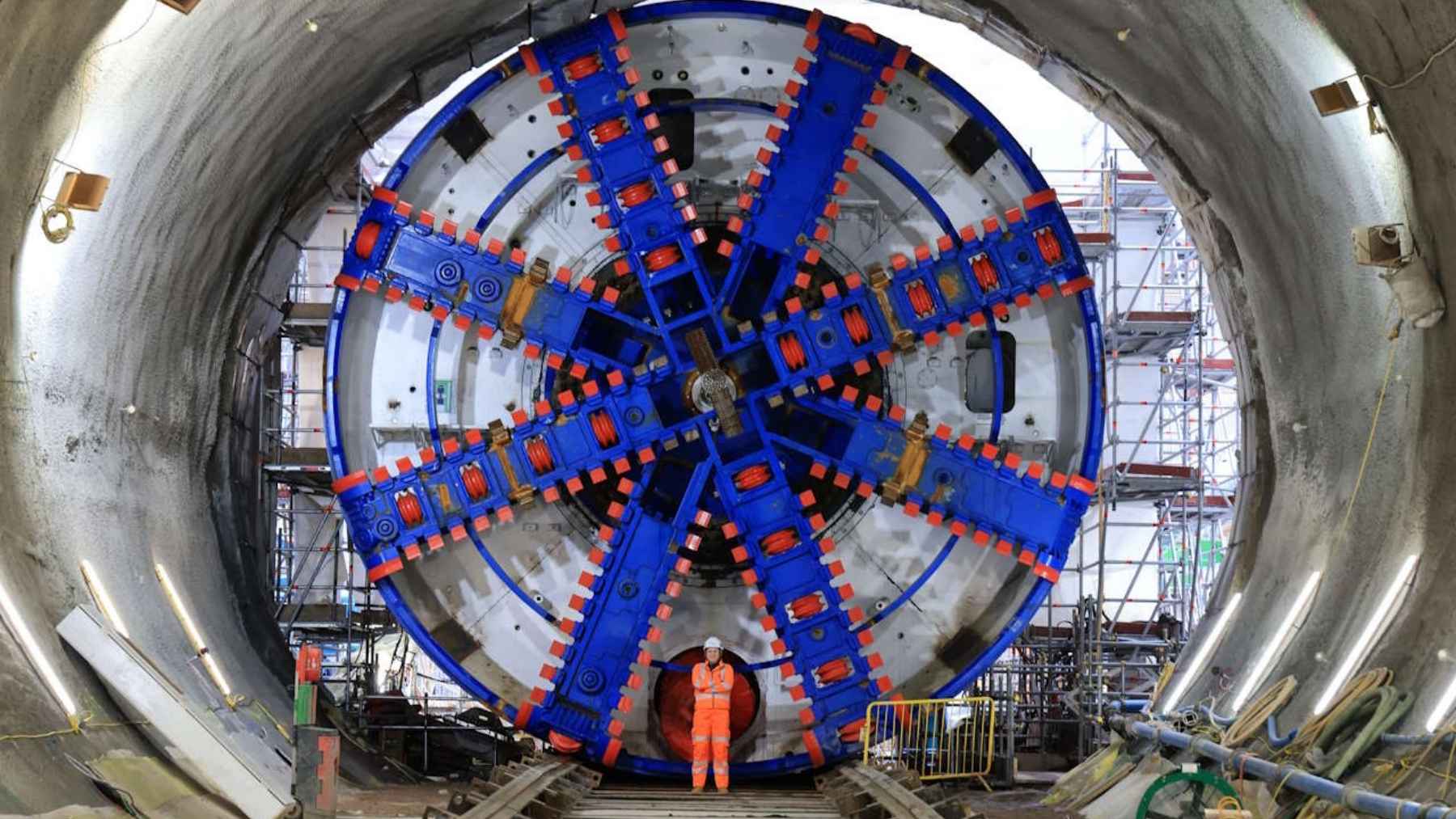
The machines under Kensal Green are called Madeleine and Karen, and they are what Brunel’s sketch grew into after two centuries of iteration. Each is a Herrenknecht, built in Germany, 198 meters long (about 650 feet, or nearly two football fields) and weighing 1,624 metric tons. They were shipped over in pieces and reassembled by a 750-ton crane inside the underground station box at Old Oak Common, 23 meters below street level.
Madeleine launched in late January on the upline. Karen followed on March 16 on the downline, the eleventh and final boring machine built for HS2, closing out the fleet that has dug every deep tunnel between London and the West Midlands. Per HS2’s announcement, she’s named for Karen Harrison, one of the first female train drivers in the UK. More on her in a minute, because the name is doing more work than most.
Together the pair is driving the 4.5-mile twin-bore Euston Tunnel. The stats are the usual heavy-industry stuff: 48,294 concrete segments across both tubes, each weighing 6 metric tons, cast at a factory in Hartlepool and delivered to London by rail, with 1.5 million metric tons of spoil coming out the other way.
At full clip, each machine advances up to 150 meters a week, roughly 490 feet. Brunel’s shield, on its best weeks, managed 8. Run the math and Karen covers more ground in a good week than Brunel’s crews managed in a good year.
Nobody swings a pick at the face anymore, either. The cutterhead does the digging, the machine erects its own concrete rings as it advances, and the crew rides inside with ventilation, lighting and a support train behind them. Other outfits have pushed the concept further still. The Boring Company’s Prufrock rigs in Nashville tilt themselves nose-first into the dirt and bore with nobody underground at all.
HS2 is scaffolding headstones so they don’t tip over
Which brings the route back to the cemetery. HS2’s June construction update put Madeleine at Chamberlayne Road, on the Kensal Green stretch, by mid-July, with Karen following about a month behind. Both machines are due at the Euston cavern by late June 2027.
The ground above is not ordinary ground, and HS2 has treated it accordingly. Engineers surveyed the cemetery’s monuments before the machines arrived and found a number of them already leaning. Some got scaffolding. A couple are being taken down entirely and re-erected once the borers have passed, according to New Civil Engineer. Further along the route, HS2 has published protection-works notices for a fragile tin chapel in Kilburn, built in 1863, that gets reinforced before the machines pass underneath.
And in the middle of all this sits the Brunel family plot. Marc Brunel died in 1849, knighted and celebrated, and was buried under a headstone that is famously modest by Kensal Green standards. His son Isambard Kingdom Brunel, the famous one, joined him there a decade later.
The lead machine isn’t boring directly beneath the grave. ianVisits, which spotted the detail on July 7 after checking the public tracking map, reports the alignment misses the plot by a small margin, close enough to read as a salute and far enough to leave the stone alone. You can watch both machines crawl east yourself on HS2’s live route tracker.
The name on the machine drove out of Old Oak Common first
HS2 names its boring machines after women, a tradition the industry keeps up everywhere from Montreal’s metro dig to the Potomac. Madeleine honors Madeleine Nobbs, a former president of the Women’s Engineering Society. Karen honors Karen Harrison, and her story maps onto this machine almost too neatly.
In 1977, as a teenager, Harrison applied to British Rail as “K. Harrison” and got an interview because the panel assumed K stood for a man. They pushed secretarial work at her. She refused, and in November 1979 she started as a traction trainee at Old Oak Common depot, one of six women who broke onto British Rail’s footplate that year against open hostility from colleagues and management.
So the depot she drove out of is the exact spot the machine carrying her name set off from. Karen the borer is now grinding toward Euston, where a mural of Harrison, 26 feet wide, already covers a wall by the platforms. Avanti West Coast put it up in 2023 and later made it permanent. Two of its current drivers, Hayley Richardson and Vicky Knight, came to the launch in March and took a turn operating the machine. “Karen Harrison’s story is one to admire,” Knight said in HS2’s release.
Brunel’s budget problems survived two centuries too
If the machinery has changed beyond recognition, the finances haven’t. Brunel’s tunnel blew through its budget, sat bricked up for seven years when the money ran out, and needed a Treasury loan to finish. Britain is still auditing every line of its infrastructure math today, from graphene asphalt trials meant to stretch how long its roads last to the railway these machines are digging.
HS2 runs the same story at industrial scale. Britain’s Public Accounts Committee put the inflation-adjusted program cost near £80 billion, and the project’s own chief executive has reportedly told ministers the final bill could reach £100 billion, with opening dates drifting toward the mid-to-late 2030s. Either figure clears $100 billion in dollars without breaking a sweat.
Brunel’s tunnel took 18 years and every penny anyone would lend him, and it has now been carrying Londoners for 183 years. That’s the standard sitting a few dozen meters above the cutterheads as they chew east. The machines reach the Euston cavern in the summer of 2027. What Britain builds on top of them is a fight for another decade. The tunnels, at least, are the one part of this project with a two-century track record behind them.