
There’s a well-worn pattern with countries that show up late to a technology: they don’t buy the old version. Plenty of nations never bothered stringing copper telephone lines across the countryside and went straight to cell towers instead. Poland just pulled the same move with offshore wind.
On July 10, the Baltic Power wind farm delivered the first electricity ever generated by an offshore turbine to Poland’s national grid, according to Northland Power, the Canadian company that owns 49% of the project alongside Poland’s state-controlled ORLEN at 51%. Denmark switched on the world’s first offshore wind farm in these same Baltic waters back in 1991. Poland has spent the 35 years since watching from the beach and burning coal.
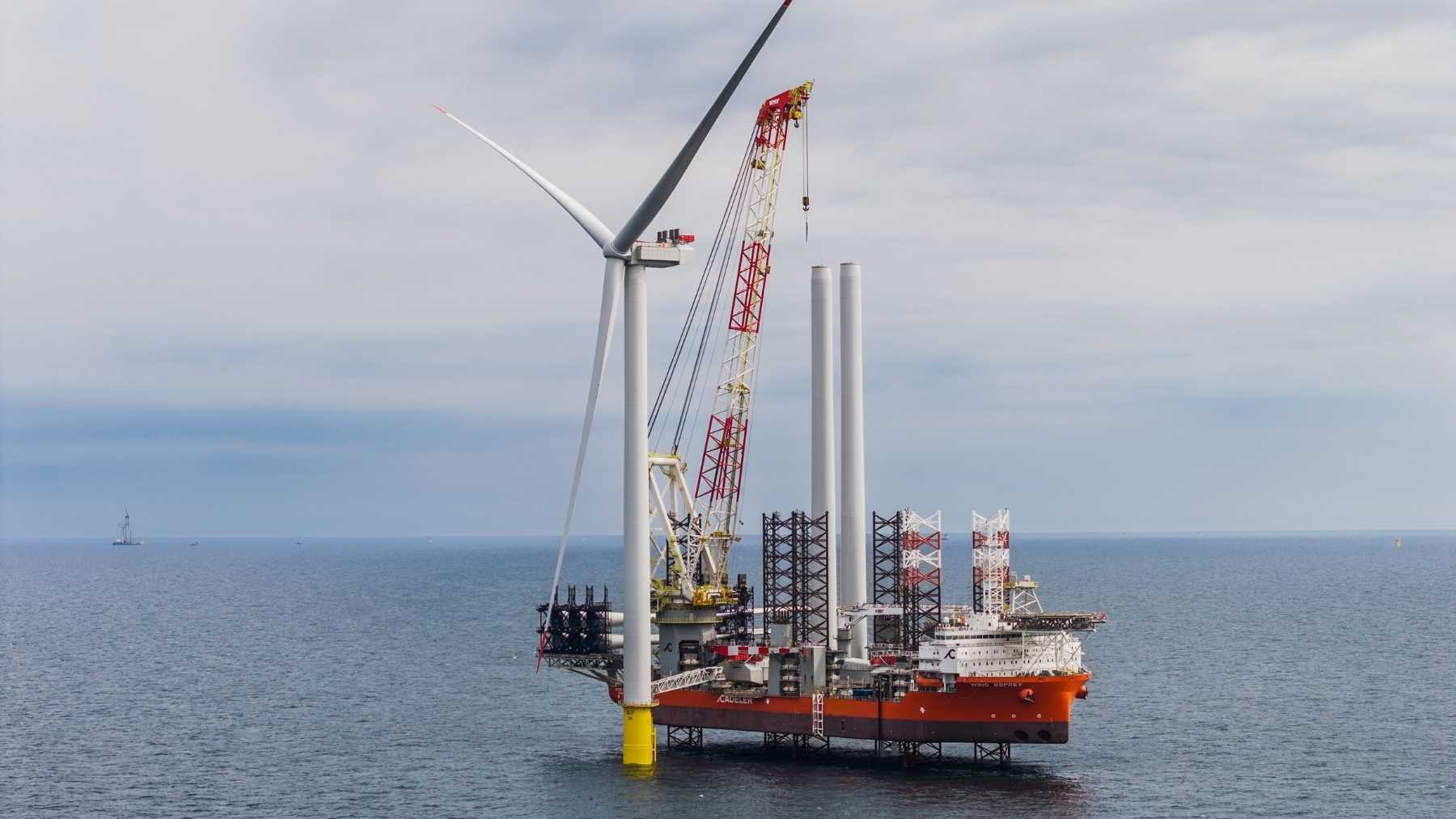
So when the country finally waded in, it didn’t start small. Baltic Power is being built with Vestas V236 turbines rated at 15 megawatts apiece, which Northland describes as the largest turbine model available from European manufacturers. The machine is so new that as of mid-June, only 100 of them existed at sea anywhere on Earth. Poland now has 54 of its own standing in a single farm.
Poland skipped the starter kit entirely
The usual way into offshore wind is gradual. Denmark’s 1991 debut at Vindeby ran 11 turbines of 450 kilowatts each, about 5 megawatts for the whole farm, enough for a couple thousand Danish households. Germany, the UK and the Netherlands all worked their way up through 2, 3.6, 8 and 13-megawatt machines over the following decades.
Poland ignored the entire ladder. One V236 puts out three times more power than that whole pioneering Danish farm did. The rotor alone spans 236 meters, about 774 feet, wider than two NFL fields laid end to end. And these aren’t hand-me-downs from a more experienced market. Baltic Power is among the first wind farms in the world to install the model at all.
For scale, the turbines going up off the Polish coast are individually more powerful than the 13-megawatt GE Haliade-X machines being planted at Dogger Bank, the largest wind farm ever built. Britain has been doing this for a quarter century. Poland’s first attempt out-muscles it turbine for turbine.
54 turbines up, 22 to go
The first turbine went up in July 2025, installed by Cadeler’s jack-up vessel Wind Osprey, and the installation contractor Van Oord had all 76 monopile foundations and transition pieces planted by March of this year. Since then the pace has been steady: 54 of the 76 turbines are now standing, per the July 10 announcement, with the first of them feeding the grid.
The supporting hardware is essentially done. All 350 kilometers (about 217 miles) of inter-array and export cabling has been laid, both offshore substations are in place, and the onshore substation in the municipality of Choczewo is ready, according to Offshore Wind. More than 100 vessels and over 5,300 crew and contractors have worked on the project so far.
Commissioning happens in phases from here. Turbines get started up and tested one after another over the coming weeks, and each one that passes begins feeding Polish homes immediately rather than waiting for the full farm. Capacity climbs gradually toward the target, with construction scheduled to wrap this autumn and commercial operations due in the second half of 2026, at costs Northland says are in line with original expectations.
About that target capacity: Northland calls Baltic Power a 1.1-gigawatt project, while ORLEN’s materials round the same farm up to 1.2 gigawatts. The actual math is 76 turbines times 15 megawatts, or 1,140 megawatts, so both companies are technically describing the same machine and neither is lying. Corporate rounding is apparently a matter of national perspective.
One farm covers 3% of the country’s electricity
Once fully operational, Baltic Power is expected to generate around 4 terawatt-hours of electricity a year. That works out to roughly 3% of Poland’s current electricity demand, or the annual consumption of more than 1.5 million Polish households, and ORLEN says it should cut CO2 emissions by up to 2.8 million metric tons annually compared with conventional generation.
The economics were locked in early. The project runs on a 25-year Contract for Difference secured from Poland’s Energy Regulatory Office in 2021, which is the same revenue mechanism that built out most of Europe’s offshore fleet. The nacelles were manufactured in Poland, and a maintenance base in the port of Łeba has been running since last year, set to handle operations for around 30 years once construction ends.
“Today, the first electricity from offshore wind flows to Polish homes and businesses — a historic moment for the country,” said Christine Healy, President and CEO of Northland Power. For the Canadian side, the farm nearly doubles its installed offshore capacity, from about 1.2 gigawatts to 2.3.
For ORLEN, it’s a stranger milestone. This is a state oil and gas company spending its way into wind at sea, part of what CEO Ireneusz Fąfara called “the largest investment programme in the history of Poland’s energy sector,” which he put at up to 380 billion zloty. Oil majors talking up renewables is nothing new. An oil major actually delivering a country’s first offshore watt is rarer.
Coal still runs half of Poland
Here’s the backdrop that makes one wind farm a national event. Coal generated 52.2% of Poland’s electricity in 2025, per Fraunhofer figures reported by Notes from Poland, which leaves it the most coal-dependent country in the EU and the only member state without a coal phase-out date.
The trend line is moving, though. The energy think tank Ember notes that coal’s share of Polish electricity has dropped by 30 percentage points in ten years, and in April 2025 it fell below half the monthly mix for the first time ever. Renewables covered 29.4% of generation last year, nearly all of it onshore wind and solar. Offshore contributed exactly zero watts until July 10.
That column is about to get busy. Poland is targeting almost 6 gigawatts of offshore wind by 2030, roughly five more Baltic Powers’ worth, and the same stretch of Pomeranian coast is slated to host three American nuclear reactors, the country’s other big bet on getting off coal. A coastline that spent decades as the quiet edge of a coal grid is turning into the busiest energy construction zone in Central Europe.
There’s still paperwork between here and the finish line, and in Poland’s case it’s paperwork nobody in the country has ever filed. The remaining 22 turbines need installing, the whole farm faces inspections, performance tests, occupancy permits and certification by an independent auditor, and the final step is an electricity generation license from the Energy Regulatory Office. Every one of those procedures is a first for Polish administration, right down to the forms.
The Baltic itself will adjust faster than the bureaucracy. If the North Sea is any guide, the seals will treat those 76 foundations as a new hunting ground long before the last permit gets stamped.