
When a road has to get to the other side of a river, the default answer is a bridge. You build it out in the open, you can see what you are doing, and for most of the Yangtze that is exactly what China has done, stitching its longest river with road and rail crossings from the interior all the way out to the coast.
But down near the river’s mouth, where the Yangtze spreads wide and the shipping traffic is some of the heaviest anywhere on the planet, a bridge starts arguing with the water it is trying to span. So China went the other way and pointed the largest tunnel boring machine it has ever built straight under the riverbed instead.
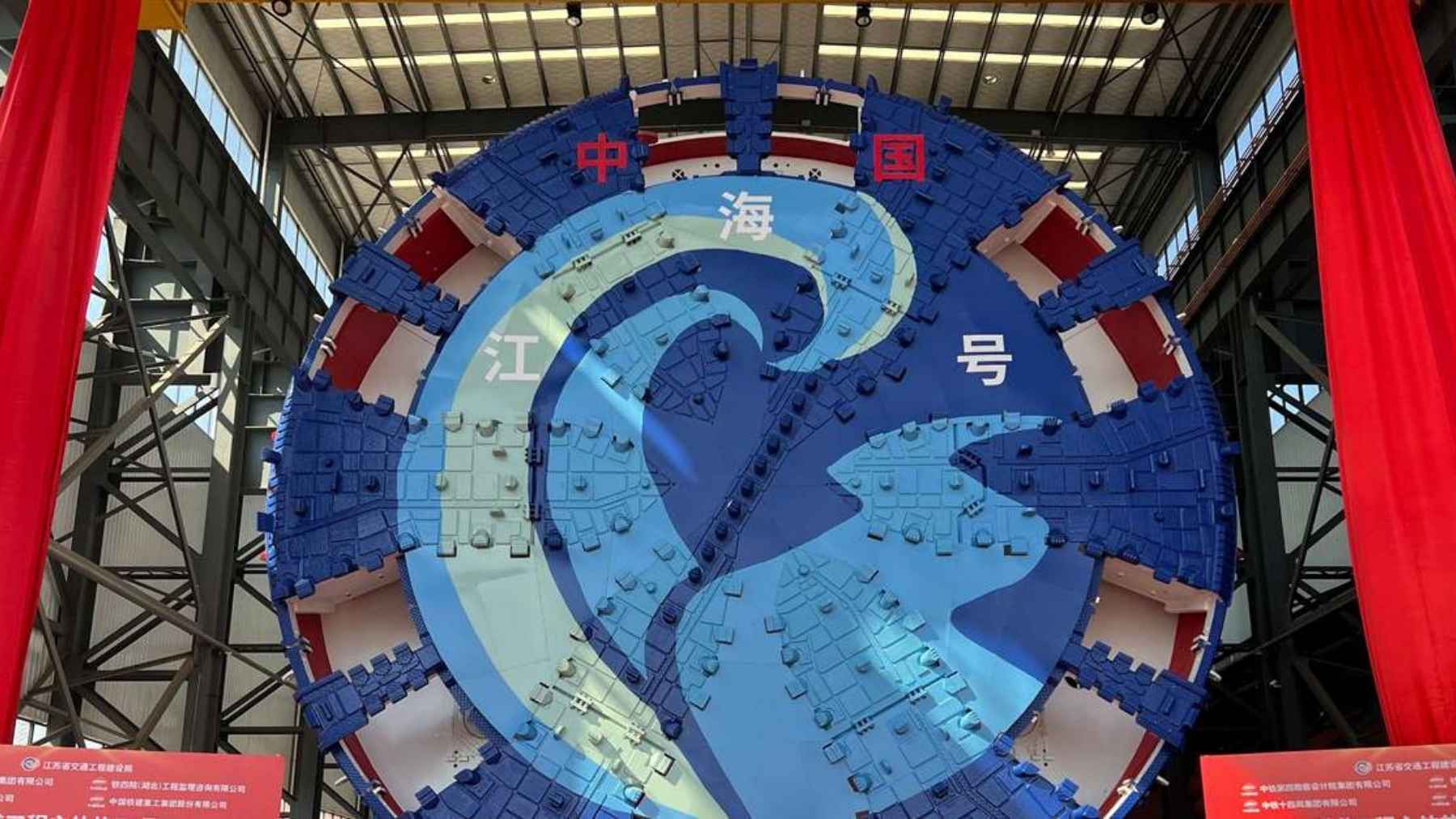
The machine is called Jianghai, and its cutter head measures 16.64 meters across. That is a little over 54 feet, or roughly a five-story building stood on end and set spinning. The whole rig runs about 145 meters long, give or take the length of a city block, and weighs somewhere near 5,000 metric tons, which is about 11 million pounds of machine, with a cutter head that by itself comes in at 460 metric tons.
According to China’s central government, citing the state news agency Xinhua, it is the largest-diameter boring machine the country has ever developed on its own, and right now it is grinding out the Haitai Yangtze River Tunnel, a road crossing Beijing bills as the world’s longest underwater highway tunnel of its kind. By the middle of June 2026 it had bored past the 6,000-meter mark, a little under two-thirds of the way through its underwater run.
The cutter head is five stories of spinning steel
A boring machine this size is less a drill than a mobile factory that happens to move forward. The cutter head at the front rotates and shaves the soil off the tunnel face. Conveyors haul the spoil out the back. And as the machine creeps ahead, it sets the curved concrete segments that become the finished tunnel wall, ring by ring, behind itself. A single one of these rigs is built from more than 20,000 parts, which is part of why countries treat the ability to make them as a stand-in for how good their heavy industry really is.
The tunnel it is cutting is not short. The full Haitai route runs about 39 kilometers (roughly 24 miles), including an underwater stretch of around 11 kilometers, of which the Jianghai is responsible for boring 9,315 meters. When it opens, it will carry a six-lane, two-way highway rated for about 100 km/h (62 mph), connecting Haimen in the city of Nantong on the north bank to Taicang, near Suzhou, on the south. Construction started back in September 2022, and the whole thing is targeted for completion around 2028, so nobody is driving through it any time soon.
The hard part isn’t the rock, because there isn’t any
When most people picture tunneling, they picture a machine biting through solid mountain. The Yangtze delta is the opposite problem. The ground here is waterlogged silt and fine sand, soft and shifting, and the real engineering fight is not chewing through it but keeping the hole from collapsing and the river from pouring in while you do.
At its deepest the Haitai tunnel sits about 75 meters (246 feet) down, and the water pressure on the structure works out to roughly 75 metric tons per square meter. You Shaoqiang, chief engineer on the project for the China Railway 14th Bureau, has called the conditions extremely challenging, which from an engineer is close to alarm.
Hold that pressure off a moving machine and you still have to keep the line almost perfectly straight, because ground settlement on the surface above has to stay under a single centimeter. To manage it, the Jianghai runs a pressure-balanced cutter head, a high-pressure flushing system to clear the face, dual slurry injection to keep things stable, and retractable cameras that let crews watch the cutter teeth wear down and swap them out without surfacing.
This is also not the only way to put a tunnel under water. Denmark is building its Fehmarnbelt crossing under the Baltic by casting 89 enormous concrete boxes on land and sinking them onto the seabed, no boring machine involved at all. Different river, different physics, same goal of getting traffic across water without a bridge in the way.
The high-speed sibling already crossed the line in March
The Jianghai is the biggest machine of its kind in China, but it is not the only record-setter working under the Yangtze this year. A second boring machine called Linghang, with a 15.4-meter cutter head and a weight around 4,000 metric tons, holds the title of the world’s largest-diameter high-speed-rail boring machine. On March 29, 2026, after 23 months of continuous tunneling, it finished an underwater bore of 11,182 meters in one uninterrupted drive and surfaced on the far bank. According to the Global Times, that made it the first machine in the 15-meter class anywhere to pull off a single continuous bore that long.
That tunnel, the Chongming-Taicang crossing, connects Shanghai’s Chongming district with Taicang in Jiangsu, and it is built for speed. The design lets trains run through it at up to 350 km/h (217 mph), which means a high-speed train can cross under one of Asia’s biggest rivers without easing off the throttle at all.
At its lowest the tunnel runs 89 meters below the surface, and much of the boring was handled by an onboard control system that made automated calls on chamber pressure, machine posture, and spoil removal as it went. So in the space of a single year, under the same river a few dozen miles apart, China finished a record high-speed bore and pushed most of the way through a record highway bore.
China used to import every one of these
None of this was a given. Three decades ago China bought its tunnel boring machines from foreign manufacturers, and it was not until 2002 that domestic development got folded into a national program. The country went from importer to building the biggest machines in the size class on its own, and the Linghang project has been held up in state media as proof of how far that climb has come. A rig made of 20,000-plus precision parts is a hard thing to fake, and China now turns them out at the top end of the market.
The two Yangtze machines are not even the only record borers China has running this year. A different machine is grinding a shaft a kilometer straight down for an iron-ore mine in the northeast, a vertical borer nicknamed the underground aircraft carrier, which solves an entirely different problem than the horizontal river crossings here. Elsewhere, the old methods still have their place too.
Norway just put up the money for a tunnel built for ships, and that one will be blasted through coastal rock the conventional way, with no giant cutter head anywhere in sight. The right tool depends entirely on what is in the way, and under the Yangtze, what is in the way is a wide, busy river sitting on soft ground. For the historical climb behind machines like these, the account in China Daily traces the shift from buyer to builder over roughly the last twenty years.
The boring is the easy part to photograph
A five-story cutter head grinding under a river makes for a striking photo, and the breakthrough moment, when a machine that size punches out the far side after years underground, is the part that travels around the internet. The part that actually decides whether any of this matters comes after.
The Haitai road tunnel still needs its lining finished, its ventilation and fire-suppression systems installed, its rescue corridors built, and years of fit-out before a single car drives through around 2028. The high-speed crossing has its own road ahead before trains run. When they finally open, crossing the Yangtze by car or by train will feel like nothing at all, no view, no sense of the water overhead, which is the strange payoff of spending years and a fortune carving a hole that everyone riding through it is meant to forget is even there.