
When you picture an owl, you probably picture a night bird up in a tree, all silence and a swiveling head. The burrowing owl didn’t get that memo.
It stands about nine inches tall, hunts in broad daylight, and lives underground, in tunnels that ground squirrels and prairie dogs dig and then abandon. Its whole way of life depends on one thing: flat, open desert with holes already in it.
That happens to be the exact patch of ground that Arizona homebuilders and solar developers both want, and want badly.
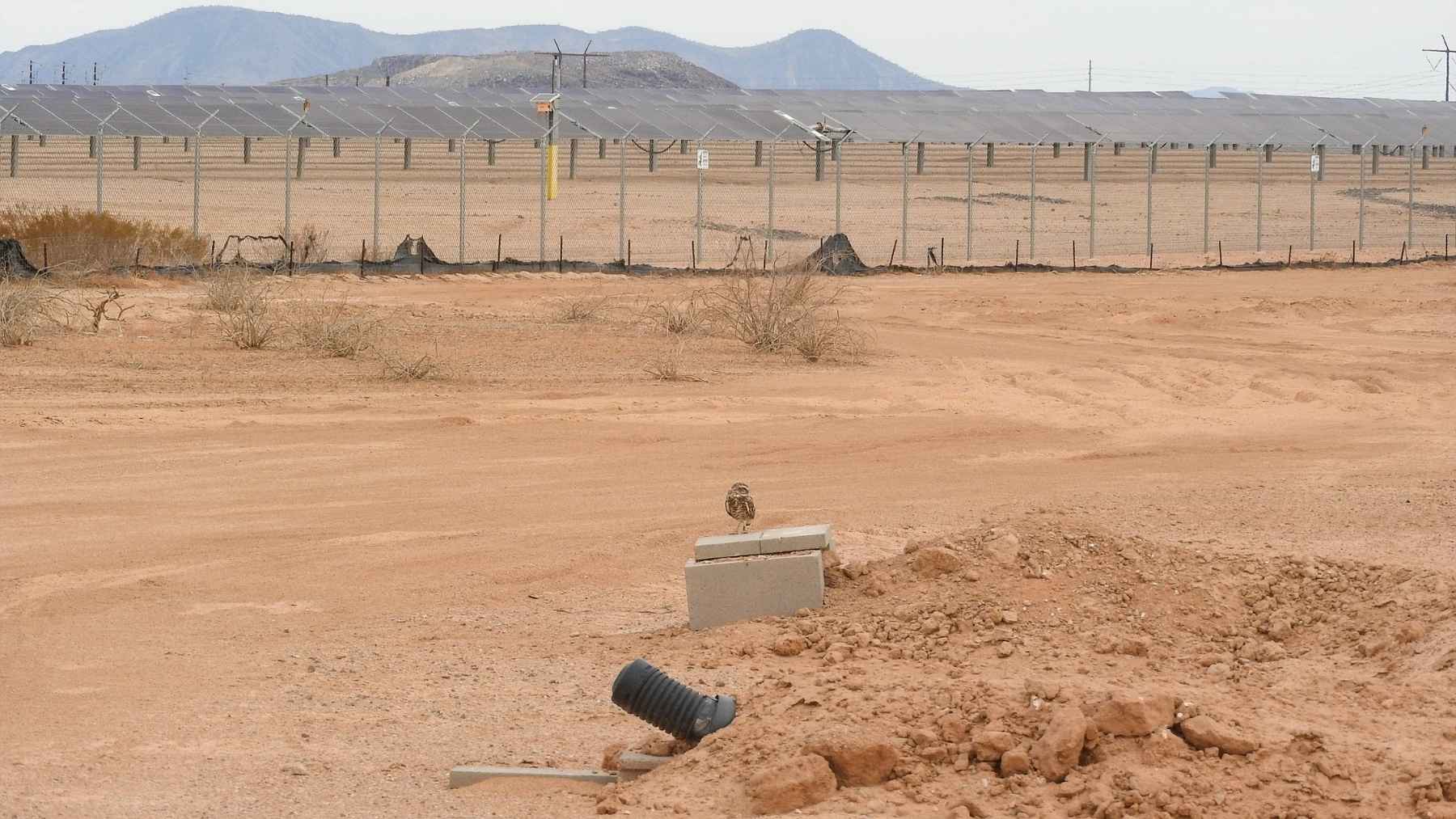
So when a housing project outside Phoenix came for one colony’s burrows, the birds had nowhere obvious to go. Where they ended up is the strange part. Nine pairs and one lone male were trapped, driven about 50 miles, and set loose inside a 10,000-acre solar complex near Tonopah, in plastic tunnels wired with trail cameras. A raptor rescue crew hand-fed them thawed mice and waited to find out whether an owl would agree to raise a family fenced in on every side by solar panels.
Moving a colony is what you do when there’s nothing left
Relocating burrowing owls is a last resort, not a first choice. The Arizona nonprofit Wild at Heart has been trapping and moving them for years, usually onto irrigated farmland near crops, where the birds can pick off the insects and rodents that live between the rows.
The problem is that the farmland keeps getting sold for something more profitable. Greg Clark, Wild at Heart’s burrowing owl habitat coordinator, now drives owls 60 to 100 miles from where they nested, which he says is too slow and too expensive to keep doing. “We’ve run up against the limit now,” Clark told Audubon.
Clark has been at this a long time. He and Wild at Heart started studying Arizona’s burrowing owls around 1999 and 2000, when it was already obvious the birds were sliding, and decided to do something about it. Nearly 27 years later, the math on where to put them has only gotten harder.
Which is why an offer from a solar company mattered. Longroad Energy set aside roughly 250 acres between two of its arrays, and Clark took it. In March 2025, the owls made the drive.
The crew didn’t just dump them and leave. Each pair went into an artificial burrow ringed with netting at first, so the birds wouldn’t simply fly back toward home. There were lights to pull in insects and a daily delivery of defrosted mice while the colony settled. One month in, every female had laid eggs.
A solar farm turns out to be decent owl country
Year one paid off. By late June, 36 chicks had hatched, and within three months 29 had fledged, according to Audubon’s reporting. Clark eased off the mouse deliveries once he started finding insect shells in the birds’ droppings, a sign they were hunting for themselves, and cut feeding off entirely at the end of August.
The cameras caught the whole thing. Curious owlets batting around clods of dirt, and parents chasing off the kit foxes, coyotes and roadrunners that turned up for the free mice.
The counterintuitive part is that the panels may actually suit these owls. A burrowing owl in tall grass or brush can’t see a coyote coming. On a flat, cropped solar site it can watch trouble approach from a long way off, and Clark suspects the arrays even draw in extra bugs to eat.
It also helps that they’re stubborn. “The owls almost act like tiny little people,” Clark told Cronkite News, describing birds that stand their ground against dogs and coyotes and pick fights with each other.
This is not the first time a solar site has ended up as wildlife housing. On California’s Carrizo Plain, an endangered kit fox moved in under two solar farms and raised pups about as safely as the foxes living outside the fence. In Britain, a study across six working solar farms found the ones managed for wildlife held nearly three times as many birds as the cropland next door.
A year on, the desert experiment is still running. Cameras were tracking about 40 owls across 30 open burrows on the site as of early July 2026.
The same industry that housed these owls is pushing others off the map
This is where it would be easy to oversell the story, so it’s worth being straight about it. The owls at Sun Streams were evicted by houses, not by panels. Solar did not rescue them from solar.
And utility-scale solar is booming across Arizona’s flat, sunny basins, which adds to the squeeze on desert wildlife rather than easing it. At this very complex, a survey of the Sun Streams 2 parcel, which Longroad bought from First Solar in 2021, turned up eight burrowing owls that had to be moved before construction could start.
A 2025 Arizona State University study mapped where prime solar sites overlap important burrowing owl habitat across seven Western states and put the figure at 13%. Build in the wrong spot and a solar farm evicts owls as surely as any subdivision. Arizona is now drafting solar development guidelines meant to keep the birds on the landscape instead of hauling them ever farther from where they hatched.
Not every animal takes the trade, either. When researchers pointed detectors at 19 solar farms in England, they found the bats had largely walked away, down 86% in the middle of the fields. Burrowing owls are down more than a third in the US since the 1960s and are listed as a species of conservation concern, which is a big part of why a few hundred acres that works is worth this much effort.
Now the plan is to make the desert feed them
Hand-feeding owls thawed mice through a breeding season is not something that scales. So about 10 miles from the burrows, Clark is running a second experiment: gravity-fed drip lines off water totes, coaxing grasses and flowering plants out of the desert to pull in the moths, butterflies and grasshoppers the owls hunt.
It is the same instinct behind a Minnesota project where swapping gravel for wildflowers under the panels sent native bee numbers up twentyfold. Design the ground for something and it stops being dead space. The goal here is a site that stocks its own pantry, so the colony hunts instead of waiting on deliveries. The watering plots double as an outdoor classroom, where horticulture students learn how bringing back native plants props up a whole desert food chain.
Deron Lawrence, Longroad’s vice president of environment, is candid that the company is still working out exactly how living next to a power plant affects the birds. Clark’s ambition is bigger: get more solar operators to build owl habitat into their sites from the start, rather than bolting it on after the fact.
None of this turns a solar farm into a nature preserve, and nobody on the project is pretending it does. What it shows is narrower and more useful. Drop a colony of evicted owls onto a working power plant, design the dirt for them instead of against them, and at least one struggling desert bird will take the deal. Whether the next few hundred solar projects going up across the West bother to leave room for that is a choice, not an accident.
Image credit: Jenohn Wrieden
 @frank ROOKIE2 months ago